
The rating agency expects that key fiscal indicators of state governments -- revenue deficit and gross fiscal deficit - may deteriorate from 2009 though the impact will begin to be felt in the current fiscal. It further said that the adverse effect of lower revenue growth will be aggravated due to higher development and non-development expenditures.
Rating agency Crisil on Friday said growth rates witnessed in the current fiscal in several sectors are expected to continue for 3-5 years, even as it predicted rising wages in the information technology sector by 2007-08.
Inflation based on wholesale price index rose to 11.91 per cent during the first week of July and the Crisil chief said that she expects average inflation of 8.5 per cent with moderation during the fourth quarter of the current financial year. But she was optimistic on investment saying, "We have not seen a sharp scale back in investments. Companies are going ahead with their plans."
In a new report, the agency said the gross non-performing assets for the sector will rise to around 4 per cent on an asset size of over Rs 5,50,000 crore by March 2009, as against 2.7 per cent at the end of March 31, 2007. The rise in bad debt will translate into more losses for lenders.
Despite an impressive performance in 2003-04, CRISIL on Thursday forecast a slowdown in the growth of the country's gross domestic product at 6.2 per cent for 2004-05 as against the estimated 8.5 per cent in FY'04.

The liquidity will move into deficit after advance tax payments and GST outflows. It will rebound in October because of government spending.

The average cost of a vegetarian thali became dearer by 10 per cent in June due to the jump in onion, potato, and tomato prices, a report said on Friday. However, a decline in the broiler price contributed to a decrease in the cost of a non-vegetarian meal, as per Crisil Market Intelligence and Analysis' monthly "Roti Rice Rate" report. The cost of veg thali, which comprises roti, vegetables (onions, tomatoes and potatoes), rice, dal, curd and salad, increased 10 per cent to Rs 29.4 per plate in June from Rs 26.7 in the year-ago period, and was higher when compared to Rs 27.8 in May 2024, it said.

India Inc, which had been battered by downgrades, would continue to see rating downgrades, although their severity and intensity might decline, said rating agency CRISIL.

Preparing a 'vegetarian thali' got dearer by 34 per cent in July as compared to June because of the soaring tomato prices, an arm of a rating agency said in a report on Monday. A non-vegetarian thali was relatively less impacted and the price of preparing one went up by only 13 per cent, Crisil's 'Roti Rice Rate' report for August said. The inflation in the thalis is largely driven by the 233 per cent jump in tomato prices to Rs 110 per kilogramme in July from Rs 33 in June, the report said.

Dr Nagesh Kumar, one of the three new MPC members, wanted the MPC to reduce the repo rate by 25 basis points to 6.25%.

'With tuition fees for international students rising, education loans have become critical for bridging the gap between savings, scholarship, and full cost.'
Crisil Ltd on Tuesday said the Centre's sops to Food Corporation of India including cut in interest rate on bank loans to FCI by 1.5%, will negatively impact the bottom line of public sector banks pulling down pretax-profit by 4.5% in the near term.

Indian banks would require additional Rs 8 lakh crore to meet the minimum capital adequacy under Basel III norms, ratings agency Crisil has said.
Fiscal deficit, the gap between government's expenditure and revenue, stood at 4.5 per cent in FY14, lower than 4.9 per cent in FY13.
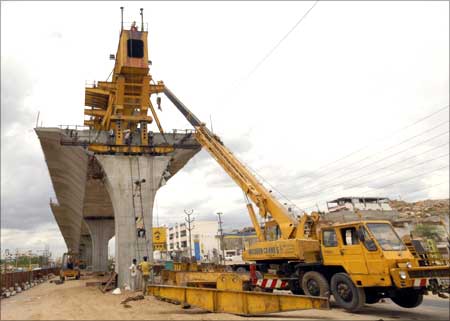
26 out of 80 operational projects are in no position to service debt.

On the fiscal deficit front, its president for research flagged concerns over the revenue collections from the taxation front and also about the government not being able to achieve its Rs 40,000-crore (Rs 400-billion) divestment target.

According to the report, export-oriented sectors like IT services, pharmaceuticals and textiles will, in aggregate, report EBITDA margin expansion of nearly 100 bps, while margin is likely to decline by about 50 bps for other sectors during this period.
Truck movements across the India-Bangladesh border are on the rise, with increasing rentals signalling a trade recovery between the two South Asian nations. Yet, geopolitical tension looms large, with Bangladesh now under an interim government for nearly two months.

According to the study spanning 11 key sectors, aggregate industrial investments would continue to grow despite the current economic slowdown amid expectations of a relatively muted GDP growth. The study stated that aggregate industrial investments would grow at a moderate pace over the next three years, with total investments projected at Rs 10,50,000 crore.

Mining conglomerate Vedanta Limited has received approvals from the majority of its creditors for a proposed demerger of businesses, marking an important step in the company's plan to split into six independent listed companies. "I am happy to let all of you know that we have received the 52 per cent plus the additional percentage, which is required for us to reach 75 per cent. "We have crossed that threshold as well. Most of the lenders have approved it," a senior Vedanta executive said in a recent bondholder conference call.

Concerned over the fallout of the Red Sea crisis and severe shortage of containers against the backdrop of a steep decline in merchandise exports in August, the Union government is pulling out all the stops to find a solution. To begin with, the government has devised a strategy aimed at boosting container supply and supporting exporters.

Only borrow an amount that can be repaid comfortably. The ratio of total EMI to take-home salary should not exceed 40 per cent.

The government on Tuesday proposed reducing the long-term capital gains tax on immovable properties to 12.5 per cent from 20 per cent, but removed the indexation benefits to adjust for inflation, a move experts termed as "negative" for sellers.

The prospective bidders of Haldiram Snacks Foods (HSFPL), a leading food firm, have sought clarity on the ownership of the brand as it is currently owned by different family factions. The Delhi and Nagpur families have decided to merge their operations and formed a joint venture to sell part of their stake. On the other hand, the Kolkata family runs its separate, independent operations. Bankers said prospective bidders of the company do not want any confusion over the brand in future. They have sought clarity over usage of the brand.

IT services firms' revenue growth in the fourth quarter will be affected by macro-driven headwinds, lower working-days, and the fact of the three-month period being low season. Analysts are expecting FY24 growth to be muted. Revenue growth will decline 600-700 basis points to 10-12 per cent for FY24, said a CRISIL Ratings report. The 10-12 per cent growth rate is a fall from the 18-20 per cent expected in FY23 and around 19 per cent growth in FY22, the highest in eight years, said the CRISIL Ratings report.

The cost of a representative home-cooked vegetarian thali has witnessed a 5 per cent on-year increase in January, while that of the non-veg thali declined 13 per cent, a report said on Wednesday. According to Crisil Market Intelligence and Analytics (MI&A) Research 'Rice Roti Rate' estimates, the rise in prices of ingredients like pulses, rice, onion and tomato made home-cooked veg thali costlier in January, while decline in poultry rates helped in the fall in non-veg thali rates.

'The Budget needs to focus more on social welfare schemes.'

Domestic commercial vehicle sales volume is expected to grow 9-11 per cent in FY24 driven by medium and heavy commercial vehicles and an estimated economic growth of around 6 per cent, rating agency CRISIL said on Monday. Besides, an increased allocation to infrastructure spending in the Union Budget for next fiscal year will support demand, it said. This would be the third consecutive year of growth in the domestic CV industry, according to CRISIL.
McGraw-Hill and S&P India on Monday revised upwards their offer price by about 14 per cent to Rs 775 per share to acquire up to 65.57 per cent stake in credit rating agency Crisil.\n\n

Government officials believe that central bridge projects perform better than state projects due to stricter checks and balances.
Economy is slated to grow by 7.1 per cent this fiscal after the excellent monsoon although fiscal deficit may overshoot the target, credit rating agency Crisil said on Monday.

Adani group will invest more than $100 billion (around Rs 8,340 crore) in energy transition projects and manufacturing capability to produce every major component required for green energy generation, its chairman said on Wednesday. Besides building solar parks to produce electricity from sunlight and wind farms that do the same from wind, the conglomerate is building major facilities to manufacture electrolyzers for making green hydrogen, wind power turbines and solar panels.

Higher growth in vegetable demand relative to supply in the recent past has led to an upward trend in inflation, with spikes becoming more frequent. A study by rating agency Crisil found that vegetable inflation has been the most volatile in the food category, in fact. Inflation volatility is detrimental for both consumers and farmers and also sidetracks policymakers in the short term, necessitating frequent and repeated price-smoothing measures.

The 13th Finance Commission had last year set a capital expenditure-to-GDP target of 4.5 per cent by FY15.

Closely watched by the world for any escalation, the Iran-Israel conflict is already showing early signs of stress for India Inc - longer deliveries, doubling freight rates, extended working capital cycles, and higher costs. For those yet to feel the heat, there is growing apprehension and nervousness over future developments, observed industry executives.

Retail inflation eased to an 11-month low of 4.83 per cent in April as prices of some kitchen items declined though overall food basket firmed up marginally, according to a government data released on Monday. The Consumer Price Index (CPI)-based retail inflation was 4.85 per cent in March. It was 4.7 per cent in April 2023.
