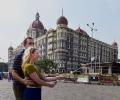
It's been seven years since 10 Pakistani terrorists arrived by sea route and opened fire indiscriminately at different sites in Mumbai, killing 166, including 18 security personnel, and injuring several others, besides damaging property worth crores.

A jail in Bihar has offered to supply its famous 'manila' rope to hang Ajmal Kasab, the lone terrorist arrested during the terror siege on Mumbai, who was awarded the death sentence by a special court on Thursday.Buxar prison is the only jail in the country that has expertise in manufacturing wax-coated manila rope, which can withstand the tension caused by the fall of the convict after the execution.Manufacturing a manila rope is a tedious affair.
Legal experts told rediff.com that there is no hard and fast rule that mercy petitions should be disposed off in order. The President can take a call and take up the matter out of turn. The President must be satisfied that there is an extraordinary circumstance concerning this case and hence it must be taken out of turn.

Kasab, whose statement is being recorded by the court on evidences adduced by the prosecution, told Special Judge M L Tahaliyani that while one of the terrorists of the Taj hotel siege was a Kashmiri, another was from Gujarat.
Pakistani terrorist Ajmal Kasab should not be allowed to approach the Supreme Court and should be hanged publicly, says Kavita Karkare, wife of slain Anti-Terrorism Squad chief Hemant Karkare. Reacting to the special court awarding the death sentence to Kasab, Kavita said, "I don't think this is the end of the chapter of 26/11. This is just the beginning. Now we should hang Kasab publicly and we should not give him a chance to go to the Supreme Court".
For Rabbi Shimon Rosenberg, the death penalty to Ajmal Kasab, the lone terrorist in 26/11 attack, is a welcome step. But it cannot help in bringing back his daughter and son-in-law, who lost their lives in the 26/11 attacks. "It feels good that the court has awarded death sentence to the terrorist. But it does not comfort us because Gabi and Rivki cannot come back," Rabbi Shimon told PTI over the phone from Israel.
The judge rejected the argument saying there is no bona fide argument or evidence that Kasab did the act under duress or because of pressure from the LeT or its chief Hafeez Saeed. "There was no duress, no pressure on Kasab. Rather, when they were in Karachi their travel got delayed. At that time Kasab was anxious to attack India."
