
The 50-year-old managing director of Jaypee Capital has enough reason to be on cloud nine these days.

The National Stock Exchange, Bombay Stock Exchange, MCX Stock Exchange and United Stock Exchange have been invited for the August 6 meet.

Market watchdog Sebi gave its approval on October 11, USE said in a statement. NSE officials too confirmed receiving the approval.

New bourse for currency derivatives the United Stock Exchange of India began operations on Monday and witnessed good volumes in the first hour of trade.
USEIL, promoted by 11 banks, MMTC, and a large brokerage firm Jaypee Capital has received in princial approval from Sebi for commencing contracts in currency derivatives.
The five-month-old exchange traded currency futures market is set to witness competition, rising volumes and innovations with the United Stock Exchange of India gearing up to launch the product in April.

BSE will become the fourth player in currency derivatives in India
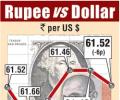
The RBI's macroeconomic report released after the close of markets said upside risks to food inflation remain and that it expects the retail and wholesale price inflation to remain above comfort levels.

The Indian currency resumed lower at 61.50 per dollar as against the last closing level of 61.46 at the Interbank Foreign Exchange Market.
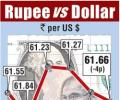
Dealers attributed the fall in rupee to gains made by US dollar against the euro and other overseas currencies ahead of US jobs data and a lower opening in the domestic equity market.
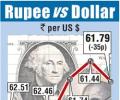
Traders say the rupee and other global currencies will likely track the continued uncertainty in the US budget stalemate and government shutdown.

The rupee resumed lower at 61.15 per dollar as against the last weekend's level of 61.07 at the Interbank Foreign Exchange market and hovered in the range of 61.15 and 61.28 before quoting at 61.24 per dollar at 1030 hours.
.jpg)
The plan being negotiated by US Senate leaders would end a partial government shutdown and raise the debt ceiling by enough to cover the nation's borrowing needs at least through mid-February 2014, a source familiar with the negotiations told Reuters.

The domestic currency spurted by 425 paise or 6.28 per cent in last five straight sessions.

The currency fell 3.4 per cent this week, and is below the levels at which it was trading on July 15 when the Reserve Bank of India unveiled its cash tightening steps to defend the currency.
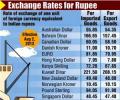
The RBI stipulated on Thursday that foreign institutional investors would require a mandate from participatory note holders to hedge on their behalf.
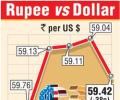
Forex dealers will keenly watch, instead, if the central bank indicates more measures to stabilise the currency or gives a timeframe for its current action.

For now, the rupee is likely to remain dependant on global factors. The dollar held on to broad gains on Thursday after Fed chairman Bernanke said the central bank still expected to start scaling back its bond purchase programme later this year, but left open the option of altering that plan.

Global currency market sentiment is likely to be driven by the US deficit and debt ceiling negotiations, with markets likely to turn more risk averse closer to October 17, the date by which the US Congress must approve raising the country's borrowing limit.

The improvement in the current account deficit is expected to provide a major reprieve to the government and the Reserve Bank of India which have been battling to prop up the rupee.
.jpg)
The partially convertible rupee closed at 63.37/38 per dollar compared with 62.83/84 on Monday. The unit dropped 0.85 per cent on the day, its biggest single-day fall in two weeks.
.JPG)
The Reserve Bank of India late on Wednesday unveiled rules to restrict how much its citizens and companies can invest abroad and announced additional curbs on gold imports.
.jpg)
Sentiments turned buoyant after RBI on Monday cut the marginal standing facility rate, at which it lends emergency funds to banks, by 0.5 per cent to 9 per cent with an aim to improve liquidity and boost economic activities.
.jpg)
Analysts worry that without more fundamental reforms, India will struggle to contain its record high current account deficit and hence support the rupee.
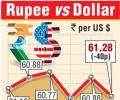
Chidambaram on Monday sought to soothe nerves about its external finances by promising to contain the current account deficit at 3.8 percent of gross domestic product this fiscal year with a slew of measures including easing rules for raising loans abroad.

The three stock exchanges -- NSE, MCX-SX and USE -- had cumulatively recorded a currency derivative turnover of Rs 7.42 lakh crore (Rs 7.42 trillion) in July, which was down 42 per cent from the preceding month, as per the latest data compiled by market watchdog Securities and Exchange Board of India.
.jpg)
The government on Tuesday announced hikes in import duties for gold and silver, but it has yet to unveil other details such as its plan to tax imports of non-essential items.
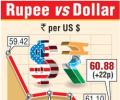
The rupee had dipped by a massive 67 paise to an all-time closing low of 61.10 against the dollar on Friday.

MCX Stock Exchange, set up by crisis-hit NSEL's promoters, on Friday appointed Saurabh Sarkar as CEO and announced plans for fresh capital infusion by its existing shareholders among measures to boost business.
.jpg)
Policymakers stepped in late Thursday to calm markets.

MCX has been struggling to raise funds with a rights issue, ending on Thursday.

The issue is likely to be discussed on Thursday at a meeting of Sebi's board, which would also be apprised of the impact of the Finance Ministry's decision for not agreeing to such a proposal from the capital markets regulator, sources said.
 © 2026 Rediff.com - Advertise with us - Disclaimer - Privacy Policy - Sitemap - Feedback - About us - Terms of use - Grievances