
10 largecaps stocks which stand to gain from the Budget.

'If our Budget allows, we may implement both measures -- making income up to Rs 10 lakh tax-free and introducing a 25 per cent slab for income between Rs 15 lakh and Rs 20 lakh.'

'If the Bill and Melinda Gates Foundation cuts funds, there could be more impact.'
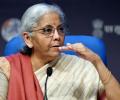
Paraphrasing Abraham Lincoln, Finance Minister Nirmala Sitharaman on Sunday described the Union Budget as "by the people, for the people, of the people", and said Prime Minister Narendra Modi was fully behind the idea to cut taxes for the middle class but it took time to convince the bureaucrats. "We have heard the voice of the middle class" who had been complaining about their aspirations not being met despite being honest taxpayers, she told PTI in an interview.

Finance Minister Nirmala Sitharaman on Saturday said the government will arrange identity cards and registration on the e-Shram portal to assist 1 crore gig workers. Presenting the Union Budget 2025-26, the finance minister also said a scheme for the socio-economic upliftment of urban workers will be implemented.

From the 30-share blue-chip pack, Adani Ports jumped over 5 per cent. NTPC, Tata Steel, Bajaj Finserv, Zomato, Bajaj Finance, Tata Motors, State Bank of India, IndusInd Bank and Maruti were among the other big gainers. From the 30-share pack, Hindustan Unilever, Titan, Tata Consultancy Services, Infosys and UltraTech Cement were the other laggards.

Kautilya, widely known as pioneer of economics in India and author of Artha Shastra (rules of economics), was invoked for the fourth time in the country's annual Union Budget speech on Friday, including thrice by the incumbent Finance Minister Pranab Mukherjee.
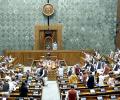
India's opposition parties have sharply criticized the Union Budget, calling it inadequate to address the country's economic woes and accusing the BJP-led government of using it to woo voters in Bihar and Delhi ahead of upcoming elections. Leaders from the Congress, TMC, DMK, SP, and CPI(M) voiced their disapproval, highlighting concerns over inflation, unemployment, and the lack of substantial measures to support the agricultural sector and the poor. They also criticized the tax cuts for the middle class as insufficient and coming too late after years of high taxes and rising prices.

Gold prices hit a fresh record high of Rs 84,900 per 10 grams in the national capital on Friday, driven by robust domestic demand and strong global cues, according to the All India Sarafa Association. The precious metal of 99.9 per cent purity continued its ascent for the third straight session, jumping by Rs 1,100 to hit a new peak of Rs 84,900 per 10 grams.

The Union Budget for 2004-05 was presented in the Lok Sabha today by Finance Minister P Chidambaram. In his opening remarks, Chidambaram said the verdict in the recent general elections was a vote for a change in the manner in which the government wa

Simplifying investment policies at the micro level and introducing a time-bound framework will be critical for India's growth targets, notes Krishna Ella.

Tax experts answer your budget-related queries

'The increase in the limit for TDS on interest to Rs 1 lakh will ensure greater cash flow in the hands of senior citizens.'

'The incentives to switch to the new tax regime... are viewed as a negative due to potential loss of customers who buy policies for saving tax.' 'The tax-saving value proposition for the sector reduces.'

Equity markets this week will take cues from global trends, trading activity of foreign investors and quarterly earnings, with TCS kick-starting the results calendar on Thursday, analysts said.

Union Finance Minister Nirmala Sitharaman on Saturday announced a fresh Rs 15,000 crore 'SWAMIH Fund' for completion of 1 lakh units in stalled housing projects across various cities, a move aimed at providing relief to distressed homebuyers whose investments are stuck. In November 2019, the Centre announced a stress fund named 'Special Window for Affordable and Mid-Income Housing' (SWAMIH), to complete stalled housing projects across India.

To tap Indian civil aviation market's growth potential, the government on Saturday announced a modified regional air connectivity scheme UDAN (Ude Desh ka Aam Naagrik) to connect 120 new destinations, airport projects in Bihar and upgradation of infrastructure for air cargo in the Union Budget.

The government on Saturday announced a host of measures such as setting up of a new Fund of Funds Scheme (FFS) with Rs 10,000 crore corpus; and extension of period of incorporation by five years with a view to promote growth of budding entrepreneurs.

The Rural Development Ministry has been allocated Rs 1.88 lakh crore in the Union Budget for 2025-26, around 5.75 per cent more than the allocation in the previous budget.
Standard deduction of 40% or Rs 30,000 whichever is less for salary till Rs 5 lakh, above Rs 5 lakh, 20,000.
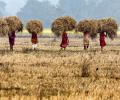
In a significant policy shift aimed at boosting agri-productivity and rural prosperity, Finance Minister Nirmala Sitharaman on Saturday announced six new agricultural schemes while increasing the subsidised Kisan Credit Card loan limit to Rs 5 lakh from the existing Rs 3 lakh, benefiting 7.7 crore farmers, fishermen, and dairy farmers.
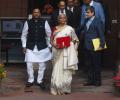
Finance Minister Nirmala Sitharaman on Saturday unveiled 'transformative' tax reforms that ranged from a simpler income tax law to higher TCS threshold for remittances and income tax benefits for middle class.

Chief Election Commissioner Nasim Zaidi has written to Cabinet Secretary P K Sinha who is likely to consult the parliamentary affairs ministry before framing his response on the government's plans to advance the budget presentation to February 1, sources said.
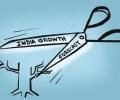
The GDP growth is expected to be about 6.3 per cent in the current fiscal year, a tad lower than the government's estimate of 6.4 per cent, owing to several factors such as weak demand, SBI research report said on Wednesday. According to the first advance estimates (FAE) of National Income for 2024-25 released by the National Statistics Office (NSO), released on Tuesday, India's economic growth rate is estimated to slip to a four-year low of 6.4 per cent in 2024-25, because of poor showing by the manufacturing and subdued investments.
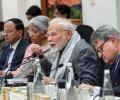
Job creation, improving farm productivity, and mobilising public funds for infrastructure development were some of the issues that figured during the interaction between Prime Minister Narendra Modi and economists ahead of the 2025-26 Union Budget. The prime minister on Tuesday met eminent economists and sectoral experts at NITI Aayog to hear their views and suggestions for the upcoming Budget. Union Finance Minister Nirmala Sitharaman is scheduled to present the Budget for 2025-26 in the Lok Sabha on February 1, 2025.

The government will provide Rs 11.11 lakh crore for capital expenditure for 2024-25 and introduce viability gap funding to spur private investment in infrastructure, Finance Minister Nirmala Sitharaman said on Tuesday. Presenting the Union Budget for FY2024-25, she said that the government will endeavour to maintain strong fiscal support for infrastructure over the next five years, in conjunction with imperatives of other priorities and fiscal consolidation.

Invest in these funds through the SIP route with at least a seven-year horizon.

'He needs to see results while he is in office.'

The most striking features of this Budget was its focus on simplification and improving the ease of doing business in India, asserts Kaku Nakhate.
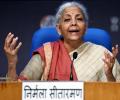
Finance Minister (FM) Nirmala Sitharaman has presented a forward-looking Budget, reinforcing the government's commitment to 'Reform, Perform, and Transform'.
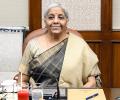
While the capital spending is being maintained at 3.1 per cent of the GDP, a little more would have boosted economic growth even further, suggests Rajiv Memani.

The government proposes to cut custom duties on Trastuzumab Deruxtecan, Osimertinib and Durvalumab from 10 per cent to nil.
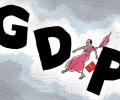
The upcoming Union Budget to be presented on February 1 is likely to assume a nominal gross domestic product (GDP) growth between 10 and 10.5 per cent for FY26, a Business Standard poll of 10 economists showed. The first advance estimates released by the National Statistics Office (NSO) had estimated a nominal GDP growth of 9.7 per cent for FY25. Nominal GDP, calculated at current market prices, factors in the effect of inflation. It is used as the base to calculate crucial macroeconomic indicators, such as fiscal deficit, revenue deficit, and debt-to-GDP ratio.
An Income-Tax Department internal committee reviewing the old direct tax law to pave the way for a new one has "largely" received suggestions for "simplifying" the language, better "structuring" the provisions and enlarging the ambit of schemes like presumptive taxation, CBDT chairman Ravi Agrawal said Sunday. Speaking to PTI during a post-Budget interview at his North Block office, Agrawal said the panel also "studied" the deliberations and processes of countries like the UK, Australia and some others where a similar tax law simplification exercise was undertaken.

The finance minister may stagger some of the recommendations.

India's Finance Minister Nirmala Sitharaman has announced an ambitious plan to develop the country's top 50 tourist destinations in a "challenge mode", with the aim of boosting employment-led growth and attracting international visitors. The Ministry of Tourism has received a significant budget increase for 2025-2026, with a focus on enhancing tourism infrastructure, promoting domestic and international travel, and ensuring the safety of tourists, particularly women. The government plans to promote homestays, improve connectivity to tourist spots, and provide performance-linked incentives to states that demonstrate effective destination management. The budget also includes investments in public enterprises, skill development programs, and initiatives to promote medical tourism and spiritual tourism.
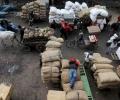
India's economic growth rate is estimated to slip to a four-year low of 6.4 per cent in 2024-25, mainly on account of poor showing by the manufacturing and services sector, according to government data released on Tuesday. The gross domestic product (GDP) rate of 6.4 per cent will be the lowest since the Covid year (2020-21) when the country witnessed a negative growth of 5.8 per cent.
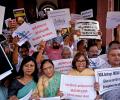
'Union Budgets are often used as political instruments and that was the intention of this government too.' 'But while the exercise has settled two fronts, it has left open several others and this has the potential to aggravate with time,' predicts Nilanjan Mukhopadhyay.
Prime Minister Narendra Modi said on Friday that there have been no attempts from abroad to stoke trouble in India ahead of the Parliament's Budget session, which begins on Saturday. Modi's statement comes as his government prepares to present its first full-fledged budget in its third term. He expressed confidence that the Budget session will infuse new confidence and energy in attaining the goal of 'Viksit Bharat' by 2047, and said his government has been working in a mission mode for an all-round development.
India's Parliament is set to begin its Budget session on Friday, with opposition parties poised to demand a discussion on the alleged mismanagement of the Maha Kumbh festival in Prayagraj, where 30 pilgrims died in a stampede. The opposition also accused the government of politicising parliamentary committees and pushing its agenda through its majority. The session will start with President Droupadi Murmu addressing both houses of Parliament. Finance Minister Nirmala Sitharaman will present the Union Budget on Saturday for the eighth consecutive time.
