
'In the January-August period, the share of hatchback in the overall PV industry sales was about 22.4 per cent. In the September-October period, the share of hatchbacks has come down to 20.4 per cent. In just October, their share was just 20 per cent. This is simple wholesale data from industry body SIAM.'

Since the Indian government reduced GST on small cars on September 22, the small car segment's share in Maruti's overall sales has risen to more than 25 per cent, up from 16.6 per cent earlier in FY26.

Automobile exports from India rose 26 per cent year-on-year in September quarter driven by highest-ever shipments of passenger vehicles, two-wheelers and three-wheelers during the period, as per the latest data released by industry body SIAM.

Among the Sensex firms, State Bank of India, Maruti Suzuki India, Axis Bank, NTPC, BEL, Adani Ports, Eternal, Sun Pharmaceuticals, Power Grid, ITC, UltraTech Cement, Trent, HCL Technologies, Mahindra & Mahindra, and HDFC Bank were the major gainers. On the other hand, Tata Steel, Tata Consultancy Services, Tech Mahindra, Titan, Bajaj Finserv, Tata Motors, Bharti Airtel and Bajaj Finance were among the laggards.

Among major Sensex gainers Bajaj Finserv rose the most by 1.42 per cent, Axis Bank gained 0.80 per cent, Infosys by 0.72 per cent, Mahindra & Mahindra by 0.60 per cent, Tata Motors by 0.55 per cent, Bajaj Finance by 0.53 per cent and Tata Steel by 0.52 per cent. Kotak Mahindra Bank, ICICI Bank, HCL Technologies, Bharti Airtel, Maruti Suzuki India, Trent Ltd and Tata Consultancy Services were the losers.

'We are seeing a lot of people with helmets visiting our showrooms.'

The country's largest carmaker Maruti Suzuki India on Thursday announced a reduction in vehicle prices by up to Rs 1.29 lakh effective September 22 to pass on the GST rate cut benefit to customers.

Almost 30 per cent of Maruti's auto-component exports are to the US, and about half of that is facing a duty of 25 per cent and the other half 50 per cent.

Japanese automaker Suzuki Motor Corporation will invest Rs 70,000 crore in the next five to six years in India to strengthen its operations in the country, its representative director and president Toshihiro Suzuki said on Tuesday. Prime Minister Narendra Modi on Tuesday kicked off exports of Maruti Suzuki India's first electric vehicle e VITARA to 100 countries and also inaugurated the production of lithium-ion battery cells for strong hybrid electric vehicles at its facility in Gujarat.

Auto majors Maruti Suzuki, Tata Motors and Mahindra & Mahindra reported robust sales in September as reduced price tags owing to GST rationalisation led to record demand in the Navaratri period. The month also saw Tata Motors and Mahindra & Mahindra settling at number two and three positions, respectively in vehicle wholesales ahead of Hyundai Motor India.

Maruti Suzuki India on Wednesday expanded its product range in the country with the launch of all-new 'Victoris' as it looks to enhance its presence in the robustly growing mid-sized SUV segment.
Maruti Suzuki, India's largest producer of small cars, stands to benefit the most.

Between April and August this financial year, passenger car exports rose 8.5 per cent year-on-year (Y-o-Y), while domestic sales fell by 8.5 per cent.

Maruti Suzuki's e-Vitara marks its high-stakes EV debut with strong export ambitions, lifting its stock even as analysts caution over pricing and fierce competition.
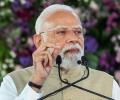
A day before US President Donald Trump's additional 25 per cent tariff kicks in, Prime Minister Narendra Modi on Tuesday made a vehement pitch for swadeshi and Make in India that should help create jobs in the country.

The country's largest carmaker Maruti Suzuki India expects auto sales to bounce back to the glory days of 7 per cent growth by FY 27, helped by the proposed GST rate cut which is expected to bring down car prices by 3.5 to 8.5 per cent.

Among the Sensex firms, Mahindra & Mahindra jumped the most by 5.96 per cent. Bajaj Finance, Bajaj Finserv, Trent, ITC and HDFC Bank were also among the gainers. However, Maruti Suzuki India, Bharat Electronics, HCL Tech, NTPC, Power Grid, Infosys and Reliance Industries were among the laggards.
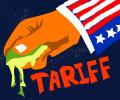
India needs to come together to deal with the 50 per cent punitive US tariffs on Indian products and stand up to any kind of bullying, Maruti Suzuki India chairman R C Bhargava said on Thursday. "It is our duty as Indians to do our very best to promote and maintain our dignity and respect and not give in to any kind of bullying in this matter... the nation has to stand united," Bhargava said at the company's 44th Annaul General Meeting in New Delhi.

Among Sensex shares, Sun Pharmaceutical, Tata Steel, Trent, Bajaj Finance, Mahindra & Mahindra, Bajaj Finserv, Reliance Industries, Axis Bank, Tech Mahindra, Adani Ports, Titan, BEL, and Larsen & Toubro were the major laggards. However, Hindustan Unilever, Maruti Suzuki India, ITC, Tata Consultancy Services and UltraTech Cement were the gainers.

The next many decades belong to India as the global economic powerhouse, and it will be essential to continue demonstrating policy stability, as the country aspires to be the world's manufacturing hub, Maruti Suzuki India MD and CEO Hisashi Takeuchi said on Friday.

Maruti Suzuki India on Thursday posted a marginal increase in consolidated net profit to Rs 3,792 crore for the June quarter, with robust overseas shipments compensating for the drop in domestic sales. The country's largest carmaker reported a net profit of Rs 3,760 crore in the April-June period of the previous fiscal year.
The country's largest carmaker Maruti Suzuki India is recalibrating production of its upcoming model e-Vitara due to the shortage of rare earth magnets, industry sources said. The auto major is looking to produce around 8,000 units of the model by September as against the earlier stated plan of rolling out over 26,000 units during the period.
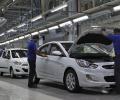
Leading automakers Maruti Suzuki, Hyundai, Mahindra, and Tata Motors saw a dip in dispatches to dealers in August amid dip in demand with many prospective buyers postponing their buys anticipating a reduction in vehicle prices on account of the new GST framework. The country's largest carmaker Maruti Suzuki India reported an 8 per cent year-on-year dip in dispatches of passenger vehicles in the domestic market last month.

Maruti Suzuki India on Wednesday said it plans to invest over Rs 925 crore to expand its captive solar capacity to 319 MWp by FY2030-31. The car market leader announced the expansion of its solar capacity by 30MWp with two new projects.

Amid challenging market environment, Maruti Suzuki India and Mahindra & Mahindra reported an increase in vehicle dispatches to dealers last month while Tata Motors and Hyundai saw a year-on-year drop in sales.

Despite the benefits of hybrid technology, a lack of government backing and few launches have kept the segment from gaining ground.

Analysts believe Tesla will first focus on building the Model Y brand before expanding -- both in terms of volume and models.

Domestic passenger vehicle wholesales were down 0.8 per cent at 3,44,656 units in May this year as compared to 3,47,492 units in the same month last year, Society of Indian Automobile Manufacturers said on Monday.

Maruti Suzuki India (MSIL) said on Thursday its operations are unaffected by the global rare earth magnet shortage, but added that the situation is "uncertain and evolving". The firm said it is exploring multiple solutions to maintain continuity in operations and will notify stakeholders in case of material impact.

The automobile industry has sought government support in expediting approvals from the Chinese government for importing rare earth magnets used in various applications, including passenger cars. As per the industry sources, various domestic suppliers have already sought approval from the Chinese government through their local vendors in China.

Tata Motors is hoping to beat its target year of 2030 and have 30 per cent of its portfolio comprising electric vehicles (EVs), according to Chairman N Chandrasekaran, who was speaking at the company's last annual general meeting (AGM) ahead if its demerger.

Maruti Suzuki India and Tata Motors on Monday announced plans to increase vehicle prices from April, the second time in this year, in order to partially offset the impact of rising input costs. Maruti Suzuki said it plans to hike prices of its entire model range by up to 4 per cent from next month.

The country's biggest carmaker, Maruti Suzuki India, has raised concerns about the continuing slide in small car sales.

Auto major Maruti Suzuki India on Friday said its consolidated net profit declined by 1 per cent year-on-year to Rs 3,911 crore in the fourth quarter ended March 31, 2025, on account of higher expenses. The country's largest carmaker reported a net profit of Rs 3,952 crore in the January-March quarter of FY24.

Car purchases in India are largely limited to the top 12 per cent of households with an annual income exceeding Rs 12 lakh, while even small cars have become unaffordable for the remaining 88 per cent, said R C Bhargava, chairman of Maruti Suzuki India Limited (MSIL), on Friday. "How can you get high car sales growth if 88 per cent of the country are below the levels of income where they cannot afford these cars costing Rs 10 lakhs and above?
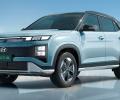
Long standing number two passenger vehicle maker in India, Hyundai Motor India, has slipped to fourth position in the domestic market in terms of retail sales last month behind Maruti Suzuki India, Mahindra & Mahindra and Tata Motors, as per the latest data shared by dealer's body FADA. Hyundai Motor India clocked retail sales of 38,156 units last month, a dip of 20 per cent as compared with 47,540 units in February last year.

Maruti Suzuki and Hyundai Motor India on Monday reported a dip in passenger vehicle dispatches to dealers in the domestic market last month as the companies tried to adjust vehicle inventory amid slowing demand. Maruti Suzuki India said it "calibrated supplies" to the dealers, aligning with the industry's retail sales projections amid India-Pakistan conflict and a dip in sales of entry-level cars.

'...the auto industry to get back to 7% to 8% annual growth.' 'High growth in the SUV segment alone will not achieve this, as it is a small market.'
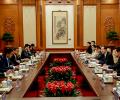
'We remain in touch with the Chinese side, in Beijing as well as in Delhi, to bring predictability in the supply chain.'

Car market leader Maruti Suzuki India on Thursday said it will hike prices by up to Rs 32,500 across various models from February 1 to partially offset the rise in input costs. Due to rising input costs and operational expenses, the company plans to increase car prices, starting February 1, 2025, Maruti Suzuki India said in a regulatory filing.
 © 2026 Rediff.com - Investor Information - Advertise with us - Disclaimer - Privacy Policy - Sitemap - Feedback - About us - Terms of use - Grievances