
Private corporations in India invested approximately 30.3 trillion in fixed assets during FY25, marking a 7 per cent increase from the previous year, according to the statistics ministry. This growth in private capital expenditure contrasts with a slowdown in government capital spending.

India's statistics ministry has defended its newly released economic growth estimates, stating that revisions to last year's GDP and the divergence between different price measures reflect updated data and estimation techniques rather than an attempt to artificially boost headline growth.

Finance Minister Nirmala Sitharaman stated that India is likely to sustain economic growth of 7 per cent or more in 2026-27, continuing the pace recorded since the Covid-19 pandemic, despite geopolitical uncertainties and supply-chain disruptions.

Base revisions are technical exercises, but history shows they can significantly reshape the narrative around India's growth performance.

Fitch Ratings on Friday said persistently higher oil prices could cause India's retail inflation to rise faster than the expected gradual pace, and lead to a slowdown in economic growth in the first half of financial year 2026-27 (FY27).

The IMF on Monday raised India's growth projection to 7.3 per cent for fiscal 2025-26, up 0.7 percentage point from its October forecast, on the back of better-than-expected performance of the economy. The Washington-headquartered multilateral lending agency has also revised India's Gross Domestic Product (GDP) growth forecast to 6.4 per cent for fiscal year 2026-27 beginning April 1, 2026, from its earlier estimate of 6.2 per cent.

India's main inflation measure, the Consumer Price Index (CPI), is set for another major update, even though it has been in its current form for only about 15 years.

India's new national accounts will leverage new data sources and surveys to enhance the measurement of the country's informal economy, and introduce double deflation methods across sectors, replacing the current system that relies on a single deflation mechanism in Gross Domestic Product (GDP) calculations.

The share of services in gross value added (GVA) in 2023-24 was the highest in Chandigarh (88.8 per cent), followed by Delhi (84.1 per cent), said a NITI Aayog report released recently.

The rate of unemployment in the country, measured in monthly term, rose to 5.6 per cent in May from 5.1 per cent in April this year mainly due to seasonal variation, showed the government data released on Monday.

Equity markets will take cues from the US tariff related developments, global trends and trading activity of foreign investors this week, analysts said.

Updated new base years for national accounts and other macro-indicators are expected to come into effect from January-February 2026, coinciding with the first and second advance estimates of national income for FY26, senior official sources aware of the development told Business Standard. "The statistics ministry set up the Advisory Committee on National Accounts Statistics (ACNAS) earlier this week. "It will advise on the base year for GDP (gross domestic product) and its alignment with other macro-indicators.

Unemployment rate for persons aged 15 years or above declined to 3.1 per cent in 2023, the lowest in the last three years, as per a report of National Sample Survey Organisation under the statistics ministry. According to Periodic Labour Force Survey (PLFS) for calender year 2023, the unemployment rate came down to 3.1 per cent in 2023 from 3.6 per cent in 2022 and 4.2 per cent in 2021. Joblessness, or unemployment rate, is defined as the percentage of unemployed people in the labour force.

NITI Aayog has not said what the reasons were for having achieved or not having achieved what was sought to be achieved, or what lessons can be learned for the future, points out Aakar Patel.

The seasonally adjusted IHS Markit India Manufacturing Purchasing Managers' Index (PMI) was at 54.9 in February, up from 54.0 in January, signalling a stronger improvement in the sector's health. The February PMI data pointed to an improvement in overall operating conditions for the eighth straight month. In PMI parlance, a print above 50 means expansion, while a score below 50 denotes contraction.

The pre-budget Economic Survey, which is tabled in Parliament ahead of the Union Budget to present the state of the economy and suggest policy prescriptions, quite often misses on the GDP forecast, sometimes by a significant margin. This time, Finance Minister Nirmala Sitharaman will table the Economic Survey for 2021-22 in the Lok Sabha on Monday soon after the President's address to both Houses of Parliament. She will present the Union Budget for the next financial year beginning April 1, 2022, on Tuesday.

The technical report of the NSSO has generated controversy following its observation that as much as 36 per cent units forming part of MCA-21 database, used in computing GDP, could not be either identifiable or traceable in the field.

The statistics ministry has proposed the new base year for GDP and IIP as 2017-18 while for CPI it will be 2018.

India's industrial output growth accelerated to 2.6 per cent in January, mainly driven by growth in the capital goods sector.

It was 2.6% in January.

Chief Economic Adviser K V Subramanian on Friday said there is an "upside potential" in the estimates about the economy during the current financial year amid a faster-than-expected recovery. He said the final print could be better than GDP estimates given by various institutions, including the Reserve Bank of India, which projected contraction of 9.5 per cent during 2020-21. During the second quarter, India's economy recovered faster than expected as a pick-up in manufacturing helped GDP clock a lower contraction of 7.5 per cent and held out hopes for further improvement on consumer demand bouncing back.

The services sector contributes the highest of around 54 per cent to the country's gross domestic product. At present, the WPI, which is released every week, contains prices of primary articles, fuel and manufactured products. Data from banking and transport services would be the first sectors to be covered on an experimental basis. The plan is to initially build a separate services index, which would be integrated into the WPI later.
A higher cumulative penalty will be levied for not sharing data, say officials. However, criminal charges will be pressed in cases where manipulation of data is involved, they say. Under the new Act, people or companies not divulging data would have to pay a fine of Rs 1,000 and they would be given a 14 day notice period to comply. If the information is not provided even after two weeks, the penalty will rise to Rs 5,000 per day.
Congress President Sonia Gandhi has pulled up the central government for slow implementation of the UPA's 20-point programme, sources in the government say.

India's economy recovered faster than expected in the September quarter as a pick-up in manufacturing helped GDP clock a lower contraction of 7.5 per cent and held out hopes for further improvement on better consumer demand. The gross domestic product (GDP) had contracted by a record 23.9 per cent in the first quarter of the 2020-21 fiscal (April 2020 to March 2021) as the coronavirus lockdown pummelled economic activity.
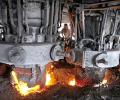
India's industrial production shrunk for the third straight month in December, dragged down by weak investment and consumer demand and pointing to continued sluggishness in Asia's third-largest economy.

Releasing the survey report after taking into account the expert committee recommendations, Statistics Secretary Pravin Srivastava told reporter, "It is a new design and a new matrix. It would be unfair to compare it with the past. This 45- year high is your interpretation. I don't want to claim that it is 45-year low or high."
The government's decision to release the reports comes two days after over 200 scholars from across the globe issued a statement demanding release of all withheld reports produced by the NSO, including the household consumer expenditure survey that was junked.

Analysts polled by Reuters had expected an annual output growth of 3.5 per cent for the month.

Women's representation in government jobs is less than 15%.
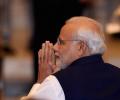
Modi has taken a slew of measures to attract investment, but he has yet to initiate steps that could help repair corporate balance sheets.

If people can lobby me for making changes in policies that goes against the country's interest, I won't keep myself in this position, says the vice chairman of NITI Aayog.

Credit rating agency Crisil observed in its report that some 'high frequency indicators go out of whack' as credit growth and service tax collections are not in tune with the CSO's growth projections.

The revision will do little to help the Congress party-led ruling alliance, which faces an uphill battle in elections due by May amid allegations of economic mismanagement, corruption scams and high inflation.
