
More pain likely, say analysts, with gloomy demand scenario and slowing economy.

Hazare-led campaign has got wide publicity in the US media.

Both Europe and the US can learn a lesson from American history to overcome their debt problems.
The ratings are opinions that reflect the ability and willingness of the rated entity to meet financial obligations.

Volatility in exchange rates are also expected to increase.

Finance minister said India had taken several measures to make markets attractive.
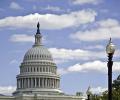
The downgrade reflects its opinion that the fiscal consolidation plan which Congress and the administration recently agreed to "falls short of what, in our view, would be necessary to stabilize the government's medium-term debt dynamics."
Nine Indian Americans among Outstanding 50 Asian Americans in Business this year.

"High inflation could derail India's stable macroeconomic and interest rate environment", Standard & Poor's said in a statement.

In a report on the rupee's depreciation, S&P said, "Revenue for companies that export and operate overseas would rise, because they would get more rupees for the goods and services they sell."
The political fall-out of the US downgrade is not over. Republicans and Democrats are both trying to pin the blame on the other party, displaying their great skill in spinning news to score partisan political points.
The US political system might not be as broke as some thought but the deal came a bit too late to allay apprehensions.
Out of 200-odd countries, just 16 nations have the coveted triple-A rating.
There is an Indian at the helm of affairs surrounding the historic downgrade of the United States' creditworthiness, as ratings agency S&P's unprecedented move was taken under the leadership of Deven Sharma.
With the downgrade there is a danger that investors who hold these financial securities may sell out. Of course, the level of selling will depend on the way the investors react to this downgrade.
The much-advertised hunger for success among the denizens of India's tier-II and tier-III cities has been the big story of the past decade. How relevant is it to memorize Ampere's Law, Charles's Law and the dates of the battles of Panipat in this brave new world?
India had time to plan and improve its competitiveness and infrastructure. Yet it chose not to. And for that we need to blame our government, says M R Venkatesh.
India's gross public debt to GDP ratio fell from 75.8 per cent to 66.2 per cent.
This could lead to an unprecedented bloodbath in the global financial markets.
Investors say stocks to drift further, but impact of rating downgrade may be short-term.
The CreditWatch action follows Vedanta's announcement that it would acquire a controlling stake in India-based oil and gas company Cairn India Ltd.
We expect the region to record another year of solid growth in 2011, the survey said.

Credit rating agency Standard & Poor's has said it might not downgrade India's sovereign credit rating further, after the government announced plans to reduce the gap between income and expenditure

Index products like fixed-income, volatility and weather to broaden basket for hedging.

The global rating agencies S&P and Moody's have downgraded the credit ratings for several government-related entities in Dubai on fears about the government's failure to provide timely financial support to them.
Factoring in the government's push to improve its finances and higher growth, Standard & Poor's today revised the outlook on India's sovereign credit rating to stable from negative. At the same time, it warned that high inflation could spoil the party. The agency affirmed the 'BBB-' long-term and 'A-3' short-term sovereign credit ratings on India.

Indian economy has clocked a growth of 8.7 per cent in the first half of the calendar year. It said strong farm production will help drive economic recovery and also bring down food inflation, even though it said, 'inflation remains worrying.'

Rajapaksa informed the lawmakers of United People's Freedom Alliance that he has resigned from the post.

A 4-year study of nearly 300 companies listed on the National Stock Exchange of India found evidence of a positive and significant relationship between corporate governance practices and company performance, S&P said on Wednesday.
Subir Gokarn, Executive Director and Chief Economist at Standard & Poor's Asia Pacific, is heading the shortlist of candidates for the Reserve Bank of India Deputy Governor's post. Gokarn is also a Business Standard columnist.

S&P said Indian technology players will continue to grow at a slightly slower pace over the next two to three years due to technological disruptions.
Rating agency Standard & Poor's on Tuesday said fiscal pressures would weigh on India's credit quality. In a report released today, the agency said that a resumption of a timely and sustainable fiscal consolidation plan that resulted in lower debt and interest burden, and further reforms to boost economic growth could improve India's sovereign ratings.

Gokarn was the first Indian central banker who regularised warnings to the government, through the monetary policy statement, on the need to reduce fiscal deficit.
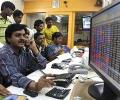
Weak economy and high interest rates in India, which have adversely affected cash flows and debt-servicing ability, have prompted the companies to improve their financial profiles.

The agency had earlier said that the economy would grow at the rate of 5.8 per cent. In a teleconference, S&P said the revision was occasioned because of the positive policy responses by the country and improving global conditions, despite the deficient rains and lurking swine flu.

The economy is projected to clock 7.4 per cent growth.

'The slide in growth has arisen primarily because we have an NBFC crisis on top of a banking crisis,' points out T T Ram Mohan.
The downturn in commodities and oil refining, stemming from global economic slowdown, has affected profitability. This is expected to weaken the company's cash flow measures, S&P said.
Nearly 200 people were killed and about 350 injured in a spate of terror attacks that rocked the commercial capital for three days, exposing the vulnerability of the world's largest democracy to terrorist operations. Experts said those sectors like tourism, hospitality and automobile may also feel the heat of the negative sentiments after the recent attacks but is likely to regain the momentum in the short to medium term in line with the improving domestic situations.
Leading economists on Friday called for more fiscal measures to sustain the Indian growth story.
 © 2026 Rediff.com - Investor Information - Advertise with us - Disclaimer - Privacy Policy - Sitemap - Feedback - About us - Terms of use - Grievances