
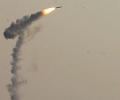
India on Wednesday successfully carried out the maiden test firing of the over 290 km-range submarine-launched version of BrahMos supersonic cruise missile in the Bay of Bengal becoming the first country in the world to have this capability.

India on Wednesday successfully test fired the 290-km range BrahMos supersonic cruise missile from the Navy's latest guided missile frigate INS Tarkash off the coast of Goa.
"The Hypersonic BrahMos version of the cruise missile would be ready for flight testing in 2017", Sivathanu Pillai, chief executive officer of the Russian-Indian joint venture BrahMos Aerospace said here. The new missiles would be capable of flying at speeds of Mach 5- Mach 7.
In an effort to protect India's vast coastline and ports from various threats, sea bed arrays and unmanned underwater vehicles will be used for ocean surveillance.
India is planning to deploy its 290km range supersonic BrahMos cruise missile on the Fifth Generation Fighter Aircraft being developed with Russia. "If we are able to reduce the weight of the missile below two tonnes, we can deploy it on the FGFA and we are looking to do that in future," BrahMos Aerospace chief A Sivathanu Pillai said.

After Sunday's test, India has become the first and only country in the world to have a "manoeuvrable supersonic cruise missile in its inventory

The modalities for developing hypersonic missile BrahMos-II to be carried out by the Indo-Russian joint venture BrahMos Aerospace, are on the verge of being finalised, a top official of the company said in Tiruchurapalli.
Of the total 124, CVRDE had already delivered 29 MBTs in two instalments till March this year. Rest of the Arjun tanks would be delivered by March 2010, Pillai said.
The failure of the BrahMos missile during a recent test was due to a "software glitch" and the Defence Research and Development Organisation is doing a number of simulations and tests to ensure that it does not recur, A Sivathanu Pillai, Chief Executive Officer of the BrahMos Aerospace, said on Monday.
Talking to reporters in Tiruchirapalli, Pillai said, "Now we are the leaders in supersonic missile system with the successful development of Brahmos Cruise Missiles."
State-run Kerala High-tech Industries Ltd (KELTEC) is all set to become part of the Indo-Russian joint venture cruise missile project, BrahMos Aerospace.
DRDO chief A Sivathanu Pillai said that if this decision is implemented, Indian insustry will get business worth Rs 12,000 crore every year.
After successfully working on the contracts for the Indian navy and army, the New Delhi-based JV is now poised to expand in the international market and some of the contracts are already in the pipeline, Brahmos CEO Sivathanu Pillai said.Many nations across the globe are taking keen interest in the deadly supersonic Brahmos cruise missile, which will remain unmatched at least for the coming decade.South Africa, Chile, Kuwait are in the waiting list.
This was the 14th launch of the missile, which has a range of 290 km. It has also been tested from a naval destroyer in the past.
Efforts were on to develop systems which could be used to launch the BrahMos cruise missiles from submarines and air platforms, a top official said on Wedsnesday.
This will make the submarines capable of attacking surface targets at sea or on land.
BrahMos is unique among cruise missiles due to its 2.8 Mach supersonic speed (all other cruise missiles are sub-sonic at present) and much-longer strike range.
The first trial of the aircraft version of BrahMos will be conducted before December 2007, the head of the team developing the indegenously-built supersonic cruise missile said in Chennai Thursday.
India, Russia to develop aircraft version of BrahMos missile
The navy has begun deploying the ship-launched version of BrahMos in its warships in a phased manner.
Pillai said the exports and induction of the missile in the armed forces would be carried out simultaneously.

'When a Project Director is appointed, the whole organization -- including the Chairman ISRO -- works for his success. It is a lesson that has been of abiding value all through the other projects I have worked on,' recalls the late President, one of the earliest pioneers at ISRO.

A noted defence scientist on Wednesday rejected suggestions that China's new missile Chaoxun-1 (CX-1) was a copy of Indian supersonic cruise missile BrahMos. The technology used in CX-1 and BrahMos, an Indo-Russian joint production, was completely different, said A Sivathanu Pillai, who formerly served as Chief Controller of Research and Development at Defence Research and Development Organisation.
Indo-Russian joint venture firm BrahMos Aerospace on Monday said it is developing a smaller version of the 290-km supersonic cruise missile for enabling its deployment on submarines and smaller fighter aircraft such as MiG 29K.
"The equivalent of BrahMos is yet to built. And, in the next 20 years, it cannot be intercepted by an enemy," says A Sivathanu Pillai, scientist, and CEO and MD of BrahMos Aerospace sharing the vision for the future trajectory of growth for the iconic missile technology developed jointly by India and Russia.

After launching missiles from land and sea, India is in the process of developing suspersonic missile aircraft that would hit long range targets from air.
 © 2026 Rediff.com - Investor Information - Advertise with us - Disclaimer - Privacy Policy - Sitemap - Feedback - About us - Terms of use - Grievances