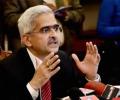
Amid prolonged uncertainty, continued policy support will be crucial for sustained economic recovery from the coronavirus pandemic, Reserve Bank Governor Shaktikanta Das said at the recent meeting of the Monetary Policy Committee. "In this period of prolonged uncertainty, it would be wise to remain agile and respond in a gradual, calibrated and well telegraphed manner to the emerging challenges," opined Das, according to the minutes of the MPC meeting released by the Reserve Bank on Thursday. Observing that economic recovery from the pandemic remains incomplete and uneven, he said, "continued support from various policies remains crucial for a sustained recovery." The governor said the renewed surge in international crude oil prices, however, requires close monitoring.

ICICI Bank was the top gainer in the Sensex pack, rising around 4 per cent, followed by UltraTech Cement, Sun Pharma, Bharti Airtel, HUL, SBI, L&T, Axis Bank and IndusInd Bank. On the other hand, Reliance Industries, Bajaj Finserv, HCL Tech and HDFC were among the laggards.

In a business friendly move, the Reserve Bank of India on Friday said that the Real Time Gross Settlement (RTGS) system, used for large value transactions, will be made available round-the-clock in the next few days. In December 2019, the National Electronic Funds Transfer (NEFT) system was made available on a 24x7x365 basis. Currently, RTGS is available for customers from 7.00 am to 6.00 pm on all working days of a week, except second and fourth Saturdays of every month.

The proposed bullet train will run between Mumbai and Ahmedabad.

The Reserve Bank of India, for the second straight time, on Thursday kept its key policy rate unchanged at 5.15 per cent, maintaining its accommodative policy stance as long as it was necessary to revive growth. The central bank retained GDP growth at 5 per cent for 2019-20 and pegged it at 6 per cent for the next fiscal.

Amid an increase in localised lockdowns across the country, Reserve Bank Governor Shaktikanta Das on Wednesday said there is no need for a loan repayments moratorium at present, stating that businesses are better prepared to face the situation. It can be noted that the RBI had announced a six-month moratorium in the early days of the national lockdown last year to help borrowers impacted by a chilling in economic activity. The entire state of Maharashtra is in a lockdown for non-essential services and localised and night lockdowns are being observed in many pockets of the country, including the national capital, to restrict the surge in cases.

The interim dividend will help Narendra Modi-led government partly bridge the deficit its budget had developed after the announcement of a Rs 75,000 crore a year cash dole scheme for small farmers.

The government is mulling changes in the income tax laws to bring cryptocurrencies under the tax net, with some changes that could form part of the Budget next year, a top official said. Revenue secretary Tarun Bajaj said that in terms of income tax, some people are already paying capital gains tax on the income from cryptocurrency, and in respect of Goods and Services Tax (GST) also the law is "very clear" that the rate would be applicable as those in case of other services.

"Indian markets (are) well placed to absorb the US Fed rate hike. Gradual approach in future increases augurs well for emerging markets," Economic Affairs Secretary Shaktikanta Das has tweeted.
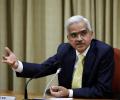
Reserve Bank Governor Shaktikanta Das on Wednesday said the country is at the doorstep of economic revival on the back of accommodative monetary and fiscal policies being pursued by the central bank and the government.

As persources, Economic Affairs Secretary Shaktikanta Das will represent India at the 2-day event to be hosted in Islamabad from August 25-26.

Besides financials, shares of telecom, IT, auto and pharma were in demand.

Despite admitting to price pressures both from food items and input prices, RBI Governor Shaktikanta Das on Wednesday hoped that a normal Southwest monsoon will have a "soothing impact" on inflation pressures and ruled out any wide variations in medium-term inflation forecast from what was given in April. In an unscheduled address earlier in the day amidst the raging pandemic, Das said the overall outlook for the economy is highly uncertain and is clouded with downside risks. He offered a slew of relief and liquidity measures to individuals and small businesses apart from a Rs 50,000 crore special liquidity window to the healthcare sector.

In a business friendly move, the Reserve Bank of India on Friday said that Real Time Gross Settlement System (RTGS), used for large value transactions, will be made available round-the-clock from December. In December 2019, the National Electronic Funds Transfer (NEFT) system was made available on a 24x7x365 basis. Currently, RTGS is available for customers from 7.00 am to 6.00 pm on all working days of a week, except second and fourth Saturdays of every month.

Reserve Bank Governor Shaktikanta Das on Thursday said the central bank's asset purchases, aimed at mitigating COVID-19-related liquidity stress in the system, did not dilute its balance sheet or compromise on core principles of central banking. In the wake of the pandemic, the RBI undertook several conventional and unconventional measures. "Unlike many central banks, the RBI's asset purchases did not dilute its balance sheet and hence, did not compromise on core principles of central banking," Das said while addressing an event organised by the Bombay Chamber of Commerce. These purchases were confined to risk-free sovereign (government) bonds including state government securities only, he said.
Jaitley calls it unfair and false attack on a disciplined civil servant

In order to provide an impetus to digital funds movement, it has been decided to do away with the charges levied by the RBI for transactions processed in the RTGS and NEFT systems, RBI said.
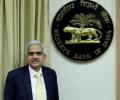
The HR challenge seems to be one of the most important issues that RBI Governor Shaktikanta Das will have to tackle.

Progress on the steps taken by Governor Shaktikanta Das' predecessor Urjit Patel to restore financial system integrity will be a key thing to assess any damage to the institution, Subramanian said.

Select the exact category by matching your investment horizon to the portfolio duration, suggests Sanjay Kumar Singh.

The repo rate, at which the central bank lends to the system, will come down to 5.75 per cent after the cut.

India's economic growth is estimated to have slowed down to 11-year low of 5 per cent during the current financial year ending March 2020.
The government on Wednesday asked the Reserve Bank to maintain retail inflation at 4 per cent with a margin of 2 per cent on either side for another five-year period ending March 2026. To control the price rise, the government in 2016 gave a mandate to the RBI to keep the retail inflation at 4 per cent with a margin of 2 per cent on either side for a five-year period ending March 31, 2021.

The Reserve Bank on Friday retained the GDP forecast for the current financial year at 9.5 per cent and flagged global semiconductor shortages, elevated commodity prices and potential global financial market volatility as downside risks to economic growth. In his address after the three-day meeting of the rate-setting panel, RBI Governor Shaktikanta Das said recovery in aggregate demand gathered pace in August-September, and it is reflected in high-frequency indicators, like railway freight traffic; port cargo; cement production; electricity demand; e-way bills; GST and toll collections. "The ebbing of infections, together with improving consumer confidence, has been supporting private consumption," he said, and added the pent-up demand and the festival season should give further fillip to urban demand in the second half of the financial year.

'We are very watchful about inflation and growth. But the main challenge is economic revival and growth.'

The Reserve Bank on Monday superseded the boards of Srei Infrastructure Finance as well as Srei Equipment Finance, citing concerns over governance and payment defaults, and decided to refer the two NBFCs for resolution under the insolvency law. This is only the second time in as many years that the Reserve Bank of India (RBI) is referring entities for the resolution process under the Insolvency and Bankruptcy Code (IBC) after taking first ever such step in the case of DHFL back in 2019. Superseding the boards of the crisis-hit Srei Infrastructure Finance Limited (SIFL) and Srei Equipment Finance Limited (SEFL), the RBI has appointed Rajneesh Sharma, former Chief General Manager of Bank of Baroda as the administrator to manage the affairs of the two companies.

'The Indian economy and the Indian financial sector today remain resilient and much better placed.'

The Reserve Bank's rate-setting panel began its three-day deliberations on Monday to decide the next monetary policy amid expectations that the central bank will maintain status quo on the benchmark interest rate in the backdrop of global scare due to the new coronavirus variant Omicron. Reserve Bank Governor Shaktikanta Das headed six-member Monetary Policy Committee (MPC) is scheduled to announce the policy resolution on Wednesday. If the RBI maintains status quo in policy rates on Wednesday, it would be the ninth consecutive time since the rate remains unchanged.

The move will avoid hoodwinking the system and reduce the blind spots, which will ultimately lead to protection of depositors' money.
The non-food component in the price basket will continue to keep inflation at a high level and result in a "long pause" in interest rates, a foreign bank said on Wednesday. The central bank is likely to pare the pandemic-driven emergency response as well, the report by Singaporean lender DBS said. It can be noted that the high inflation driven by the food prices has forced the RBI to go for a status quo in rates for the three consecutive reviews of the bi-monthly policy meetings, even as growth continues to be in the negative territory.

'Banks are being encouraged to lend instead of parking their resources with the RBI and earn risk-free interest income,' points out Tamal Bandyopadhyay.
The cryptocurrency industry on Wednesday urged the government to take a nuanced approach towards regulating crypto assets in India and asked investors in the country to remain calm and not arrive at a rushed conclusion, a day after the government listed for introduction a Bill to ban all such cryptocurrencies, with some exceptions.

Axis Bank was the top gainer in the Sensex pack, surging over 13 per cent, followed by ICICI Bank, IndusInd Bank, Maruti, TCS, Kotak Bank and Reliance Industries. On the other hand, Nestle India, HUL, Tech Mahindra and Sun Pharma ended in the red. NSE Nifty zoomed 273.95 points, or 3.03 per cent, to finish at 9,266.75.

In order to promote the housing sector, Reserve Bank of India on Friday decided to rationalise risk weightage on housing loans, making the product attractive for both borrowers and lenders. With revision in the risk weightage, the requirement of capital provision for banks will come down. This will encourage banks to push housing loan products with attractive features.

Only Rs 10,720 crore of the junked currency notes did not return to the banking system, rest 99.9 per cent was deposited raising question mark over the government's effort of curbing black money through the demonetisation.

Domestic financial institutions and mutual funds on Wendesday pitched for rationalisation of tax provisions to improve ease of doing business in the country.
The Reserve Bank of India on Friday decided to leave benchmark interest rate unchanged at 4 per cent but maintained an accommodative stance as the economy faces heat of the second Covid wave.

As the central bank continues to increase forex reserves by running down the forward book which totalled $42 billion as of end-July, signalling its strong resolve to build a bigger reserve cushion to aid its expansionary, unorthodox monetary policy, the reserves are set to top the $655-billion-mark by March, according to a report. The forex kitty declined by $2.10 billion to $619.36 billion for the week to August 13 due to a fall in the core currency assets and gold, showed the latest RBI data. The reserves had risen to a lifetime high of $621.46 billion in the previous reporting week ending August 6.

The new rates, effective Wednesday, is the third reduction by SBI in this financial year having cut the rates by 5 bps each in April and May, while its home loan rates has come down by 20 bps during this period.
