
RBI Governor Shaktikanta Das on Tuesday launched a new service, which will enable over 40 crore feature phone users to undertake digital payments in a secure way. The service christened UPI (unified payments interface) '123PAY' is a three-step method to initiate and execute services for users which will work on simple phones which do not have an internet connection. Das said, as of now, the multifaceted features of UPI are mostly available only on smartphones, which excludes people from the lower rung of the society from an economic perspective, especially in the rural areas, from accessing the popular service, even though the smartphone prices are going down.

RBI Governor Shaktikanta Das has assured Finance Minister Nirmala Sitharaman that the Rs 12.05-trillion gross borrowing programme for FY22 will go through smoothly.
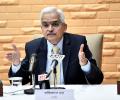
The Reserve Bank of India (RBI) on Wednesday raised the benchmark lending rate by 35 basis points to 6.25 per cent in a bid to tame inflation, which has remained above its tolerance level for the past 11 months. With the latest hike, the repo rate or the short-term lending rate at which banks borrow from the central bank now has crossed 6 per cent. This is the fifth consecutive rate hike after a 40 basis points increase in May and 50 basis points hike each in June, August and September.

In FY23, the State Bank of India (SBI) reported a 57.4 per cent jump in its net profit to Rs 55,684.17 crore. But the chairman of the country's largest bank, Dinesh Khara's annual pay for this creditable performance was just Rs 37 lakh (his peers at state-run banks are no better off). Look at his private bank rivals - most pocketed in excess of Rs 7 crore annually - plus stock options.

Ahead of the 2023-24 Union Budget, the thinking at the top level of the central government is clear: Gross domestic product (GDP) growth of 6-6.5 per cent is a comfortable enough target for FY24 and the focus should be on fiscal consolidation to ensure that the sovereign cost of borrowing does not become prohibitively expensive in a high-interest rate environment, according to people in the know. Those aware of deliberations between the Prime Minister's Office (PMO) and the Ministry of Finance said while the Budget would look to strike a balance between infrastructure investment and welfare schemes, it is unlikely to be populist, though it will be the last full-year Budget before the 2024 Lok Sabha election. Incidentally, 6-6.5 per cent GDP growth is what the upcoming 2022-23 Economic Survey is expected to project for FY24.

Enthused by higher than expected GDP numbers in the fourth quarter of 2022-23, Chief Economic Adviser (CEA) V Anantha Nageswaran on Wednesday said India's economic growth may exceed the initial estimate of 6.5 per cent in the current fiscal and the country can look for another year of solid economic performance.
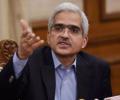
The Reserve Bank of India Governor Shaktikanta Das on Monday said that the "momentum of inflation is on a downward slope" and the central bank would continue to strike a delicate balance between the need to contain price rise and ensure economic growth. The Reserve Bank's inflation projections, Das said, are "robust" but contingent on downside and upside risks associated with the movement of global crude oil prices. The RBI takes into account a particular range within which crude prices are expected to fluctuate considering all the factors that can be anticipated and that can be sort of foreseen as of today, he said.

In the June quarter of FY24, 51 per cent of consumers who took small-ticket personal loans already had more than four credit products at the time of accessing yet another new loan, compared with just 17 per cent in the June quarter of FY20, points out Tamal Bandyopadhyay.
Higher for longer' may be the narrative in the developed markets, but interest rates might not stay high for very long in India, with a section of the market expecting rate cuts to begin this year. The six-member Monetary Policy Committee of Reserve Bank of India (RBI) decided to keep interest rates unchanged at 6.5 per cent in the April review - after hiking the policy repo rate in six previous meetings. RBI Governor Shaktikanta Das emphasised that the pause was only for the April policy and that the central bank was ready to act if the situation demanded.
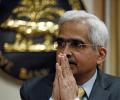
Available data obscures the true stress in bank books, and the pandemic will result in balance sheet impairments and capital shortfalls at lenders, RBI Governor Shaktikanta Das said on Monday. Balance sheet impairment and capital shortfalls will be more evident once the regulatory reliefs are rolled back, Das said in the bi-annual Financial Stability Report, asking lenders to augment capital.
The Reserve Bank of India's rate-setting panel on Wednesday started discussions to firm up the next bi-monthly monetary policy amid expectations that it might retain status quo on interest rate but change its monetary policy stance amid rising inflation on account of geopolitical developments.
The fourth consecutive rate cut is expected to lower equated monthly instalments (EMIs) for home and auto buyers, and borrowing cost for corporate.
All members of the Monetary Policy Committee (MPC) -- Shashanka Bhide, Ashima Goyal, Jayanth R Varma, Mridul K Saggar, Michael Debabrata Patra and Shaktikanta Das -- had unanimously voted to keep the policy repo rate unchanged at 4 per cent after the three-day meet of the panel earlier this month. Further, except Varma, other members voted to continue with the accommodative stance as long as necessary to revive and sustain growth on a durable basis and continue to mitigate the impact of COVID-19 on the economy, while ensuring that inflation remains within the target going forward. Varma expressed reservations on this part of the MPC resolution, according to the minutes.
Reserve Bank of India Governor Shaktikanta Das on Monday stressed on achieving 100 per cent self-sufficiency in banknote manufacturing in the near future. He was speaking after dedicating Varnika, the ink manufacturing unit of Bharatiya Reserve Bank Note Mudran Private Limited (BRBNMPL), to the nation in Mysuru. BRBNMPL, a wholly-owned subsidiary of the RBI, has set up Varnika with an annual ink manufacturing capacity of 1,500 MT to enhance the security of banknotes.
The MPC headed by RBI Governor Shaktikanta Das will announce the resolution of the meeting at around noon on Thursday.

ICICI Bank was the top gainer in the Sensex pack, rising around 3 per cent, followed by Axis Bank, HDFC twins, SBI, L&T, ONGC and Infosys. On the other hand, Sun Pharma, Asian Paints, Nestle India, UltraTech Cement and HUL declined. NSE Nifty rose by 79.60 points or 0.67 per cent to 11,914.20.

Reserve Bank Governor Shaktikanta Das on Friday said 67 per cent of the decline in the foreign exchange reserves since April was due to valuation changes arising from strengthening US dollar and higher American bond yields. The forex reserves, which stood at $606.475 billion as on April 2, have declined to $537.5 billion as on September 23. It was also the eighth straight week when the reserves declined.

The Reserve Bank of India (RBI) on Friday said it expects the economy to record positive growth in the second half of the current financial year.

RBI Governor Shaktikanta Das kept the red flag on cryptocurrencies flying, warning that the next financial crisis can be triggered by private cryptocurrencies if such speculative instruments are allowed to grow.

The country's foreign exchange reserves surged by $5.271 billion to touch a record high of $598.165 billion in the week ended May 28, RBI data showed on Friday. In the previous week ended May 21, 2021, the reserves had increased by $2.865 billion to $592.894 billion. While announcing the second bi-monthly monetary policy review earlier on Friday, RBI Governor Shaktikanta Das said the country's forex reserves may have crossed $600 billion currently.

The RBI on Friday said the impact of coronavirus outbreak on the economy will depend on the intensity, spread and duration of the deadly virus even as the central bank refrained from projecting any numbers for growth and inflation amid the widespread uncertainty. While announcing the seventh bi-monthly monetary policy statement for 2019-20, RBI Governor Shaktikanta Das said that in view of the impact of coronavirus pandemic, the growth projections for 4.7 per cent for the fourth quarter of 2019-20 and 5 per cent for the full fiscal are "now at risk".

Concerned over elevated inflation, Reserve Bank of India on Friday decided to leave the benchmark interest rate unchanged at 4 per cent but maintained an accommodative stance, implying more rate cuts in the future if need arises to support the economy hit by the Covid-19 pandemic.

Shaktikanta Das is a master of the finest balancing act who listens to all but takes his own decisions, discovers Tamal Bandyopadhyay.

She said I treated her like a bachchi. At another moment, she said I had gone to various people and 'bitched' about her. She also threatened to bring the entire matter to the PM's notice. A revealing excerpt from Subhash Chandra Garg's We Also Make Policy: An Insider's Account of How the Finance Ministry Functions.

The members of the Reserve Bank of India's (RBI's) Monetary Policy Committee (MPC) voiced different views on the interest rate and stance, with two of them indicating they may not vote for further rate increases even if Governor Shaktikanta Das and Deputy Governor Michael Patra maintain bringing down inflation as their primary objective, the minutes of the December review of the monetary policy showed. The other two members remained neutral. The MPC increased the policy repo rate by 35 basis points (bps) - which was lower than the previous three hikes of 50 bps. The repo rate has been hiked by 225 bps to 6.25 per cent since May this year.

When it comes to running between the wickets -- which is exactly what an FM and a governor do -- Jadeja always defers to Dhoni's larger judgement of the situation and the needs of the team, observes T C A Srinivasa-Raghavan.

'There are occasions when the prices of individual items like food raise inflation; then supply-side measures must be taken.' 'But if there is continued inflation, it means liquidity is aggravating the situation.'
RBI Governor Shaktikanta Das on Thursday said financial inclusion will continue to be a "policy priority" for the central bank to make the post-pandemic recovery more equitable and sustainable. The Reserve Bank of India will very soon be coming out with the first financial inclusion index, which will assess progress in terms of access, usage and quality, Das said, while speaking at the Economic Times Financial Inclusion Summit. It is the responsibility of all stakeholders to ensure that the financial ecosystem (including the digital medium) is inclusive and capable of effectively addressing risks like mis-selling, cybersecurity, data privacy and promoting trust in the financial system through appropriate financial education and awareness, he added.

The government on Monday ruled out making public the RBI report detailing the reasons why the central bank could not keep inflation within the targeted 6 per cent upper limit for the three consecutive quarters. "Yes sir, RBI has furnished a report to the central government, as mandated under Section 45ZN of the RBI Act, 1934 and Regulation 7 of RBI Monetary Policy Committee and Monetary Policy process Regulations, 2016," minister of state for finance Pankaj Chaudhary said in a written reply. The said provisions of the RBI Act, 1934, and regulations therein does not provide for making the report public, he said.

'Banks will continue to increase FD rates to attract more deposits and meet the increasing demand for credit.'
The RBI's rate-setting panel MPC on Monday began its three-day deliberation amid expectations of another round of hike in benchmark interest rates to contain inflation that continues to remain above the central bank's upper tolerance level. RBI Governor Shaktikanta Das will announce the decision of the Monetary Policy Committee after deliberations on Wednesday. Das has already indicated that there may another hike in the repo rate, though he refrained from quantifying it.

The Indian services sector activity fell to a six-month low in September, as new business inflows rose at the slowest rates since March, amid inflationary pressures and competitive conditions, a monthly survey said. The seasonally adjusted S&P Global India Services PMI Business Activity Index fell to 54.3 in September, from 57.2 in August, highlighting the weakest rate of expansion since March. For the fourteenth straight month, the services sector witnessed an expansion in output. In Purchasing Managers' Index (PMI) parlance, a print above 50 means expansion, while a score below 50 denotes contraction.

Investors saw their wealth rise by more than Rs 3.96 lakh crore on Wednesday as stocks continued their rally for the second straight session amid the Reserve Bank reiterating its accommodative stance and easing concerns over the Omicron variant of the coronavirus. The 30-share Sensex soared 1,016.03 points or 1.76 per cent to close at 58,649.68 and all the constituent stocks, except for two, closed in the green. Most of the rate-sensitive auto, banking and realty stocks registered gains during the day's trade. While the BSE Auto index rose 2.24 per cent, BSE Bankex went up 1.61 per cent and BSE Realty spurted 1.72 per cent.

The repo rate has been left unchanged at 4 per cent, Governor Shaktikanta Das said while announcing the decisions taken by the central bank's MPC.

The Sensex jumped 412.23 points on Friday, braving heavy volatility during the day, amid the Reserve Bank of India maintaining status quo on the benchmark lending rate and buying in index heavyweights Reliance Industries Limited and ITC. The BSE Sensex climbed 412.23 points or 0.70 per cent to settle at 59,447.18. During the day, the benchmark hit a high of 59,654.44 and a low 58,876.36. The Nifty also gained 144.80 points or 0.82 per cent to finish at 17,784.35.

Retail inflation fell to a 15-month low of 5.66 per cent in March, mainly due to a decline in food prices, government data showed on Wednesday. The inflation figure in March is within the RBI's comfort zone as it is below 6 per cent. The retail inflation based on Consumer Price Index (CPI) was 6.44 per cent in February 2023 and 6.95 per cent in the year-ago period.

Retail inflation dropped marginally to 7.01 per cent in June mainly due to slight easing in prices of vegetables and pulses, though it still remained above the Reserve Bank's comfort level for the sixth month in a row. The consumer price index (CPI) based inflation stood at 7.04 per cent in the preceding month of May and 6.26 per cent in June 2021. Inflation in the food basket in June 2022 was 7.75 per cent, compared to 7.97 per cent in the previous month, as per the National Statistical Office (NSO) data released on Tuesday.

The Reserve Bank of India (RBI) on Friday kept the key repo rate unchanged at 4 per cent in view of rising inflation and faint signs of economic growth amid the gradual lifting of coronavirus related countrywide lockdown.
RBI Governor Shaktikanta Das on Tuesday asked private sector banks to ensure continuity in the provision of various financial services, including credit facilities to individuals and businesses, in the face of challenges brought on by the pandemic. Earlier this month, the governor had held a similar meeting with MD and CEOs of public sector banks. During the meeting with the MD and CEOs of select private sector banks, Das also impressed upon the banks to quickly and swiftly implement the measures announced by the RBI on May 5, 2021, in right earnest.
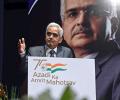
Reserve Bank Governor Shaktikanta Das on Thursday described cryptocurrencies as "clear danger" and said that anything that derives value based on make believe, without any underlying, is just speculation under a sophisticated name. The government is in the process of finalising a consultation paper on cryptocurrencies after gathering inputs from various stakeholders and institutions. Reserve Bank of India (RBI) has been flagging concerns about cryptocurrencies, which are seen as a highly speculative asset.
