
As the gentle carer of the 'poorest of poor' became a saint on Sunday, Rediff.com looks back at the two miracles that she performed, paving the way for her to be called a saint.

Euphoric scenes were witnessed when Pope Francis declared Mother Teresa a saint.

What is strange, for someone who spent a lifetime in seva, is that St Teresa's own personal journals and communication with the Church hierarchy reveal someone in "spiritual desolation", says Sankrant Sanu. Could the Indian sacred traditions have helped her?

For many of the poor and destitute whom Mother Teresa served, the tiny nun was a living saint.
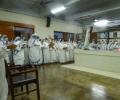
Sister Mary Joseph has been elected as the superior general of Missionaries of Charity, becoming the fourth occupant of the top post of the global organisation founded by Saint Teresa of Kolkata, a spokesperson of the order said on Monday.
Nuns of the order congregated at the prayer hall keeping safe distance from each other and lit candles before a large portrait of St Teresa, still fondly called Mother Teresa. They prayed to her for the well being of the people, specially the poor for whom she had devoted her entire life.
Money, apparently, doesn't matter in a place where service is not a dogma but a way of life.

Coming just a day after she was canonised by Pope Francis in the Vatican City, the death anniversary had a special significance on Monday.
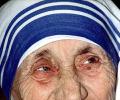
In order to mark the sainthood of Mother Teresa, the government of India granted the trade mark registration.
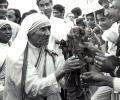
For the thousands of destitute that Mother Teresa treated, she was 'god incarnate' and her hand was the miracle of love the poor needed. Attributing scientifically-unproven remedies as miracles does not help the followers of Missionaries of Charity and humanity in general, says Pallava Bagla.
 © 2026 Rediff.com - Investor Information - Advertise with us - Disclaimer - Privacy Policy - Sitemap - Feedback - About us - Terms of use - Grievances