
Can we find fault with RBI for not intervening enough in the market? Actually no, say some experts. A correction in rupee was long overdue.

The latest official numbers on the price of agricultural produce gives an idea of what's fueling the farmers' protest in Delhi.

Experts say it will make GDP growth target of 5.7-5.8% difficult to achieve, while ministries feel late resurgence will help in sowing of rabi crops.

Advertising whiz kids are the new entrepreneurs on the block.

October infrastructure output, which contributes nearly 38 per cent to the industrial output index, was up 3.2 per cent annually.

The reason why private banks will play the deposit pricing game strategically is the weakening of banks' deposits base given the competition from MFs and insurance companies due to tax-savings schemes.
The meeting will focus on how to make the crisis an opportunity for India.

A monsoon deficit is likely to affect the agriculture output, which could have an impact on the food inflation
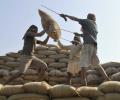
For many farmers, though, a bumper harvest isn't good news, as they have been forced to sell their produce, particularly pulses, dirt cheap.

While the farmers are not getting remunerative prices for their produce, at the same time they are forced to pay high prices for items they consume.
According to Soumya Kanti Ghosh, chief economic advisor of the State Bank of India group, a 50 bps rate cut is a possibility, but 25 bps is more likely.

Acreage of these crops is likely to fall as prices drop below MSP in mandis; area under cotton, maize may increase on better realisation

The main reason was that CPI inflation would likely remain below 4 per cent till July.

With RBI holding on to rates, investors should avoid longer duration funds for the near future, experts tell Joydeep Ghosh

While the positive surprise has been the high growth in agriculture, the negative surprise is in the trade, transport, hotels segment where growth came lower than expected, says Madan Sabnavis.

The highest number of jobs were created in the age group of 18-21 at 1.29 million, followed by 22-25 years of age at 1.12 million during these seven months.

If the industrial sector expanded, growth rate is likely to rise in the remaining quarters to reach 7.6-7.8 per cent for 2017-18.

Poor rainfall has also depleted water reservoirs levels, which is likely to impact the winter crops.

'While collections under the Income Disclosure Scheme explain it partly, indirect tax numbers not showing any effect of the withdrawal of high denomination currency notes was puzzling.'

A reversal of policy at this juncture could jeopardise the recent gains on inflation

Higher interest rates in the US do not necessarily coincide with capital outflows.

The incoming government will have to encourage private investments, bring down cost of capital

The gains will be gradual as the measure will be executed over 12 months or so.

The NITI Aayog's vice-chairman's charge holds ground.

The government had breached its fiscal deficit target given in the Budget for 2017-18 in November itself, touching 112 per cent of the limit.

Unless supported by investment, any spark of a recovery could be temporary, hint economists.

Though inflation, on the basis of the wholesale price index, is nowhere near the 1990-91 level of 10.26 per cent and India is in a much better position to check it, the greater integration of our economy with the globe has exposed it to a much higher risk of imported inflation.

The real benefits can be seen when prices stabilise, preferably at levels acceptable to both consumers and producers.

The next 12 months will be quite challenging marked by uncertain political events and evolving macroeconomic scenario

More than 40% of the companies surveyed showed job contraction in FY18, says a report by CARE Ratings

Gold import in the December quarter is estimated to come down.

Softening of global commodity prices might not help much

Experts said the slowdown could be attributed to adjustments leading to destocking and the offering of discounts by companies as the government ushered in the new indirect taxation system on July 1.
.jpg)
Else, more capital outflow and pressure on rupee likely.

India's balance of payments in negative territory.

Skymet said the monsoon this year could be 100 per cent of the long period average (LPA) with a model error of plus and minus 5 per cent.

Fresh investments are constrained by tepid demand.

Even if RBI partially replaces the stock of the high value notes, RBI will have to incur thousands of crores of rupees in cost, say economists.

Amid hints that the government might be exploring capping royalty payments by India-based subsidiaries to US companies, experts warn Subhayan Chakraborty why such a move will only hurt the Indian economy.

An analyst says, due to excess capacity, investment in manufacturing will not be forthcoming
 © 2026 Rediff.com - Advertise with us - Disclaimer - Privacy Policy - Sitemap - Feedback - About us - Terms of use - Grievances