
Section 144 of the Criminal Procedure Code has been imposed in sensitive areas in the districts of Udupi and Dakshina Kannada, and Bengaluru.

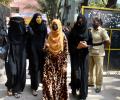
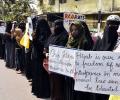
Amid tight security with policemen deployed in and around pre-university colleges at many sensitive places, the day saw a section of Muslim students remaining adamant not to remove the burqa, let alone hijab, the Islamic scarves.

The Karnataka unit of the Bharatiya Janata Party allegedly shared the personal details of the girls from Udupi including their residential addresses who had approached the Karnataka high court against the ban on wearing of hijabs in classrooms.
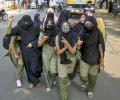
The controversy refuses to die down as some students remained adamant to be allowed to attend classes with 'hijab' and 'burqa' on Thursday as well.

The girls insisted that they should be allowed to write the exam wearing hijab but the college authorities citing the High Court order denied them entry.

"We are making it very clear that whether a degree college or a PU college, if a uniform has been prescribed, that has to be followed so long as the matter is pending before the court," Chief Justice Ritu Raj Awasthi told advocate Mohammed Tahir who is the counsel for one of the petitioners seeking permission to wear hijab in the classrooms.
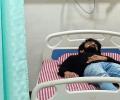
Masood Manna, who is known to Shifa, claimed in a tweet that a mob of 150 people attacked Saif.
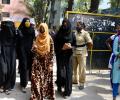
As you know that the Karnataka Education Act and Rule does not permit any religious items inside the class. So we are very clear that no student can wear hijab inside the class, Nagesh explained.
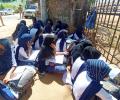
The Karnataka high court on Thursday asked the counsels in the hijab case to wind up their arguments by Friday as it indicated that it will shortly deliver the order.

According to the lawyers appearing for the petitioner girls from Udupi district, the matter pertaining to hijab case has been listed for Tuesday as serial No. 1 and the court may spell out the operative part of the verdict from 10.30 am onwards.
Senior counsel S S Naganand, representing the Government PU College for Girls, its principal and a teacher, on Wednesday told the full bench, comprising Chief Justice Ritu Raj Awasthi, Justice J M Khazi and Justice Krishna S Dixit, that the hijab row was started by some students owing allegiance to CFI.
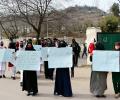
As many as 58 students at Shiralakoppa in Shivamogga district who had refused to remove their hijab and staged a demonstration against the government pre-university college administration were suspended.

Challenging the government order restricting the use of any cloth that can disturb peace, harmony and, law and order, the girls who petitioned in favour of hijab requested the Karnataka high court on Monday to allow them to wear Islamic headscarves of the colour of the school uniform.
A video clip of the students allegedly offering namaz in the classroom of a government primary school in Dakshina Kannada has gone viral.
"The consequence of the demand to declare Hijab as an essential religious practice is huge because there is an element of compulsion or else you will be expelled from the community," Navadgi told the court.

Scenes of angry parents of such children arguing with police and school authorities and an instance of a student trying to flaunt a saffron scarf as an apparent retaliation were also reported.
"This is our stand that hijab is not an essential religious practice. There was a statement by Dr B R Ambedkar in the Constituent Assembly where he said 'let us keep the religious instructions outside educational institutions'," Karnataka Advocate General Prabhuling Navadgi told the full bench of the high court, which is hearing the hijab case.
The Karnataka high court on Tuesday dismissed petitions filed by a section of Muslim students from the Government Pre-University Girls College in Udupi, seeking permission to wear the hijab inside the classroom.

The Karnataka high court on Friday said it has called for a report from the state government on the role of radical organisations behind the hijab controversy in the state.
 © 2026 Rediff.com - Investor Information - Advertise with us - Disclaimer - Privacy Policy - Sitemap - Feedback - About us - Terms of use - Grievances