
The comments come about a week after PSU bank employee unions went to a four-day relay strike to press for early revision of wages.

Investors are showing some interest in the downstream energy cycle. Refiners and marketers, especially the public sector (PSU) oil marketing companies (OMCs) could see a revival of marketing margins. Lower crude oil and gas prices may also improve margins in industries like paints, logistics, synthetic fabrics, plastics, and fertilisers. In the medium-term, however, there could be a supply overhang affecting OMCs as new refining capacities are scheduled to be commissioned, especially in China, and this may lead to a drop in the refining margins as capacity would be surplus to demand until and unless there's a pick-up in global growth.

Oil India and other PSUs had filed clarificatory /modificatory petition before the Supreme Court. These companies own and operate telecom networks though they do not provide telecom services.

Indices across Indian equity markets have edged towards new record highs before undergoing a small correction in the past few sessions. The National Stock Exchange Nifty has gained 20 per cent in the past year; mid-caps (up 33 per cent), small-caps (up 31 per cent), and micro-caps (up 44 per cent) have done better. Several factors have precipitated this rally.

Fund managers are withdrawing after a two-year long run in public sector bank (PSB) stocks. Domestic mutual funds (MFs) were net sellers of PSB stocks for the first time in nine quarters, offloading shares worth Rs 1,800 crore in the March quarter, said a report by ICICI Securities. In the previous eight quarters, fund houses had invested more than Rs 10,000 in PSBs amid deep discounts in valuation vis--vis their private sector peers.

Public sector banks may have to bear a burden of Rs 1,800-2,000 crore arising due to a recent Supreme Court judgement on the waiver of compound interest on all loan accounts which opted for moratorium during March-August 2020, sources said. The judgement covers loans above Rs 2 crore as loans below this got blanket interest on interest waiver in November last year. Compound interest support scheme for loan moratorium cost the government Rs 5,500 crore during 2020-21 and the scheme covered all borrowers including the prompt one who did not avail moratorium.
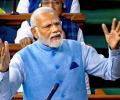
The prime minister was seen wearing a light blue "sadri" jacket as he sat in the Rajya Sabha in the morning.

The gap between the highs and the lows in April for the benchmark S&P BSE Sensex was just 4.1 per cent - the narrowest since July 2021 and nearly half its three-year average. The absence of major positive triggers, sectoral rotation, and cautiousness due to earnings and economic uncertainty have kept a tight leash on the markets, observe experts. Remarkably enough, during the 17 trading sessions in April, the Sensex didn't even log an advance or a decline of more than 1 per cent.

If only you had thought ahead, you would have stocked snacks and biscuits, bread and cake, and vegetables suited for Amma or pondatti to make your favourite bajji and pakoda, observes N Sathiya Moorthy.

'Comparing the rates of interest with PSU banks, the three- and five-year time deposit rates of the post office are more favourable.'

Young Indian Grandmaster R Praggnanandhaa has been roped in by IndianOil and would be receiving all the backing from the PSU major

Mihir Tanna, Associate Director, S K Patodia & Associates, answers your tax queries.

The high-speed free Wi-Fi internet facility is now available at 6,100 railway stations across the country, RailTel said on Tuesday. "The milestone of 6,100 stations with Wi-Fi coverage was reached today (Tuesday) with the commissioning of Wi-Fi facility at Ubarni railway station (Rae Bareli district, UP) in Lucknow Division of Northern Railway," the statement by RailTel noted.

Banking and financial stocks got more than their fair share of foreign portfolio investor (FPI) flows in February. Overseas investors pumped in $3.56 billion into domestic equities last month. Of this $1.96 billion went into financial stocks, data analysed by Edelweiss shows. "The sector now has 34.8 per cent of FPI assets, up from 33.8 per cent in January.

The 30-share BSE gauge climbed 465.14 points or 0.80 per cent to finish at 58,853.07. During the day, it jumped 546.97 points or 0.93 per cent to 58,934.90.

Why it is important for investors to select the right product according to their specific investment needs, risk appetite and investment tenure.

The Union Cabinet on Wednesday approved the dissolution of the Central Inland Water Transport Corporation Limited as part of the government's move to identify and close down "irretrievable" cases.

Bajaj Finserv was the top loser in the Sensex pack, shedding over 3 per cent, followed by Maruti, Bharti Airtel, Asian Paints, Bajaj Finance and HDFC.

The Sena faction alleged corruption cases against BJP leaders are being suppressed.

Given the uncertain macroeconomic conditions, most brokerages have turned slightly cautious on the pace of growth in State Bank of India's (SBI's) earnings going ahead. While they don't see any significant risk arising for now, its sheer balance sheet size and systematic importance has nudged them to cut earnings estimates for fiscal year 2023-24 (FY24) and 2024-25 (FY25) up to 5 per cent. India's largest state-owned bank, on Thursday, reported standalone net profit of Rs 16,694.51 crore for Q4FY23.
Both the Sensex and Nifty, however, registered gains for the week.

From the Sensex pack, State Bank of India, ICICI Bank, IndusInd Bank, Axis Bank, Kotak Mahindra Bank, HDFC Bank, Reliance Industries were among the major laggards. Bucking the trend, auto stocks Tata Motors and Mahindra & Mahindra closed with gains.

While prices sustaining lower levels is crucial, Govt actions are also a key monitorable given the forthcoming elections in 2024.

Some of the public banks showed improvement; much more still needs to be done

The rout in Adani Group stocks after US-based short seller Hindenburg Research released a report on January 24 has sparked a rebound in trading activity this month. The average daily trading volume (ADTV) for the cash segment (both NSE and BSE combined) so far in February stands at Rs 59,346 crore, and is around 15 per cent more than the previous month's tally of Rs 51,844 crore, which was the lowest in six months. The ADTV for the futures and options (F&O) segment rose to a record Rs 204 trillion (notional turnover) against Rs 202 trillion in January.

Earnings growth, attractive valuations and change in FPI flows from negative to positive over the next 12 months are some of the key triggers for an upside. "A poor monsoon, high inflation and further rate hike are some of the key risks
Be wary of co-operative banks which have historically been most vulnerable.

Bank of Baroda Q4 results: Key brokerages have raised their target prices on Bank of Baroda after the state-owned lender posted better-than-expected March quarter (Q4FY23) results. Analysts now see up to 29 per cent upside in the stock from a one-year perspective as they believe BoB is well-placed among the large public banks with nearly all key business metrics moving closer to the top-tier banks. Valuations, too, remain attractive despite steady strong quarterly performances.

Ahead of the Budget, the government has achieved almost half the divestment target of Rs 65,000 crore. FY23 divestment receipts are unlikely to be anywhere close to the budgeted target.

"I'm taking a minute to respond... I do respect Raghuram Rajan as a great scholar who chose to be in the central bank in India at a time when the Indian economy was all buoyant," Sitharaman said during the lecture organised by the Deepak and Neera Raj Centre on Indian Economic Policies of the Columbia University.

'iNCOVACC' is priced at Rs 800 for private markets and at Rs 325 for supplies to the government of India and state governments.

Since March 31, 2022, the PSBs' market cap has risen 43.7 per cent, from Rs. 7.29 trillion to Rs. 10.47 trillion. It's time for the government, the majority owner of public sector banks, to reap the benefit of the rally in bank stocks, recommends Tamal Bandyopadhyay.

The apex body of petroleum workers in Assam on Thursday said it has stopped transportation of fuel to Meghalaya, following reports of attacks on vehicles from Assam in the backdrop of violence along the inter-state border that left six people dead.

'Banks will continue to increase FD rates to attract more deposits and meet the increasing demand for credit.'

Anup Roy and Krishna Kant on the challenges the public sector banks face in revitalising themselves

India is back on the diplomatic table pushing oil producing countries to raise production in a bid to cool down runaway oil prices. Brent crude oil prices traded above $90 a barrel, on Thursday, for the first time since 2014. Brent is the most popular marker for crude oil trade. It is used as a benchmark for two-thirds of the world's internationally traded crude oil.
Bharti Airtel was the top gainer in the Sensex pack, rising around 4 per cent, followed by Tech Mahindra, HDFC, Kotak Bank, M&M and HCL Tech. NSE Nifty advanced 21.85 points to 16,280.10.

Defence public sector undertakings (PSUs) have been asked by the Centre to hold roadshows in Dubai and Abu Dhabi to share their financials and business plans to reel in investors. Hindustan Aeronautics (HAL), Bharat Dynamics (BDL), Bharat Electronics (BEL), Garden Reach Shipbuilders & Engineers (GRSE), and Mishra Dhatu Nigam (MIDHANI) have informed stock exchanges that they will conduct investor outreach programmes and participate in 'non-deal' roadshows and meetings with prospective investors from September 12-15. They will share their short- and medium-term growth plans, financial metrics, improvement in their stock performance/ market capitalisation - and make a pitch of sorts to prospective investors.

HDFC was the top gainer in the Sensex pack, spurting over 2 per cent, followed by Bajaj Finserv, M&M, NTPC, Bharti Airtel, UltraTech Cement and ONGC. NSE Nifty rose 98.35 points to 14,823.15.

Net investments in active equity mutual fund (MF) schemes rose to Rs 7,300 crore in December after declining to a 21-month low of Rs 2,260 crore in November, shows the latest data from the Association of Mutual Funds in India (Amfi). The rebound in net inflows was driven by a surge in investments and moderation in redemptions. While the inflows into these schemes rose 5 per cent month-on-month (MoM) in December, the redemptions were 14 per cent lower compared to November.
