
The Indian economy recovered from the Covid-induced downturn during 2022 and is poised for further improvement in the coming quarters though downside risks emanating from geopolitical tensions, strengthening dollar and elevated inflation will continue. The positive trajectory in the growth trend and improved fundamentals will help the nation in neutralising the impact of global headwinds which are expected to have a bearing on the country's exports in the months to come. The challenges before the government and the Reserve Bank in the new year would be to arrest inflation, check declining value of rupee against US dollar and promote private investment and growth, with a view to ensure that the country remains one the fastest growing major economies of the world.

The Reserve Bank on Wednesday retained the GDP growth forecast at 9.5 per cent for the current fiscal but cautioned that the economic recovery is not yet strong enough to be self-sustaining and durable.

India's manufacturing sector activity witnessed a significant loss of growth momentum in May due to the intensification of the COVID-19 crisis and its detrimental impact on demand, a monthly survey said on Tuesday. The seasonally adjusted IHS Markit India Manufacturing Purchasing Managers' Index (PMI), fell to 50.8 in May, down from 55.5 in April, as companies observed the slowest rises in new work and output in ten months amid intensification of the COVID-19 crisis. In PMI parlance, a print above 50 means expansion while a score below 50 denotes contraction.
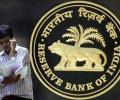
Reserve Bank will have to constantly re-assess the "dynamic and fast changing situation" and tailor its actions accordingly, Governor Shaktikanta Das said during the recent meeting of the Monetary Policy Committee (MPC) which decided to maintain status quo on key interest rate. According to the minutes of the six-member MPC meet released by Reserve Bank of India (RBI) on Friday, the five other members had also expressed a similar opinion amid the ongoing Russia-Ukraine conflict's impact on the global and domestic economies. MPC, which held its meeting from April 6-8, unanimously decided to keep the borrowing costs unchanged at a record low for the 11th time in a row in a bid to continue supporting economic growth despite inflation edging higher in the aftermath of Russia-Ukraine conflict.

SBI was the top gainer in the Sensex pack, spurting over 2 per cent, followed by ICICI Bank, Nestle India, IndusInd Bank, M&M, Bajaj Auto and Maruti. NSE Nifty advanced 135.55 points to 14,819.05.
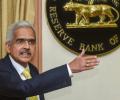
In the second policy review under Governor Shaktikanta Das, the six-member Monetary Policy Committee voted 4:2 in favour of the rate cut.

'New record for the Nifty50 is only a question of when.'

Although there is headroom for further monetary policy action, at this juncture it is important to keep our arsenal dry and use it judiciously: RBI's Das.

Retail inflation eased to 4.06 per cent in January, mainly on account of a decline in vegetable prices, as per government data released on Friday. The inflation based on Consumer Price Index (CPI) was 4.59 per cent in December 2020.
RBI Governor Shaktikanta Das has assured Finance Minister Nirmala Sitharaman that the Rs 12.05-trillion gross borrowing programme for FY22 will go through smoothly.

Equity investors became richer by over Rs 5.77 lakh crore on Tuesday, helped by a rally in the broader market where the BSE benchmark jumped nearly 2 per cent. The BSE Sensex zoomed 934.23 points or 1.81 per cent to settle at 52,532.07. Driven by the rally in equities, the market capitalisation of BSE-listed firms jumped by Rs 5,77,006.83 crore to stand at Rs 2,40,63,930.50 crore. "Absence of fresh selling triggers in the domestic and global economy along with falling commodity prices relieved the heavily discounted equity market to showcase recovery.

Reserve Bank Governor Shaktikanta Das on Friday said 67 per cent of the decline in the foreign exchange reserves since April was due to valuation changes arising from strengthening US dollar and higher American bond yields. The forex reserves, which stood at $606.475 billion as on April 2, have declined to $537.5 billion as on September 23. It was also the eighth straight week when the reserves declined.
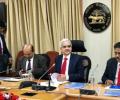
'Overall, domestic demand has moderated significantly. 'The weakening of private consumption, which for long has been the bedrock of aggregate demand, in particular, is a matter of concern,' RBI Governor Shaktikanta Das said in the MPC meetings, in October.

After turning net buyers last month, foreign investors have become aggressive shoppers of Indian equities and have invested Rs 22,452 crore in the first two weeks of August amid softening inflation concerns. This was way higher than a net investment of nearly Rs 5,000 crore by Foreign Portfolio Investors (FPIs) in the entire month of July, data with depositories showed. FPIs had turned net buyers for the first time in July, after nine straight months of massive net outflows, which started in October last year.
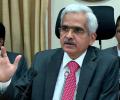
Das favoured shifting the stance of monetary policy from neutral to accommodative to send a clear signal, indicating that more measures could be taken in the near future to boost growth.

In a double delight, retail inflation eased to a one-year low of 5.72 per cent - staying below the upper tolerance limit for two months in a row, while factory output rose sharply to 7.2 per cent on the back of healthy growth in manufacturing. The retail inflation numbers based on Consumer Price Index (CPI) will provide some room for the Reserve Bank to further moderate the quantum of hike in key interest rate or even press a pause button. The RBI has been on a rate hiking spree since May 2022 in its bid to tame inflation, having raised the repo rate by a cumulative 225 basis points (bps).

"The Monetary Policy Committee recognises that there is monetary policy space for future action. However, given the evolving growth-inflation dynamics, the MPC felt it appropriate to take a pause at this juncture," the RBI said in its fifth bi-monthly monetary policy for this fiscal.

Declining vegetable prices brought down the retail inflation to a 15-month low of 4.59 per cent in December and within the comfort zone of the Reserve Bank, government data showed on Tuesday. It is for the first time during the current fiscal that the Consumer Price Index (CPI) based inflation print is below 6 per cent or in the RBI's target range of 2 to 6 per cent. The central bank factors in the CPI-based inflation while arriving at its monetary policy. The inflation in December 2020 came down from 6.93 per cent in November, mainly on account of 10.41 per cent decline in vegetable prices over the year-ago period.

As regards India, FIIs have pumped in over Rs 34,400 crore in the Indian stocks in calendar year 2021.

Retail sales of overall vehicles in India grew by 15.28 per cent to 2,11,20,441 units in 2022 led by record sales of passenger vehicles and tractors, Federation of Automobile Dealers Associations (FADA) said on Thursday. In 2021, total retail sales of vehicles in India were at 1,83,21,760 units, FADA said in a statement. Two-wheelers retail sales stood at 1,53,88,062 units last year, a growth of 13.37 per cent from 2021 when sales stood at 1,35,73,682 units.

The Reserve Bank on Friday said it will soon commence the pilot launch of e-rupee for specific use cases with a view to bolstering India's digital economy, making payment systems more efficient, and checking money laundering. In a concept note on Central Bank Digital Currency, the RBI said CBDC is aimed to complement, rather than replace, current forms of money and is envisaged to provide an additional payment avenue to users, not to replace the existing payment systems. "Supported by state-of-the-art payment systems of India that are affordable, accessible, convenient, efficient, safe and secure, the Digital Rupee (e?) system will further bolster India's digital economy, make the monetary and payment systems more efficient and contribute to furthering financial inclusion," the paper said.
The Reserve Bank of India on Wednesday retained the economic growth projection for the current financial year at 10.5 per cent, while cautioning that the recent surge in COVID-19 infections has created uncertainty over the economic growth recovery. In its last policy review, the RBI had projected a GDP growth rate of 10.5 pc for FY'22. Taking various factors into consideration, it said, "the projection of real GDP growth for 2021-22 is retained at 10.5 per cent consisting of 26.2 per cent in Q1, 8.3 per cent in Q2, 5.4 per cent in Q3 and 6.2 per cent in Q4."

The Indian services sector activity fell to a six-month low in September, as new business inflows rose at the slowest rates since March, amid inflationary pressures and competitive conditions, a monthly survey said. The seasonally adjusted S&P Global India Services PMI Business Activity Index fell to 54.3 in September, from 57.2 in August, highlighting the weakest rate of expansion since March. For the fourteenth straight month, the services sector witnessed an expansion in output. In Purchasing Managers' Index (PMI) parlance, a print above 50 means expansion, while a score below 50 denotes contraction.

Tata Steel was the top gainer in the Sensex pack, rising 3.10 per cent, followed by Bajaj Finance, Bajaj Finserv, Reliance Industries, Asian Paints and Titan.

Fitch Ratings on Thursday slashed India's GDP growth projection for FY23 to 7 per cent, saying the economy is expected to slow against the backdrop of global economy, elevated inflation and high interest rate. In June, it had forecast 7.8 per cent growth for India. "We expect the economy to slow given the global economic backdrop, elevated inflation and tighter monetary policy. "We now expect the economy to grow 7 per cent in the financial year to end-March 2023 (FY23) from 7.8 per cent previously, with FY24 also slowing to 6.7 per cent from 7.4 per cent before," Fitch said in its September edition of the Global Economic Outlook.

The sector seems set for a rally that may be somewhat temporary.

'If you look at the order books of capital equipment companies or money deployed on the ground, there is forward movement in terms of actual investment by the private sector.'
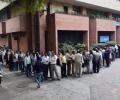
The Supreme Court on Tuesday said limited scope of a judicial review in economic policy matters does not mean that the court will fold its hands and sit back, observing that the manner in which a decision is taken by the government can always be examined.

The benchmark Sensex is 2.4 per cent shy of a new lifetime high but the market capitalisation (m-cap) of all companies listed on the BSE is already in the record books. At Thursday's (August 18) closing price, the total m-cap of 4,776 firms on the BSE stood at Rs 280.5 trillion, surpassing the previous high of Rs 280 trillion on January 17. This, even if the Nifty Midcap 100 is currently 5.4 per cent below its lifetime high, while the Nifty Smallcap 100 index is down over 20 per cent.

For the banking system a new cycle starts in FY2024. It's fraught with fresh challenges on asset quality and profitability, warns Tamal Bandyopadhyay.

'Overtightening of monetary policy by central banks and the spread of new Covid variants, which may force governments to restart lockdowns or restrict mobility.'
India's services sector activity witnessed a sharp upturn in August on the back of stronger gains in new business, ongoing improvements in demand conditions and job creation, a monthly survey said on Monday. The seasonally adjusted S&P Global India Services PMI Business Activity Index rose from July's four-month low of 55.5 to 57.2 in August, amid a quicker upturn in business activity and the sharpest rise in employment for over 14 years. For the thirteenth straight month, the services sector witnessed an expansion in output.

Of the six-member rate-setting monetary policy committee, five members voted for a 25 bps cut while one by 40 bps, the RBI said.

The growth in the contact-intensive portion of the economy trailed our expectation, highlighting how imperative it is for confidence to improve, either through accelerated vaccinations or otherwise, to drive a sustainable recovery in these sectors, asserts Aditi Nayar.

'Investors should hold equity assets for 3 to 5 years.'
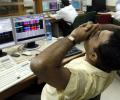
Investors' wealth has eroded by over Rs 680,441 crore in three days of market fall amid weak global trends and muted domestic sentiments. Extending its losses for the third straight day, BSE benchmark Sensex on Thursday finished below the 60,000-level, weighed by hectic selling in IT, energy and finance stocks amid a sell-off in European equities. The index has lost 1,844.29 points in three sessions.

'The China opportunity, the digital opportunity and the end of geography opportunity are the three pieces of luck India got due to Covid.'

Domestic macroeconomic data, RBI policy and developments related to the Russia-Ukraine war would be major driving factors for the stock market this week, analysts said. Moreover, FPI investment and trends in crude oil would also influence the trading sentiment, they added. "This week, the RBI credit policy will be a critical factor for Indian markets.

A rise in petrol and diesel consumption can help the government cut cesses on the fuels by Rs 4.5 a litre without impacting revenue collections of FY21, and help cool off the pressure on inflation, domestic rating agency ICRA said on Friday. Petrol consumption is estimated to increase 14 per cent in 2021-22 and diesel by 10 per cent on the lower base, rise in mobility and economic recovery, ICRA said. The rating agency added that it will result in an additional Rs 40,000 crore in revenue for the government through higher collections of the cess.
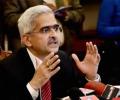
Amid prolonged uncertainty, continued policy support will be crucial for sustained economic recovery from the coronavirus pandemic, Reserve Bank Governor Shaktikanta Das said at the recent meeting of the Monetary Policy Committee. "In this period of prolonged uncertainty, it would be wise to remain agile and respond in a gradual, calibrated and well telegraphed manner to the emerging challenges," opined Das, according to the minutes of the MPC meeting released by the Reserve Bank on Thursday. Observing that economic recovery from the pandemic remains incomplete and uneven, he said, "continued support from various policies remains crucial for a sustained recovery." The governor said the renewed surge in international crude oil prices, however, requires close monitoring.
 © 2026 Rediff.com - Investor Information - Advertise with us - Disclaimer - Privacy Policy - Sitemap - Feedback - About us - Terms of use - Grievances