
The forthcoming Budget could think of maintaining public capital expenditure at 3 per cent so that domestic resources are available for private investments, points out N R Bhanumurthy.

Almost a decade after India shifted to a formal inflation-targeting regime under the Monetary Policy Committee (MPC) framework of the Reserve Bank of India (RBI), a high-level panel of economists said that the flexible inflation targeting has largely worked in keeping it under control and no major revamp is required.
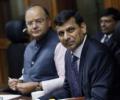
RBI Governor Raghuram Rajan has been pursuing hawkish monetary policy stance to keep inflation under check.
.jpg)
The truth is the government and the Reserve Bank enjoy a free, frank and cordial relationship.

Moody's Ratings on Tuesday said India has a lower overall exposure to the US relative to others in the APAC region, although certain sectors such as food, textiles and pharmaceutical products face risks. Moody's said most companies in its rated portfolio are domestic-focused with limited exposure to the US market.
The government on Tuesday appointed three external members -- Ram Singh, Saugata Bhattacharya and Nagesh Kumar -- to the RBI's rate-setting Monetary Policy Committee for four years. The central government has reconstituted the Monetary Policy Committee (MPC) of RBI, the finance ministry said in a statement. Ram Singh is the director of the Delhi School of Economics, Saugata Bhattacharya is an economist, and Nagesh Kumar is the director and Chief Executive, Institute for Studies in Industrial Development, New Delhi.

Manufacturing activities in India remained robust and price pressures were contained in October as new orders and production rose at a slower but stronger pace, according to a monthly survey released on Tuesday. The seasonally-adjusted S&P Global India Manufacturing Purchasing Managers' Index (PMI) was up from 55.1 in September to 55.3 in October. The October PMI data pointed to an improvement in overall operating conditions for the 16th straight month.

Crypto assets should not be granted official currency or legal tender status, the much-awaited synthesis paper by the International Monetary Fund (IMF) and Financial Stability Board (FSB) has said ahead of the G20 leadership summit under India's presidency. However, the report has argued against a blanket ban on activities linked to crypto assets, explaining that such a move can be costly as well as technically demanding to enforce. Central banks should avoid holding crypto assets in their official reserve as they pose a risk to monetary and global financial stability, according to the synthesis paper.

RBI Governor Raghuram Rajan had set up a committee to review the monetary policy framework.

Finance Minister Arun Jaitley on Saturday said that retail inflation is expected to remain close to 5 per cent

'To the believers of crypto regulations, I have only one question to ask, how will you regulate it?'

The Reserve Bank's rate setting panel on Thursday met to finalise a report for the government on why it failed to keep retail inflation below the target of 6 per cent for three consecutive quarters since January this year, said sources. The report will be presented to the government as per the Reserve Bank of India Act, they added. The six-member Monetary Policy Committee (MPC) is headed by Governor Shaktikanta Das.

RBI Governor Shaktikanta Das has assured Finance Minister Nirmala Sitharaman that the Rs 12.05-trillion gross borrowing programme for FY22 will go through smoothly.

The government on Monday ruled out making public the RBI report detailing the reasons why the central bank could not keep inflation within the targeted 6 per cent upper limit for the three consecutive quarters. "Yes sir, RBI has furnished a report to the central government, as mandated under Section 45ZN of the RBI Act, 1934 and Regulation 7 of RBI Monetary Policy Committee and Monetary Policy process Regulations, 2016," minister of state for finance Pankaj Chaudhary said in a written reply. The said provisions of the RBI Act, 1934, and regulations therein does not provide for making the report public, he said.

The final and most significant reset in the relations between the government and the RBI is the manner in which the process of appointing the governor and deputy governors of the central bank has been changed.
The central bank should be made responsible for delivering on an inflation target.
The Reserve Bank will hold a special meeting of its rate-setting committee on November 3 to prepare a report for the government on why it failed to keep retail inflation below the target of 6 per cent for three consecutive quarters since January. The six-member Monetary Policy Committee (MPC) headed by RBI Governor Shaktikanta Das will prepare the report on reasons for failure to meet the inflation target as well as the remedial measures the central bank is taking to bring down prices in the country. "Under the provisions of Section 45ZN of the Reserve Bank of India (RBI) Act 1934... an additional meeting of the MPC is being scheduled on November 3, 2022," RBI said in a statement on Thursday.

The RBI cut the rate several times last year to reduce it by 125 basis points to the current 6.75 percent.

Under the new Monetary Policy Framework, the central bank aims to contain inflation at 4 per cent with a band of (+/-) 2 per cent.

Government, RBI sign pact to target CPI at 4%.

The government had amended the RBI Act through Finance Act 2016.
Focus on inflation, higher CPI projection dampen bond market mood.
The committee set up under Urjit Patel to revise the policy framework needs to re-examine the Reserve Bank's approach to monetary stability.

Sahil Kapoor of Edelweiss Retail Capital Market Research says that setting up a monetary policy committee should have been the first step. And the central bank could have moved towards a formal inflation targeting mechanism after the processes and data sets are in place.

Will seek to bring inflation to the mid-point: Rajan

Referring to the proposed new monetary policy framework, it said in the weeks ahead, government and RBI will work towards it.

The ratings agency currently rates India at Baa3
The long-term answer lies in getting the central bank to focus on inflation.

DBS called Rajan's decision not to seek an extension as a 'negative surprise'.
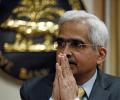
'Three external members of the first MPC are respected researchers with excellent academic background, but there is no harm in considering academicians with diverse backgrounds such as finance and labour along with economists for this body,' recommends Tamal Bandyopadhyay.

With the setting of MPC, the interest rate setting powers would move from RBI Governor to the panel.
.jpg)
Bank has cited trend of global easing and weak growth

Consumer prices rose an annual 5.11 per cent (2012 base) in January.

The panel was set up to suggest ways to reform India's monetary policy.

Inflation in food articles during June stood at 2.04 per cent, as against 1.13 per cent in May.

Interview with former Reserve Bank of India governor by Duvvuri Subbarao.

A three-year validity of an inflation target is, perhaps, more reasonable and practicable.

RBI's latest rate cut will bring down home, car loan's EMI.

Policy with regard to the foreign banks is part of his five pillars of reforms, says RBI Governor.
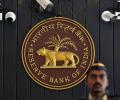
The Reserve Bank of India (RBI) is precariously balancing two opposing objectives - maintaining easy financial condition in the domestic market, while ensuring external stability - and economists have started taking note. They say India is going through the classic trilemma of the 'Impossible Trinity'. The RBI cannot have an independent monetary policy (setting domestic interest rates) in an environment of an open capital account and flexible exchange rates. What is even more complicated for the central bank now is that financial market stability overlays all the other three objectives.
 © 2026 Rediff.com - Investor Information - Advertise with us - Disclaimer - Privacy Policy - Sitemap - Feedback - About us - Terms of use - Grievances