
The Supreme Court of India has ruled that a gift (hiba) under Mohammedan Law is valid even without a written document, provided certain essential conditions are met.

A bench of Justice Vikas Bahl heard a habeas corpus petition of Javed (26), seeking custody of his 16-year-old wife who was kept at a children's home in Haryana's Panchkula.

When there is a conflict between the Prohibition of Child Marriage Act and the Mohammedan law that allows a Muslim girl to marry on attaining puberty at the age of 15, which will hold the field?

The court denied bail to a 31-year-old man charged under the Act for allegedly abducting and impregnating a 15-year old minor girl whom he claims he had married.

The Delhi high court has said that a girl, who has attained puberty, can marry without the consent of her parents under Muslim laws while hearing a plea seeking protection to a couple who got married against the consent of girl's parents.

A bench headed by Chief Justice DY Chandrachud said the submissions on the issue involve an interplay between constitutional rights on the one hand and special legislative enactments, including the Special Marriage Act, on the other.

Ruling that a Muslim girl can marry as per her choice at the age of 15 years if she has attained puberty, the Delhi high court has held the marriage of a minor girl valid and allowed her to stay in her matrimonial house.

The Supreme Court on Thursday fixed May 11 for commencement of hearing on pleas challenging the validity of triple talaq, 'nikah halala' and polygamy practices among Muslims.

Vice President Hamid Ansari's wife Salma Ansari has said that uttering 'talaq' thrice does not amount to divorce and asked Muslim women to read the Quran thoroughly instead of relying on clerics.
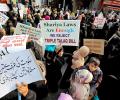
The application has been filed to oppose a batch of petitions on which the apex court had in 2018 issued notices to the Centre and other stakeholders while referring the matter to a 5-judge Constitution bench.

'Some of his decisions were not so good, but his intentions were always guided by a deep national interest.'

A five-judge Constitution bench headed by Chief Justice J Khehar will commence hearing on seven petitions
The board said that practices provided by Muslim Personal Law on the issues of marriage, divorce and maintenance were based on holy scripture Al-Quran and "courts cannot supplant its own interpretations over the text of scriptures".

A five-judge bench headed by Chief Justice J S Khehar said it would look into the aspect whether triple talaq is part of an "enforceable" fundamental right to practice religion by Muslims.
 © 2026 Rediff.com - Investor Information - Advertise with us - Disclaimer - Privacy Policy - Sitemap - Feedback - About us - Terms of use - Grievances