
Among the 30 Sensex firms, HCL Technologies, NTPC, Bajaj Finserv, Tech Mahindra, JSW Steel, Titan, Mahindra & Mahindra, Tata Steel, Larsen & Toubro and Tata Consultancy Services were the biggest gainers. Kotak Mahindra Bank, IndusInd Bank, Maruti and Hindustan Unilever were among the laggards.

From the 30 Sensex firms, Mahindra & Mahindra, JSW Steel, Maruti, Tata Steel, Larsen & Toubro, ICICI Bank, Power Grid, Nestle, Bharti Airtel and Adani Ports were the biggest gainers. Tata Consultancy Services emerged as the only laggard.

Among Sensex firms, Tata Consultancy Services, HCL Technologies, Tech Mahindra, Infosys, Mahindra & Mahindra and Tata Motors were the biggest gainers. UltraTech Cement, JSW Steel, Tata Steel, Adani Ports, Power Grid and Bajaj Finserv were among the laggards.

Equity investors will track the trading activity of foreign investors, global trends and ongoing earnings results for further cues, and benchmark indices may continue to witness consolidation in a holiday-shortened week amid the monthly derivatives expiry, analysts said. Markets fell sharply last week amid massive foreign capital outflows and dismal Q2 earnings so far. Weakness in the markets might continue in the near term amid cautiousness among investors ahead of the US presidential election early next month, an expert said.

Among the 30 Sensex firms, Bharti Airtel, Infosys, IndusInd Bank, Sun Pharma, Tech Mahindra, Mahindra & Mahindra, Bajaj Finance and JSW Steel were the biggest gainers. Asian Paints, Maruti, Nestle, Kotak Mahindra Bank, Axis Bank and UltraTech Cement were among the laggards.
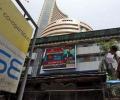
Shares of Tata Group companies on Thursday rose up to 10 per cent, with Tata Chemicals and Tata Teleservices among the major gainers. Tata Sons Chairman Emeritus Ratan Tata, who played a key role in transforming the group into a global conglomerate, passed away late on Wednesday. He was 86. "Investors can pay tribute to Ratan Tata and the great corporate empire he built by buying stocks like TCS, Tata Motors, Tata Steel, Tata Consumer and Indian Hotels.

'The economy is clearly at a very soft spot, and earnings growth is disappointing every day.' 'After three great years, the Indian economy has hit a rough patch.'

The rally in Indian mid-and smallcap indices thus far in calendar year 2024 (CY24) has been the best in class across the world, eclipsing the global FTSE benchmarks, and also out running peers from other leading world stock markets. This is despite the correction in the mid-and smallcap segments back home seen in the last few days, triggered by valuation concerns, geopolitical developments amid nervousness ahead of the July - September 2024 (Q2-FY25) corporate results season.

Benchmark Sensex hit the historic 83,000 level for the first time on Thursday and the Nifty settled at a lifetime high after a rally in blue-chip shares, surge in global markets and foreign fund inflows. A sharp fag-end rally drove the 30-share BSE Sensex to the 83,000 level for the first time. The barometer surged 1,593.03 points or 1.95 per cent to hit its lifetime intra-day peak of 83,116.19 in the last hour of trade.

Investors' wealth eroded by Rs 9.51 lakh crore on Monday morning, following a crash in equity markets where the benchmark Sensex tanked over 2,400 points, mirroring a sharp plunge in global peers. The 30-share BSE benchmark tanked 2,401.49 points to 78,580.46 in early trade. Following the sharp decline in equities, the market capitalisation of BSE-listed firms dropped by Rs 9,51,771.37 crore to Rs 4,47,65,174.76 crore ($5.35 trillion) during the morning trade.

The US Federal Reserve's interest rate decision is the biggest event that would drive sentiments in the domestic stock market this week, besides a host of macroeconomic data from the global front and trading activity of foreign investors, analysts said. The Indian equity market had an exceptional last week, with both the Nifty and Sensex hitting their all-time high levels on Thursday.

Foreign investors have adopted a cautious stance and infused Rs 7,320 crore in the Indian equities in August owing to high valuation of stocks and the unwinding of the Yen carry trade after Bank of Japan raised interest rates. This investment was way lower than Rs 32,365 crore in July and Rs 26,565 crore in June, according to data with the depositories. While September is likely to see continued interest from FPIs, the flows would be shaped by a combination of domestic political stability, economic indicators, global interest rate movements, market valuations, sectoral preferences, and the attractiveness of the debt market, Vipul Bhowar, Director Listed Investments, Waterfield Advisors, said.

Foreign investors have injected close to Rs 33,700 crore in domestic equities in this month so far primarily due to interest rate cut in the US and resilience of the Indian market. This also marks the second highest inflow in a month in this year so far, the last one being in March, when Foreign Portfolio Investors (FPIs) infused Rs 35,100 crore, data with the depositories showed. Going ahead, the trend of FPIs buying is likely to continue in the coming days, V K Vijayakumar, Chief Investment Strategist, Geojit Financial Services, said.
Among the 30 Sensex companies, Axis Bank, ICICI Bank, HDFC Bank, Tech Mahindra, Larsen & Toubro, Bajaj Finserv, State Bank of India, Reliance Industries and Infosys were the biggest gainers. Power Grid, Asian Paints, Tata Steel, Nestle, Maruti and JSW Steel were among the laggards.

'Invest only in stocks of those companies that deliver on earnings and there is earnings visibility too for the next few quarters.'

After two months of net outflow, foreign investors turned buyers in June, infusing Rs 26,565 crore in Indian equities, driven by political stability and a sharp rebound in markets. Looking ahead, attention will gradually shift towards the budget and Q1 FY25 earnings, which could determine the sustainability of FPI flows, Vipul Bhowar, Director, Listed Investments, Waterfield Advisors, said.

Among the 30 Sensex companies, Hindustan Unilever, Nestle, Asian Paints, HCL Technologies, HDFC Bank, Kotak Mahindra Bank and ITC were the biggest gainers. Larsen & Toubro, Power Grid, NTPC and State Bank of India were among the laggards.

The IPO market will be bustling next week, with four companies, including Bajaj Housing Finance, set to launch their initial share-sale to raise a total of Rs 8,390 crore. Besides these four main-board IPOs, nine SMEs are preparing to debut with their maiden public issues next week, targeting to collect Rs 254 crore. Together, these 13 firms are looking to raise Rs 8,644 crore through IPO.

The US Fed interest rate decision, domestic inflation data and global trends would be key driving factors in dictating movement in the market this week, as the Lok Sabha elections outcome and the RBI policy decision are behind us, analysts said. The past week was a roller-coaster ride for investors as markets swung sharply in both directions before closing with strong gains.

'The move to remove indexation benefits on LTCGs presently available for property, gold, and other unlisted assets may have a negative impact as it directly impacts real estate investors.'

The bias for the BSE benchmark index, technical charts suggest, is likely to remain bullish as long as the index holds above 75,600 levels for the rest of the year.

Trading in the equity market will largely depend on two major events this week - general elections result and the RBI interest rate decision - analysts said, adding that the benchmark indices may rally on Monday on exit polls' prediction of a massive win for the BJP-led NDA and strong GDP data. Exit polls on Saturday predicted that Prime Minister Narendra Modi will retain power for a third straight term, with the NDA expected to win a big majority in the polls. Counting of votes will take place on June 4.

Domestic institutional investors pumped Rs 2.3 trillion into equities during H1 CY24. Of this, mutual funds contributed 80%.

Among the 30 Sensex companies, Larsen & Toubro, Power Grid, NTPC, State Bank of India, Reliance Industries and HDFC Bank were the biggest laggards. Sun Pharma and Nestle were the only gainers.

Foreign Portfolio Investors (FPIs) continued their buying spree and poured close to Rs 4,800 crore in the Indian equity markets in the first week of January driven by confidence in the country's robust economic fundamentals. Additionally, they injected Rs 4,000 crore in the debt market during the period under review, data with the depositories showed. With expectations of a prolonged decline in US interest rates in 2024, there is an anticipation that FPIs will likely escalate their purchase, particularly in the initial months of the New Year leading up to the general elections, V K Vijayakumar, chief investment strategist at Geojit Financial Services, said.

Foreign investors made a significant turnaround and injected over Rs 1,500 crore into Indian equities in February, reversing the massive outflows seen in the preceding month, primarily due to robust corporate earnings and positive economic growth. Additionally, Foreign Portfolio Investors (FPIs) continued to be bullish on the debt markets as they put in over Rs 22,419 crore during the month under review, data with the depositories showed. Looking ahead to March, the outlook for FPI flow appears promising, provided the current economic trajectory and corporate performance sustain their positive momentum, potentially continuing to attract foreign investment into Indian equities, Mayank Mehraa, smallcase manager and principal partner at Craving Alpha, said.

'It is advisable to stay away from the markets for now and buy only on a dip.'

'Investors need to be stock specific and should not rush to buy stocks at the current levels.'

After pumping in close to $20 billion in the preceding five months, foreign portfolio investors (FPIs) have yanked out $220 million from domestic stocks this month. The selling by overseas funds has led to turbulence in the domestic markets, with benchmark indices swinging wildly recently.
Stock markets will be largely driven by global trends and macroeconomic data announcements in a holiday-shortened week which may see volatility amid monthly derivatives expiry, say analysts. Equity markets will remain closed on Monday for Gurunanak Jayanti. Trading activity of foreign investors and the movement of the rupee against the dollar will also be tracked by investors.

Stock markets will be largely driven by global trends in the absence of any major domestic triggers this week, say analysts. The trading activity of foreign investors, global crude oil prices and rupee-dollar movement will also influence market movement, they said. "Anticipating a period of consolidation in the absence of clear global cues, the market's trajectory will likely hinge on the movement of the US bond yields, the dollar index, and crude oil prices, as well as institutional flows.

Tracking losses in the broader market that has seen the Nifty Smallcap 250 index and the Nifty Midcap 100 indices slip 9 per cent 6.1 per cent in the last three sessions, the frontline Nifty 50 index has remained resilient and registered a fall of 2.2 per cent during this period. Going ahead, can the nervousness in the mid- and small-cap universe spread to the large-cap peers? Most analysts do not think so. They expect a minor dip and a sharp recovery as investors flock to the large-caps in search of safety and value buying as the mid-and small-caps falter.

Foreign Portfolio Investors (FPIs) selling spree continued as they dumped Indian equity worth over Rs 5,800 crore this month so far on rising interest rates and geopolitical tensions in the Middle East. This came after such investors withdrew Rs 24,548 crore in October and Rs 14,767 crore in September, data with the depositories showed. Before the outflow, FPIs were incessantly buying Indian equities in the last six months from March to August and brought in Rs 1.74 lakh crore during the period.
RBI's interest rate decision, macroeconomic data, global trends and trading activity of foreign investors are the crucial factors to drive equity markets in a holiday-shortened week ahead, analysts said. Markets would remain closed on Monday for Gandhi Jayanti. "While global cues will continue to dictate trends in local markets, focus will shift to RBI's monetary policy announcement on Friday. "Although the market is expecting a status quo on interest rates, global concerns like rising US dollar index and bond yields coupled with surging crude oil prices continue to weigh on investors' minds.

It has mostly been a one-way street for smallcap stocks that have taken it on their chin thus far in February. The Nifty Smallcap 250 index has shed 3.2 per cent in the current month as compared to the 1.8 per cent decline in the Nifty Midcap 100 and the 0.5 per cent drop in the Nifty 50 index, data showed. Technically, the index has slipped below its 20-day moving average (DMA) placed at 14,800 levels on Monday, and is currently testing the 50-DMA, and is placed at 14,278 levels.

Domestic equity markets, which are at record high levels, will be driven by quarterly earnings, global trends and foreign fund movement, analysts said. The movement of rupee and global oil benchmark Brent crude will also be tracked by investors. "The direction of global stock markets, fluctuations in the rupee-to-dollar exchange rate, and movement in crude oil prices will all play a crucial role in influencing the overall market trend.
Foreign Portfolio Investors' (FPIs) selling spree continues as they pulled out over Rs 3,400 crore from the Indian equity markets in the first three trading sessions of November on rising interest rates and geopolitical tensions in the Middle East. This came after such investors withdrew Rs 24,548 crore in October and Rs 14,767 crore in September, data with the depositories showed. Before the outflow, FPIs were incessantly buying Indian equities in the last six months from March to August and brought in Rs 1.74 lakh crore during the period.

From the Sensex pack, Bajaj Finance, Tata Motors, Asian Paints, Power Grid, NTPC, Infosys, Nestle, Reliance Industries and UltraTech Cement were the biggest laggards. Larsen & Toubro, Tata Steel, HDFC, Bharti Airtel, HDFC Bank and Mahindra & Mahindra were among the major gainers.

Nearly 90 per cent of the stocks comprising the National Stock Exchange Nifty 500 Index and 49 of the 50 stocks that make up the Nifty50 are trading above their respective 200-day moving averages (DMAs). The 200-DMA is considered one of the most relevant trend indicators by investors and traders. They believe that stocks and indices trading above this key level exhibit strength and are likely to rally, while those trading below this level are viewed as bearish, with the stock/index expected to see a selloff.

Foreign Portfolio Investors (FPIs) have pulled out over Rs 10,000 crore from Indian equities in the first three weeks of September, primarily due to rising US interest rates, recessionary fears, and overvalued domestic stocks. Before the outflow, FPIs were incessantly buying Indian equities in the last six months from March to August and brought in Rs 1.74 lakh crore during the period. Mayank Mehra, smallcase, manager and principal partner at Craving Alpha,believes that strong economic growth prospects, attractive valuations, and government reforms could support foreign investment flows in the next month.
 © 2026 Rediff.com - Investor Information - Advertise with us - Disclaimer - Privacy Policy - Sitemap - Feedback - About us - Terms of use - Grievances