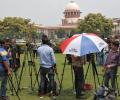
The Supreme Court on Monday refused to extend the security of former special judge S K Yadav who had pronounced the verdict in the Babri Masjid demolition case and acquitted all 32 accused, including Bharatiya Janata Party veterans L K Advani, M M Joshi and Uma Bharti.

Fourteen-year-old Aarushi was found dead inside her room in the Talwars' Noida residence with her throat slit in May 2008.
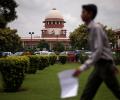
The new judges of the top court include Justice B V Nagarathna, who will be in line to be the first woman Chief Justice of India (CJI) in September 2027, Justice Bela M Trivedi, Justice Hima Kohli, Justice C T Ravikumar, Justice M M Sundresh, and senior advocate and former Additional Solicitor General P S Narasimha.

In an unprecedented decision, the Supreme Court Collegium has recommended the names of three women judges for appointment in the apex court which, if cleared, would give the country its first woman Chief Justice of India (CJI) in the form of Justice B V Nagarathna on February 10, 2027.

The case was registered by the Ahmedabad Crime Branch on a complaint accusing Setalvad and Anand of "fraudulently" securing grants of Rs 1.4 crore from the union government through their NGO Sabrang Trust between 2008 and 2013.

Vedanta had sought handing over of the plant for three months saying it requires two months to start the unit and the company should be allowed to run it for four weeks to ascertain whether its polluting or not. The interim plea by Vedanta was opposed by Tamil Nadu government which claimed before a bench headed by Justice R F Nariman that the plant had been 'polluting consistently'.

Chief Justice of India N V Ramana on Wednesday termed as "very unfortunate" certain "speculations and reports" in the media about the collegium meeting regarding the appointment of judges in the Supreme Court.

The plant had been kept shut in violation of the order of the NGT and a subsequent interim order of the top court.

While recusing himself from hearing the matter, Justice Ramana said Rao is from his home state and he had attended the wedding ceremony of Rao's daughter.

'A precedent in the Rajv killers' plea for freedom may flow from slain brigand Veerappan's 2000 demand for the release of 109 associates languishing in prisons in Karnataka for him to release abducted Kannada matinee icon, the late Rajkumar.' 'Acting on a petition filed by the father of a Karnataka cadre IPS officer killed by Veerappan, the Supreme Court reversed the orders of lower court orders in Tamil Nadu and Karnataka.' 'If democratically-elected governments give an impression to the citizens of this country of being law-breakers, would it not breed contempt for the law? Would it not invite citizens to become a law unto themselves?' the Supreme Court had observed on the occasion, recalls N Sathiya Moorthy.
 © 2026 Rediff.com - Investor Information - Advertise with us - Disclaimer - Privacy Policy - Sitemap - Feedback - About us - Terms of use - Grievances