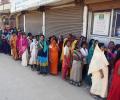
Meghalaya has shown significant progress in digital transactions and financial inclusion, recording 32.76 crore digital transactions and nearly 10 lakh Jan Dhan accounts by 2025-26. Efforts like the JAM Trinity and financial literacy programmes have expanded banking access, with a high percentage of bank account holders adopting digital modes. The next phase focuses on enhancing financial literacy and cyber resilience, especially in rural areas.

Underlining that students are the "architects of India's future," President Droupadi Murmu on Friday said the government is taking comprehensive steps to reform public examinations to completely curb paper leaks and unfair means, making the system transparent, secure, and trustworthy.

Under the scheme, which seeks to open 75 million accounts by January 26, 2015, an accident insurance cover of Rs 100,000 is provided with every RuPay debit card offered by the National Payments Corporation of India.

An accident insurance cover of Rs 1 lakh is also given to all individuals who open a bank account under the Jan-Dhan Yojana.

The government is giving adequate publicity to the benefit to be extended to account holders, sources added.
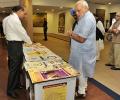
During a video conference with the executive directors of both private and public sector banks, the banks were directed by the government to open at least one account for an adult member of every household.

In her address to the nation on the eve of the country's 80th Independence Day, the president stressed that just as government and society remain united to ensure national security, everyone must contribute through joint and concerted efforts to safeguard the present and future of students.

"The PMJDY has been the foundation stone for the Modi government's people-centric economic initiatives. "Whether it is direct benefit transfers, Covid-19 financial assistance, PM-KISAN, increased wages under MGNREGA, life and health insurance cover, the first step was to provide every adult with a bank account, which PMJDY has nearly completed," Nirmala Sitharaman said on the sixth anniversary of the scheme.
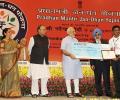
Against National Democratic Alliance's 75 million target, United Progressive Alliance added 61 million in 2013-14.

The problem is set to grow following issuance of 75 million new RuPay cards in the next six months with the launch of the Jan Dhan Yojana.

Bill & Melinda Gates Foundation (BMGF) has offered to help in monitoring of the progress made with regard to Pradhan Mantri Jan Dhan Yojana (PMJDY), the flagship financial inclusion scheme of the government.
Based on the credit history banks may later decide to extend the amount.
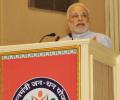
The Finance Minister said government's target was not villages only but cover every household of every village under the PMJDY.
There were concerns that simply opening a bank account wouldn't constitute meaningful financial inclusion, as the poor would rarely use these accounts. However, recent data submitted to Parliament attests to increased account usage, says Ishan Bakshi.
The first stage of the inclusion strategy was focussed on opening bank accounts, logically seen as creating the last-mile channels for financial access.

The Jan-Dhan accounts are zero balance accounts, comes with a life cover of Rs 30,000 per person, and an accidental cover of Rs 100,000. An active user of the account can also get overdraft facility of Rs 5,000 from banks.

Prime Minister Narendra Modi has accused opposition parties of obstructing the passage of the women's reservation bill in Parliament, alleging they have crushed the dreams of women and prioritised selfish politics over national progress.

In addition to the problem of long queues at automated teller machines, there would be the problem of guiding new cardholders, especially in rural and semi-urban areas, on how to use those cards, some bankers told Business Standard.

In a world fractured by uncertainty, India stands out for its policy consistency, paired with sustained ambition, points out Pritam Banerjee.

The government plans a mega launch of the Pradhan Mantri Jan Dhan Yojana (PMJDY) by Prime Minister Narendra Modi on August 28, which is likely to see opening of one crore bank accounts on the first day itself.

State-owned banks have received guidance from the government to close Jan Dhan accounts whose beneficiaries are unwilling to keep them active, amid rising instances of such accounts being misused by fraudsters as mule accounts to defraud people, people aware of the development said.

The next generation GST reforms would 'absolutely' set an economy open and transparent with further reduction in compliance burden and benefiting small businesses, Union Finance Minister Nirmala Sitharaman said on Tuesday.

CPGRAMS -- an online platform available to citizens 24x7 to lodge their grievances to public authorities on service delivery -- has existed for close to two decades. But it has never been this active, points out Tamal Bandyopadhyay.
'Self-declaration from the customer in case of no change in KYC information or change only in the address details may be obtained.'

The Reserve Bank of India (RBI) brass, including its Governor Sanjay Malhotra, on Tuesday told a Parliamentary panel that it was "optimistic" about the impact of the US tariffs on the Indian economy and, in long-run, it could benefit the country due to dipping trade relations between the US and China.
Concerned over the rise in mis-selling of products by banks and non-banking financial companies (NBFCs), the Reserve Bank of India (RBI) is examining whether to come up with norms to curb such practices. Observing that pushing financial products, such as insurance, indiscriminately to unaware consumers may be detrimental to their well-being, RBI Deputy Governor M Rajeshwar Rao said, "We are examining whether it necessitates framing of guidelines to address mis-selling of financial products and services by REs (regulated entities)."
Finance Minister Nirmala Sitharaman on Wednesday said the National Rural Livelihood Mission has achieved remarkable success by mobilising rural women into 1 lakh SHGs (self help groups).

With rising disposable incomes in cities beyond metros, the penetration of credit cards - and consequently, credit card spending - is growing at a much faster pace than in traditional metro cities, primarily driven by e-commerce spending.

Replying to a question about women empowerment, Sitharaman insisted that patriarchy is a concept invented by the Left.

While a giant, it's a nimble-footed one, and is growing at a speed that even some of its private sector peers find enviable.
Between FY18 and FY24, it doubled its balance sheet. Despite being a late entrant in some segments, it has been able to grab market share, observes Tamal Bandyopadhyay.
The Union Finance Ministry on Tuesday said that aggregate business of public sector banks (PSBs) has shown strong growth of 11 per cent in the first half of the financial year 2024-25 (H1FY25) to touch Rs 236 trillion. The operating and net profit were also robust. At Rs 1.5 trillion, operating profit grew by 14.4 per cent year-on-year (Y-o-Y) while the net profit saw an impressive 25.6 per cent jump at Rs 85,520 crore in the first half of FY25.
The two states account for 24% of total accounts opened under financial inclusion scheme.
Inaugurating the Grameen Bharat Mahotsav, the Prime Minister exuded confidence that villages will play a key role in pushing forward the dream of Viksit Bharat by 2047.

Will allowing business correspondents to hawk insurance products help in reviving 5-lakh strong field agents as a viable channel?
Pradhan Mantri Jan Dhan Yojana scheme will help in bringing the benefits of formal banking system to even the poorest of poor.
The RBI Governor had earlier cautioned the banks on the risks involved in just hunting for numbers, asking them not to compromise on core objectives of the programme.
The announcement comes on the first anniversary of the project.

Addressing a G20 Summit session, Modi also presented his '5-I' vision to maximise digital technology for social benefit.

'Today, let us reaffirm our commitment to strive to realise Gandhiji's dreams. His watchwords, truth and nonviolence, will continue to remain relevant for the whole world. He also taught us that rights and duties are but the two sides of the coin - indeed, the true source of rights is duty. Today we recall his lessons in compassion too - compassion not only for our human neighbours but also for our other neighbours, namely, flora and fauna, rivers and mountains.'

More than 50 per cent of SIP accounts come from semi-urban and rural areas.
