The issue had cropped up when a three-judge bench headed by Chief Justice Dipak Misra was hearing the batch of appeals filed against the Allahabad high court's 2010 verdict by which the disputed land on the Ram Janmabhoomi-Babri Masjid area was divided in three parts.

By pegging the exact area of the Babri Masjid site at 0.313 acres, and not the original 2.77 acres, the government hopes to be in line with the court ruling in the 1994 Ismail Faruqui case which mentions return of land to original claimants once the exact area needed for acquisition is determined, observes Saisuresh Sivaswamy.

The court said that King Ashoka had given several messages to the world which are engraved in rock edicts which shows reverence towards faith of others.
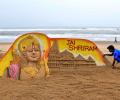
The following is the chronology of events related to the Ram Janmabhoomi-Babri Masjid land dispute in which, after the Supreme Court verdict, Prime Minister Narendra Modi on Wednesday conducted the 'Bhoomi Pujan' or ground breaking ceremony and laid the foundation stone for the temple's construction.

Here is a timeline of the second-lengthiest case in the apex court history:

The apex court said the parties in the matter should be ready to start the hearing on the appeals which are before it.

Senior advocate Rajeev Dhavan, representing the Muslim parties in the case, tore up a pictorial map.
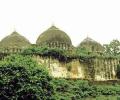
The petitioners seeking reconsideration by a larger bench, the observations made by it in a 1994 verdict that a mosque was not integral to Islam.
In a fresh plea on Tuesday, the Centre said it had acquired 67 acres of land including the 2.77 acre disputed Ram Janambhoomi-Babri Masjid site and sought permission of the top court to return the excess land to its original owners.
Senior advocate Rajeev Dhavan told the bench that Justice Lalit appeared for former UP CM Kalyan Singh in 1994.

Justice Ranjan Gogoi, who will demit office as the Chief Justice of India in a week's time, has etched his name in the annals of history by giving finality to one of the most politically and religiously sensitive cases, the Ayodhya land dispute, which dates back to even before the Supreme Court came into existence in 1950.
 © 2026 Rediff.com - Investor Information - Advertise with us - Disclaimer - Privacy Policy - Sitemap - Feedback - About us - Terms of use - Grievances