
India's gross domestic savings rate increased from 29.8 per cent in 2003-04 to 30.7 per cent in 2007-08, said union Foreign Minister Pranab Mukherjee, who is holding additional charge of the finance portfolio while presenting the Interim Budget for 2009-10 on Monday in parliament.
The CRPF bagged the lion's share -- Rs 1,698 crore. It got Rs 7,208.18 crore this year against Rs 5,510.10 crore in 2008-09. The BSF, entrusted the task of keeping vigil along the LoC in Jammu and Kashmir and the country's 6,622 km borders with Pakistan, Bangladesh and Myanmar, got Rs 1,156.23 crore more compared to last year's Rs 5,376.99 crore. The elite commando force NSG, which played a sterling role in Mumbai terror attacks, has got Rs 44.63 crore more.
The government expects the expenses on tours of ministers and former Prime Ministers in the current fiscal to be Rs 3 lakh less than the total budget allocation, but still this would be more than Rs 160 crore (Rs 1.6 billion).
Borrowings will account for 29 paise of every rupee the government will earn in FY'10 and it would spend 20 paise towards servicing debt, as it battles dwindling tax resources on account of economic slowdown.
The gross domestic savings rate increased from 29.8 per cent in 2003-04 to 30.7 per cent in 2007-08. The tax to GDP ratio increased from 9.2 per cent 2003-04 to 4.5 per cent 2007-08, Pranab Mukherjee said.
However, he disappointed big time by not announcing any relief in taxes or change in the tax structure to bring relief to the common man.

The total direct tax collection stands at a little over Rs 9 trillion, giving the taxman just few days to reach the 2018-19 revised target of Rs 12 trillion., reports Shrimi Choudhary.

Total burden on the exchequer will increase by Rs 12,000 crore to Rs 87,217.50 crore for the year 2019-20.
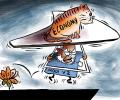
'There are deliberations on whether there can be lowering of income taxes and other sops to keep more money in the hands of taxpayers, enabling them to spend more and boost demand.'

If the BJP comes to power, sources say it may change the financial year (April-March) to the calendar year (January-December).
Prime Minister Manmohan Singh in his Independence Day address in 2007 had announced setting up of 6,000 new high quality schools, one in every block of the country. The education sector as a whole received Rs 41,978.21 crore as against Rs 37,366.57 crore (Rs 373.66 billion) in the revised estimate of 2008-09 budget, showing a jump of Rs 4,611.64 crore (Rs 46.11 billion).

The government of India had budgeted to bring down fiscal deficit to 4.8 per cent of GDP in the current financial year, from 4.9 per cent in 2012-13.

Almost all infrastructure ministries continued spending on capex throughout the lockdown, even as the Centre tried to maintain some semblance of economic normalcy.

This is Jaitley's first overseas visit since his kidney ailment was confirmed in April last year.

CBDT has been given a collection target of Rs 5.69 trillion in personal income tax in the fiscal year 2019-20 - 19.2 per cent more than the Rs 4.77-crore collection in the previous year.
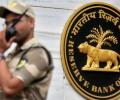
A high-level panel led by former RBI governor Bimal Jalan, set up to decide the appropriate capital reserves that the central bank should maintain, on Wednesday finalised its report.

In the Sensex pack, Axis Bank, Tata Motors, Infosys, Kotak Bank, HDFC Bank, RIL, Bajaj Auto, SBI, HUL, Tata Steel, Vedanta, HFDC, TCS, ITC and Sun Pharma jumped up to 4.64 per cent.

It was 55.3 per cent for the same period last year, and data shows the fiscal deficit for April-May was kept in reasonable check in spite of heavy frontloading of expenditure.
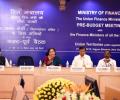
Sitharaman exhorted the states to work together with the Centre, stating that while the Union government sets the direction of economic growth, it is for the states to ensure effective implementation on the ground.

Mumbai collected Rs 17,174 crore of advance taxes against Rs 7,356 crore in the same period last year. The tax authorities believe that such a staggering growth rate is a positive sign for the economy.

Foreign brokerage Goldman Sachs on Monday said it expects new Finance Minister Arun Jaitley to peg the fiscal deficit target for FY15 at 4.3 per cent, up from the 4.1 per cent stated by his predecessor P Chidambaram.

From Dabur to HUL, here are 10 stocks with significant rural exposure in the auto, agri-chemical and fast moving consumer goods sectors, which should see an uptick in sales growth.

A K Bhattacharya lists three reasons why Finance Minister Arun Jaitley will most likely present a full Budget on February 1, 2019.
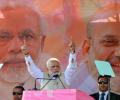
'The finance minister has told the BJP's core voters we are hearing you and we are sensitive to your aspirations.'

The Opposition accused the government of bringing a populist budget.
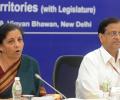
Subhash Chandra Garg, the former finance secretary who was shunted out of the finance ministry within three weeks of Modi-2.0 government's first budget last year, on Saturday alleged that new Finance Minister Nirmala Sitharaman got him transferred out.

Sectorally, metal and banking stocks rallied the most, while FMCG and realty stocks came under selling pressure.
Among the Sensex pack, Yes Bank, L&T, HDFC, RIL, HDFC Bank, PowerGrid and Coal India were the biggest losers -- falling up to 2.43 per cent.
Buoyed by the proposed public offerings in six companies, including Oil and Natural Gas Corp and Gas Authority of India Ltd, the government on Tuesday set an ambitious target of mobilising Rs 16,000 crore
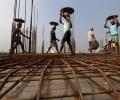
The review will not only present data, trends but also list out the achievements of the Narendra Modi government
Union Railway Minister Lalu Prasad Yadav presented the Railway Budget for 2004-2005 in the Lok Sabha on Tuesday (July 6, 2004).

The reduced growth is largely because of consumption slowdown and tax rate cuts.
In line with the relief package for tea growers announced in the Interim Budget, Commerce Minister Arun Jaitley on Friday sought a three-point package including two per cent reduction in interest rate on Special Coffee Term Loans.
