
Begin the year-end review by assessing whether your portfolios are on track to achieve your life goals.

The Centre is unlikely to offer new direct tax incentives for units operating in special economic zones (SEZs) and may instead allow the grandfathering of previous exemptions that such units were entitled to, according to proposed amendments to the SEZ Act, 2005, people aware of the matter said. The amendments, proposed by the commerce department, will soon be considered by the Cabinet for approval. This represents a departure from the department's earlier plan to introduce these changes through the Development Enterprises and Services Hubs (DESH) Bill, 2023, which faced strong criticism from the ministry of finance.

Boom, bust or a bit of both: as the jury bides time before ruling on the US 'recession', the economy's vital signs at a perplexing time of high-interest rates, still-punishing inflation, and surprisingly strong economic gains are a study of a growing debate over whether the world's largest economy is barrelling into a new downturn. With the US Federal Reserve's (Fed's) inflation fighters attempting the risky pursuit of 'pillow-soft landings' and its economy sending out mixed signals, if there is indeed a recession, it could spell trouble for domestic equities and corporate earnings growth.

Diesel sales in India fell 3 per cent in September as a receding monsoon continued to dampen demand and slowed industrial activity in some parts of the country, preliminary data of state-owned firms showed. While diesel sales by three state-owned fuel retailers fell year-on-year, petrol sales rose in September. Consumption of diesel, the most consumed fuel in the country -- accounting for about two-fifths of the demand, fell to 5.81 million tonnes in September from 5.99 million tonnes demand in the same period a year ago.

The annual decline works out to be 16.3 per cent in 2022-23 compared to inflows in 2021-22. The gross FDI inflows in 2021-22 were $81.97 billion, up 10 per cent over fiscal 2019-20. The previous year-on-year contraction in FDI was in 2012-13 when the inflows declined by 26 per cent to $34.298 billion.

Interrupting a two-month streak of decline, outward foreign direct investment (FDI) rose sequentially to $1.85 billion in July over $1.07 billion in June, an increase of 73 per cent. However, it was lower than the $2.18 billion in July last year, according to the Reserve Bank of India data. Outbound FDI, expressed as financial commitment, has three components - equity, loans, and guarantees.

Deteriorating ties between India and Canada could have a bearing on flows into the domestic capital markets. At present, Canada is the seventh largest country for foreign portfolio investor (FPI) flows into India. According to the National Securities Depository Ltd (NSDL), the assets under custody (AUC) of FPIs domiciled in Canada stood at nearly Rs 1.8 trillion ($21 billion) at the end of August. Almost 85 per cent of these investments are in listed equity, while the remaining in debt and hybrid instruments.

India's corporate sector, including public sector enterprises (PSEs), continues to go slow on investments and capital expenditure (capex). According to data from Motilal Oswal Financial Services (MOFSL), corporate investments declined for the second consecutive quarter in the April-June period (first quarter, or Q1) of 2023-24 (FY24). After a contraction of 0.5 per cent year-on-year (Y-o-Y) in the 2022-23 (FY23) January-March quarter, corporate investments likely fell 6.2 per cent Y-o-Y in Q1FY24, write Nikhil Gupta and Tanisha Ladhaa of MOFSL in their recent report on corporate investments.

'Focus on 19,400/64,900 as the key resistance levels for the Nifty/Sensex.'

More Indians renounced their citizenship and took citizenship in other countries in 2022 than ever before, according to data. Answering multiple questions in Parliament - the last on March 31 this year - Minister of State for External Affairs V Muraleedharan told the Lok Sabha that more than 200,000 Indians gave up Indian citizenship in 2022. The question was asked by Congress Members of Parliament Kodikunnil Suresh and M K Raghavan, and All India Majlis-e-Ittehadul Muslimeen chief Asaduddin Owaisi.

'We are calling companies to set up assembly plants for mobile phones while all the components are imported.' 'Only the last turn of the screwdriver is done here. And you call it self-reliance, Atmanirbharta, etc.' 'Unless you invest in research, you will not climb up the ladder. But this government is happy getting sub-contract work.'
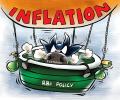
"We have to stand in readiness to go beyond keeping Arjuna's eye to deploying policy instruments, if necessary" to contain inflation, said Reserve Bank Governor Shaktikanta Das on Thursday. Headline consumer price index-based inflation projection for the second quarter of 2023-24 has been revised up substantially, primarily due to the price shock from vegetables, at 6.2 per cent by the RBI form 5.2 per cent estimated in June. Unveiling the bi-monthly monetary policy, Governor Das said the moderation in headline inflation to 4.6 per cent in the first quarter of 2023-24 was in line with the projections set out in the June MPC meeting.

'When manufacturing or even services cannot generate the kind of employment they are looking for, they prefer to be unemployed rather than under-employed.'

'We are expected to grow at above 28 per cent this year, higher than the industry.'
The Reserve Bank on Friday retained its inflation projection for current fiscal year at 6.7 per cent amid global geopolitical developments triggered by Russia-Ukraine war. RBI Governor Shaktikanta Das said the impact of inflation globally is weighing heavily on the domestic market. For September quarter of 2022-23, RBI projected retail inflation at 7.1 per cent.

Economic growth, which we are taking for granted, slows for a completely different set of local or global factors and the Modi premium vanishes, observes Debashis Basu.

The move comes barely a week after fellow crypto unicorn CoinDCX laid off 12 per cent of its workforce - an estimated 80 employees - amid challenging macroeconomic conditions and regulatory uncertainty in the sector. CoinSwitch has 519 employees, according to its LinkedIn profile. This means around 8 per cent of its workforce were shown the door.

If you spread your investments and get exposure to many asset classes, then that is called diversification. Asset allocation is the process of allocating your money to different investments. And they offer tremendous advantages, says Rishi Piparaiya.

The banking system's liquidity slipped into deficit for the first time in the current financial year (2023-24) due to the imposition of the Incremental Cash Reserve Ratio (I-CRR) for banks and outflows from goods and services tax (GST) payments, according to dealers. Reserve Bank of India (RBI) data shows it injected Rs 23,644 crore on August 21. The last time liquidity was in deficit was on March 27, when the RBI injected Rs 45,575 crore.

Is it a good idea to give Rs 1 crore to someone who promises you a return of 24% per annum, wonders financial advisor P V Subramanyam.

In a move that will benefit a significantly large number of Indian technology professionals, the US is set to begin a pilot programme for domestic renewal of certain categories of H-1B visas in December. The H-1B visa is a non-immigrant visa that allows US companies to employ foreign workers in speciality occupations that require theoretical or technical expertise. Technology companies depend on it to hire tens of thousands of employees each year from countries like India and China.

Fund houses are exploring ways to differentiate themselves in the hybrid space. A relatively unknown hybrid fund variant, Balanced Hybrid, is about to see its first launch since the introduction of mutual fund (MF) scheme categorisation norms in 2017. WhiteOak Capital MF has filed papers with the regulator for this scheme, which comes amid increasing interest in the hybrid space. MFs anticipate that hybrids will become the preferred category for investors with a lower risk appetite following changes in debt fund taxation.

Private equity and venture capital funds' investment in the country continued to fall in May, with the overall values declining by nearly 44 per cent to $3.5 billion, a report said on Monday. The dedicated funds had invested $6.2 billion in May 2022 and $7.4 billion in the preceding month of April 2023, representing a dip of 44 per cent and 52 per cent, respectively, as per the report by industry lobby IVCA and consultancy firm EY. "Despite a recovery of sorts being seen in tech sector indices and some of the large global tech names, sentiment in India for tech sector investments has been lacklustre, and fundraising by Indian startups has been sluggish," the firm's partner Vivek Soni said.

rediffGURU Ulhas Joshi recommends five factors you need to look at to evaluate the performance of two schemes.

The average cost of a data breach in India reached Rs 17.9 crore in 2023, according to the IBM Security report that classified it as an "all-time high" for the report and almost a 28 per cent increase since 2020. The most common attack type in India was phishing (almost 22 per cent), followed by stolen or compromised credentials (16 per cent). Social engineering was the costliest root cause of breaches at Rs 19.1 crore, followed by malicious insider threats, which amounted to nearly Rs 18.8 crore.

Days after JP Morgan announced the inclusion of government bonds in its emerging market (EM) bond index, a host of banks and other financial institutions (FIs) are set to tap the debt market. They plan to raise Rs 18,000 crore by issuing non-convertible debentures (NCDs) and bonds. National Bank for Agriculture and Rural Development (Nabard) plans to raise up to Rs 3,000 crore via five-year social impact bonds on Tuesday, the first of its kind in India.

Fintech companies believe that the impact of Reserve Bank of India's order last week on unsecured loans will be visible in six to 12 months and prompt them to diversify and strengthen their secured portfolio. Fintechs which source funds through banks or non-banking finance companies (NBFCs) are looking at quickly building their secured portfolio options to at least 40 per cent of their total portfolio. "Over the medium to long term, as part of our product strategy, we are evaluating secured products which can be enabled over a digital platform" said Yogi Sadana, the founder of Zype, a lending-focussed fintech.

Domestic quarterly earnings, global trends and foreign fund trading activity would dictate the movement in equity markets, which may face volatility amid the scheduled monthly derivatives expiry this week, analysts said. Equity markets took a breather last week. The BSE Sensex declined 298.22 points or 0.48 per cent and the Nifty dipped 111.4 points or 0.60 per cent.

After pulling out $17 billion in calendar year 2022, foreign portfolio investors (FPIs) have pumped $7.3 billion back into equity markets so far this year. The turnaround in foreign flows has helped domestic markets exceed the all-time highs chalked up in December 2022 and bounced back more than 10 per cent from this year's lows. However, a big nugget of FPI inflows seen this year could be off the back of two factors: exchange-traded funds (ETFs) and block deals.

Funding winter and corporate governance woes separated the men from the boys in the country's startup space in 2023 that saw funds into the segment tapering to just around $8 billion. All said, investors are hopeful of strong growth of the maturing startup ecosystem in the new year. Edtech and health tech segments that grew exponentially during the pandemic plunged into an abyss of financial uncertainties, with several firms shuttering their business, and valuation of prominent players like BYJU'S and PharmEasy plummeting 85-90 per cent.

SEBI has published data showing that more than 90 per cent of investors lose money in futures and options, explains Harsh Roongta.

Corporate India is busy restructuring - through mergers, demergers and splits. That seems to be the new normal as CXOs and boards brainstorm on how to create assets and value. The pitch rose significantly during the third quarter of this financial year (FY24), translating into $32.9-billion worth of such deals - the highest quarterly total since the HDFC Bank-HDFC merger announced in FY22 Q2.

While managing their finances, individuals can make it a rule to seek advice from an expert or feedback from a trusted colleague or friend.

The International Monetary Fund (IMF) warned on Tuesday that India's general government debt (comprising both central and state government debt) could exceed 100 per cent of gross domestic product (GDP) in the medium term. It also cautioned that long-term debt sustainability risks are high due to the significant investment required to meet India's climate change mitigation targets. The Indian government, however, disagreed, arguing that risks from sovereign debt are extremely limited as it is predominantly denominated in domestic currency.

Only the top 5 per cent profit makers account for 75 per cent of profits.

When billionaire Warren Buffet started his first fund in 1956 with eleven investors, he invested a token amount of $100 of his own money as "skin in the game". Buffet denies it but he is credited with coming up with the term describing those running a fund risk some of their own money in it. The mutual fund (MF) industry has more than Rs 81,200 crore riding on its schemes, shows a Business Standard analysis of data on sponsor and associate contributions from the Association of Mutual Funds in India (Amfi).

Smaller stocks have emerged as Dalal Street's favourites in 2023 that has turned out to be a "great year" for equities, rewarding investors with big gains, driven by optimism over the country's macroeconomic fundamentals and heavy retail investors participation. Experts said equity markets are experiencing a prolonged bull run and it is during this time that the midcap and smallcap segments tend to outshine their larger counterparts. Till December 22 this year, the BSE smallcap gauge has jumped 13,074.96 points or 45.20 per cent while the midcap index has surged 10,568.18 points or 41.74 per cent.

India's trade ties with Israel have only strengthened in the years after 2019. The total value of trade rose to $10.5 billion on a rolling four-quarter basis in June 2023 from $5.5 billion in the same month in 2019, shows a Business Standard analysis of data from the Centre for Monitoring Indian Economy (CMIE). A rolling four-quarter number provides a comparable figure across different time periods.

The central government's fiscal deficit touched 67.8 per cent of the full-year target at the end of January due to higher expenses and lower revenue realisations, according to official data released on Tuesday. In actual terms, the fiscal deficit or gap between the expenditure and revenue collection during April-January period stood at Rs 11.9 lakh crore, as per the data from the Controller General of Accounts (CGA). The fiscal deficit in the comparable period of 2021-22 was 58.9 per cent of that year's Revised Estimate (RE) in the Budget.

GST collections rose 28 per cent to Rs 1.49 lakh crore on an annual basis in July on the back of economic recovery and measures taken to curb tax evasion, the government said on Monday. In July, 2021, Goods and Services Tax (GST) collections stood at Rs 116,393 crore. The collections in July this year is the second highest since the introduction of GST in July 2017, the ministry said in a statement.
 © 2026 Rediff.com - Investor Information - Advertise with us - Disclaimer - Privacy Policy - Sitemap - Feedback - About us - Terms of use - Grievances