
The government has revised gold import data, bringing down numbers for November by $5 billion to $9.84 billion, possibly to rectify double accounting of inbound shipments. According to revised data of the commerce ministry arm Directorate General of Commercial Intelligence and Statistics (DGCIS), gold import numbers have been slashed since April 2024, revealing excess imports of about $11.7 billion during the first eight months of 2024-25.

Labour Minister Mansukh Mandaviya urges state government 'to intervene for an early and amicable resolution for maintaining a positive manufacturing sector ecosystem'.

India has reduced the time period for foreign investors to seek international arbitration from five years to three years as part of the recently signed investment pact with the United Arab Emirates (UAE), a departure from its model Bilateral Investment Treaty (BIT). Under the Investor-State Dispute Settlement (ISDS) mechanism, if the Indian judicial system is unable to resolve a dispute within this shortened period, investors can resort to international arbitration. The investment pact, signed on February 13 in Abu Dhabi, came into force on August 31, replacing the previous pact.

As the Union government explores ways to restrict import of laptops and other electronic devices starting with a 5 per cent reduction from the current level, it is working to ensure that there's no supply disruption in India even if an import cap is introduced, it is learnt. The caveat assumes significance in the context of the government's announcement of its plan in August 2023 to issue licences for import of select IT hardware products to reduce the country's dependence on China.

Gold imports more than doubled in August to a record high of $10.06 billion, mainly on account of a drastic cut in customs duty and ongoing festive demand, according to the Commerce Ministry data. Gold imports stood at $4.93 billion in August 2023. On record high imports, Commerce Secretary Sunil Barthwal said that the tariff rates on gold have been reduced drastically so that smuggling and other activities can come down.

India stares at the risk of an influx of Chinese products as US tariffs on a range of Chinese goods, including solar panels, electric vehicles, lithium-ion batteries, syringes, and steel, are set to take effect from September 27. With higher tariffs reducing China's access to the US market, there is concern that China may divert its exports to other markets, including India, which could lead to potential dumping of goods. This situation could challenge Indian industries, particularly in sectors where competition with Chinese products is already fierce.

The escalation of conflict in the West Asian region is expected to push already high logistics costs besides hurting trade in sectors such as oil, electronics and agriculture, according to exporters. They said that insurance costs for exports to the countries directly involved in the war could also go up, which will impact Indian exporters' working capital. Think tank Global Trade Research Initiative (GTRI) stated that the conflict is already hurting India's trade with countries like Israel, Jordan, and Lebanon.

With Donald Trump all set to become US president, Indian exporters may face high customs duties for goods like automobiles, textiles and pharmaceuticals if the new US administration decides to pursue the 'America First' agenda, opined trade experts. Experts also said that Trump could also tighten H-1B visa rules, impacting costs and growth for Indian IT firms. Over 80 per cent of India's IT export earnings come from the US, making it vulnerable to changes in visa policies.

The steep cut in Customs duty on silver in the FY25 Budget to 6 per cent from 15 per cent may provide the government temporary relief by checking the spurt in silver imports from the United Arab Emirates (UAE) under the Comprehensive Economic Partnership Agreement (CEPA). In FY24, silver imports from the UAE jumped to $1.7 billion from only $11.18 million in FY23, according to commerce department data. In May, about 87 per cent of India's silver imports came from Dubai.

With the new government taking charge in Britain, senior officials of India and the UK will hold the next round of talks this month for the proposed free trade agreement to resolve the pending issues and close the negotiations, an official said. The India-UK talks for the proposed free trade agreement (FTA) began in January 2022. The 14th round of talks stalled as the two nations stepped into their general election cycles.

Countries that raised concerns about the quality of Indian spices have called for urgent attention and action, Delhi-based think tank Global Trade Research Initiative (GTRI) said on Wednesday. The stakes are high since India exported spices worth about $692.5 million to the United States (US), Hong Kong, Singapore, Australia and Maldives in the financial year 2023-24 (FY24), it said. During FY24, India's spice exports were worth $4.25 billion, accounting for a 12 per cent share of the global spice exports.

Domestic exporters on Monday expressed concerns over the crisis in Bangladesh and said the developments in the neighbouring country would have implications on bilateral trade. However, exporters expect that the situation may normalise soon. According to exporters, they are already facing disruptions in exports to Bangladesh due to a shortage of foreign exchange in that country.
The government is formulating guidelines on the use of ethylene oxide (ETO) in samples of spices for the domestic market and exports, people aware of the matter said, as it plans to step up efforts to make quality checks more stringent. ETO, a flammable, colourless gas, is typically used as a disinfectant. It is also used as a sterilising agent and an insecticide to reduce microbial contamination in spices. However, its use is considered carcinogenic, beyond permissible limits.

India's gain will be an additional business of $300 million to $400 million per month if 10-11% of Bangladesh's export is diverted to Indian hubs like Tiruppur.

India's gold and silver imports from its free trade agreement (FTA) partner UAE have skyrocketed 210 per cent to $10.7 billion in 2023-24 and there is a need to potentially revise the concessional customs duty rates under the pact to mitigate the arbitrage driving this surge, a report said on Monday. Economic think tank Global Trade Research Initiative (GTRI) said this sharp rise in gold and silver imports is primarily driven by import duty concessions granted by India to the UAE under the India-UAE Comprehensive Economic Partnership Agreement (CEPA).

India should become a middle-income country and then push to make INR (rupee) a hard currency, and till then, it must promote the settlement of global trade in the local currency, think tank GTRI said on Sunday. Global Trade Research Initiative (GTRI) said that transforming a currency into a hard currency is a complex process that hinges on several pivotal factors. Firstly, economic stability is paramount; a country must exhibit low and stable inflation, consistent growth, and a balanced trade environment.

Top government officials in New Delhi have started discussions with stakeholders ranging from shipping and container companies to export promotion councils to understand the impact of the Iran-Israel tensions and plan ahead. Inter-ministerial talks are also being lined up amid the crisis situation in West Asia, sources confirmed. While the crude flows are not directly under any threat, elevated oil prices remain a concern, according to officials.

Domestic customers will get access to high-quality Swiss products such as watches, chocolates, biscuits, and clocks at lower prices as India will phase out customs duties under its trade pact with the EFTA bloc on these goods over a period of time. India and the four-European nation bloc EFTA signed a trade and economic partnership agreement (TEPA) on Sunday to boost trade and investments between the two regions. The European Free Trade Association (EFTA) members are Iceland, Liechtenstein, Norway, and Switzerland.

Domestic customers will get access to high-quality Swiss products such as watches, chocolates, biscuits, and clocks at lower prices as India will phase out customs duties under its trade pact with the EFTA bloc on these goods over a period of time. India and the four-European nation bloc EFTA signed a trade and economic partnership agreement (TEPA) on Sunday to boost trade and investments between the two regions. The European Free Trade Association (EFTA) members are Iceland, Liechtenstein, Norway, and Switzerland.

The government on Thursday imposed import restrictions on laptops, tablets, all-in-one personal computers, ultra small form factor computers, and servers with immediate effect. The Directorate General of Foreign Trade (DGFT) in a notification said exemption from import licensing is provided up to 20 items per consignment for R&D, testing, benchmarking and evaluation, repair and return and product development purposes.
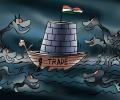
The talks for a free trade agreement (FTA) between India and Canada may have taken a pause but will resume once the political row between the two countries is resolved as the pact has economic benefits for both the nations, trade experts and exporters said on Friday. However, they said that India may not hurry for the trade agreement as 60 per cent of New Delhi's exports are already entering Canada at zero duty. Earlier this month, India and Canada paused the negotiations for the agreement due to political reasons.
Indian exporters shipping goods to Israel may face higher insurance premiums and shipping costs due to the Israel-Hamas conflict, according to experts. Israel witnessed a surprise and unprecedented multifront attack by air, land and sea by the Hamas militant group, which rules the Gaza Strip, in its southern parts on Saturday morning. The International trade experts said the conflict may reduce the profits of domestic exporters but will not impact trade volumes unless war escalates.

India's trade ties with Israel have only strengthened in the years after 2019. The total value of trade rose to $10.5 billion on a rolling four-quarter basis in June 2023 from $5.5 billion in the same month in 2019, shows a Business Standard analysis of data from the Centre for Monitoring Indian Economy (CMIE). A rolling four-quarter number provides a comparable figure across different time periods.

Centre mulls strategy to ensure powers given to the agencies are not misused.

A healthy growth in India's services segments has helped the country's total exports and imports of goods and services to cross the $800 billion mark during the first half of 2023, despite a slowdown in global demand, think tank GTRI said in a report on Monday. According to the analysis of the Global Trade Research Initiative (GTRI), exports of goods and services rose by 1.5 per cent to $385.4 billion during January-June this year, as against $379.5 billion in January-June 2022. Imports, however, dipped by 5.9 per cent to $415.5 billion during the six months of this year, as against $441.7 billion in January-June 2022.

Six years after the rollout of the biggest indirect tax reform in India, Goods and Services Tax (GST) revenue of Rs 1.5 lakh crore every month has become a new normal and tax officers are focusing on dealing with fraudsters who are adopting newer modus operandi to game the system, causing loss to the exchequer. To apprehend black sheep, who operate as syndicates and create fake entities on the basis of forged documents to claim input tax credit (ITC), tax officers have started using data analytics, artifical intelligence and machine learning aiming to curb evasion, which was over Rs 3 lakh crore since inception of GST. It was over Rs 1 lakh crore in 2022-23. Thinktank Global Trade Research Initiative (GTRI) said the most critical pending GST reform is upgradation of GST Network to prevent fake supplies and fraudulent claims of Input Tax Credit (ITC).
Countries negotiating free trade agreements (FTAs) need to keep in mind eight "myths" which surround these pacts, like they lead to accelerated increase in exports and promote domestic manufacturing, according to a report by think-tank GTRI. The report by Global Trade Research Initiative (GTRI) claims to dispel these 'myths', including that FTAs weaken the WTO (World Trade Organisation), countries are rushing to do FTAs, and these pacts promote investment and lower prices. It is "erroneously" believed that most world trade happens through the FTA route, but in reality, it is less than 20 per cent, said the report titled 'FTAs: Fabulous, Futile, or Flawed?'.
 © 2026 Rediff.com - Investor Information - Advertise with us - Disclaimer - Privacy Policy - Sitemap - Feedback - About us - Terms of use - Grievances