
More than half (56 per cent) of chief economists expect the global economy to weaken in 2024, with most saying the pace of geo-economic fragmentation will accelerate, according to the latest "Chief Economists Outlook" released on Monday at the World Economic Forum (WEF). The report indicates that the global economic prospects remain subdued and uncertain. Challenges include tight financial conditions, geopolitical rifts, and the rapid development of generative artificial intelligence (AI).

The ministry of finance is likely to assume crude oil price to remain within $85 per barrel while estimating subsidies for the Interim Budget 2024-25 (FY25), to be presented on February 1. Brent crude prices moved up on Thursday, ending at $78.9 per barrel. Crude oil and cooking gas prices, which move in tandem, impact fertiliser and cooking gas subsidies, constituting 53 per cent of the government's total subsidies.

India's exports contracted by 22 per cent, the steepest decline in the last three years, to $32.97 billion in June on account of global demand slowdown, especially in the Western markets like the US and Europe. According to the data of the commerce ministry, the trade deficit in June stood at $20.3 billion against $22.07 billion in the same month last year due to a fall in exports and imports. The inbound shipments during the month under review declined by a steep 17.48 per cent to $53.10 billion.

Growth in India is expected to slow to 6.3 per cent in FY 2023/24 (April-March), a 0.3 percentage point downward revision from January, the World Bank said Tuesday but noted there is an unexpected resilience in private consumption and investment and robust growth in the services. The World Bank made these points in its latest edition of Global Economic Prospects according to which global growth is projected to decelerate from 3.1 per cent in 2022 to 2.1 per cent in 2023. In Emerging Markets and Developing Economies (EMDEs) other than China, growth is set to slow to 2.9 per cent this year from 4.1 per cent last year. These forecasts reflect broad-based downgrades.

The World Bank has retained India's economic growth forecast for the current fiscal at 8.3 per cent as the recovery is yet to become broad-based. As per the first advanced estimates of the national income released by the National Statistical Office (NSO) last week, the economy is projected to grow at 9.2 per cent in 2021-22, surpassing pre-COVID level in actual terms, mainly on account of improved performance, especially in farm, mining and manufacturing sectors. "India's economy is expected to expand by 8.3 per cent in fiscal year 2021/22 (ending March 2022), unchanged from last June's forecast as the recovery is yet to become broad-based.
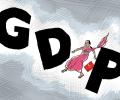
India's economy continues to be robust, but downside risks such as rising crude oil prices, adverse weather conditions, and the global banking crisis outweigh the upside potential in gross domestic product (GDP) growth in the current financial year (FY24), the finance ministry said on Tuesday in its Monthly Economic Review for March. "We reiterate that downside risks to our official forecast of 6.5 per cent for real GDP growth in FY24 dominate upside risks," the review said. "Opec's surprise production cut has seen oil prices rise in April, off their lows of low-seventies per barrel in March.
'Limited spillovers' to Asia's third-largest economy, even as world 'perilously close' to recession.
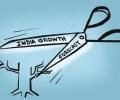
The International Monetary Fund (IMF), in its latest World Economic Outlook report, has slashed its forecast for India's FY23 gross domestic product growth to 8.2 per cent from 9 per cent, saying that higher commodity prices will weigh on private consumption and investment. This was one of the steepest cuts for emerging economies compared to the IMF's January WEO forecasts. Saying that global economic prospects have worsened significantly due to commodity price volatility and disruption of supply chains caused by the war in Europe, IMF cut its global growth outlook for calendar year 2022 to 3.6 per cent from 4.4 per cent, and said both Russia and Ukraine could experience large GDP contractions.

The sweeping economic sanctions on Russia - the second largest producer of crude oil - following its invasion of Ukraine late last month can cull global and domestic growth along with the added pains of higher inflation and currency depreciation, RBI Deputy Governor Michael Patra has said. And if the war lingers on, it can even lead to deglobalisation and even a recession, he added. The ongoing war has only added a whole new dimension to the outlook, and in fact, a weighty downside, Patra said in a lecture at the industry lobby IMC on Friday evening.

In its latest report, the Bank has lowered its forecasts for developing countries, now eying growth at 4.8 per cent this year, down from its January estimate of 5.3 per cent.
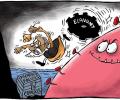
India's economy is estimated to contract by 9.6 per cent in the fiscal year 2020-21, reflecting a sharp drop in household spending and private investment, and the growth is expected to recover to 5.4 per cent in 2021, the World Bank said on Tuesday. In its Global Economic Prospects report, the World Bank said that the informal sector, which accounts for four-fifths of employment, has been subject to severe income losses during the COVID-19 pandemic.

International Monetary Fund Chief Economist Gita Gopinath tells Indivjal Dhasmana high-frequency indicators for the third quarter of 2021 indicate momentum in economic recovery in India.
Although risks from advanced economies have eased and growth is firming, despite ongoing contraction in the Euro Area, the pick-up in developing countries will be modest because of capacity constraints in several middle income countries.

Developing countries need to focus on raising the growth potential of their economies, while strengthening buffers to deal with risks from the euro area and fiscal policy in the US, the Bank said in its latest report Global Economic Prospects, which was released on Tuesday.
The World Bank on Thursday forecast a 6.7 per cent growth rate for India by next fiscal as exports and private investment are projected to strengthen and provide a boost to growth.
The multilateral agency had earlier projected that the world economy would expand by 3.6 per cent this year.
By 2015, it expects, the growth rate of China would be 7.9 per cent and that of India 7 per cent.

However, the Indian economy is expected to bounce back in 2021, the World Bank said.
While growth in India and China is likely to remain robust, the rest of the world risks falling back into recession if developed countries embark prematurely on fiscal austerity measures, says a United Nations report, released in New York on Thursday.
India will be among the fastest-growing countries in the world in the next two years.
The multilateral lending agency said India's growth would ease to 8.2 per cent this financial year (2011-12) against 8.5 per cent a year ago, as high inflation had cut into disposable income and hence demand.
Elaborating on the reasons behind the expected slowdown in the country's economic growth, the multilateral lending agency said it 'stems from a moderation in domestic demand, as elevated inflationary pressures have cut into disposable incomes and household spending'.

The World Bank on Tuesday projected India's economy to grow at 8.3 per cent in 2021 and 7.5 per cent in 2022, even as its recovery is being hampered by an unprecedented second wave of the COVID-19, the largest outbreak in the world since the beginning of the deadly pandemic. The Washington-based global lender, in its latest issue of Global Economic Prospects released here, noted that in India, an enormous second COVID-19 wave is undermining the sharper-than-expected rebound in activity seen during the second half of Fiscal Year 2020/21, especially in services.

The World Bank has pegged Indian economic growth to take over Chinese by 2012 on purchasing power parity (PPP) basis, but New Delhi has played down the projection by the multi-lateral agency saying the country is not in race with anyone.

The global economy in 2011 and 2012 is shifting into a phase of slower but solid growth, with India and China contributing towards almost half of the global growth, says the World Banks latest Global Economic Prospects 2011 report.
The government should use interest rates for more than administrative measures to handle economic growth in the long term.

This comes at a time when the global recovery remains fragile and is expected to slow later this year as the impact of the fiscal stimulus measures wanes.
The warning being issued by many respected economists to governments across the world has been as follows: do not declare victory too soon since the path ahead is a very long one.
The problems of financial markets have started affecting the real economy worldwide. Consensus estimates suggest that 2009 will be worse than 2008.
The multilateral lender, in its recently released report 'Global Economic Prospects for 2009', said a quarter of India's population will be living in extreme poverty, on less than $1.25 a day, in 2015. According to the World Bank's poverty forecast, China had 60.2 per cent of its population living on less than $1.25 a day in 1990, compared to India's 51.3 per cent.

In its report 'Global Economic Prospects 2010' the World Bank has said: 'Global GDP, which declined by 2.2 per cent in 2009, is expected to grow 2.7 per cent this year and 3.2 per cent in 2011'.
Indians working abroad sent a whopping $21.7 billion to their kin in 2004, making the country the highest recipient of remittances worldwide
With this India will continue to retain the position of being the fastest growing emerging economy. And by 2021, its growth rate is projected to be 1.5 per cent more than China's 6 per cent.
World Bank on Wednesday asked developed countries to work out a "trade deal" including removal of trade barriers to accelerate growth in the developing nations.
The World Bank has sounded a note of caution on the global economy, which it says has reached a turning point with a slowdown that has already begun.
Growth in the region is expected to average 4.6 per cent for the year, a downward revision from the "Global Economic Prospects 2002" forecast of 5.3 per cent GDP growth.

Export sectors that showed positive growth last month included chemical, iron ore, electronics, marine products and pharmaceuticals. Decline in overall imports, including oil and gold, led to narrowing of trade deficit.
According to data released by the commerce and industry ministry, exports stood at $25.01 billion in the month. The fall is only the second time exports contracted in the past year.

India's GDP is estimated to contract by a record 7.7 per cent during 2020-21 as the COVID-19 pandemic severely hit the key manufacturing and services segments, as per government projections released on Thursday. Amid overall decline in economic activities, some respite was provided by the agriculture sector and utility services like power and gas supply, which have been projected to post positive growth during the current fiscal ending March 2021.
 © 2026 Rediff.com - Investor Information - Advertise with us - Disclaimer - Privacy Policy - Sitemap - Feedback - About us - Terms of use - Grievances