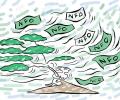
Asset management companies launched 239 new fund offerings (NFOs) mobilising Rs 1.18 lakh crore in 2024, with sectoral or thematic equity funds emerging as the top choice of investors, according to a report by Germinate Investor Services Research. This was higher than 212 NFOs collecting Rs 63,854 crore in 2023 and 228 NFOs garnering Rs 62,187 crore in 2022.

Investing is not just about setting aside money -- it's about making it work for you, says Ramalingam Kalirajan.

Goldman Sachs expects gold to reach $3,150 per ounce in the international market by December 2025, up around 19.1 per cent from its current level of $2,645, according to a recent report in Business Standard. Domestically, gold is trading at Rs 76,018 per 10 grams after delivering a remarkable 21.9 per cent return in the past year.

Zomato on Monday became the first new-age company to join the prestigious 30-share benchmark Sensex, replacing JSW Steel. This milestone marks a significant achievement not only for Zomato but also for the Indian startup ecosystem, which is increasingly making its presence felt in the $5.2 trillion listed ecosystem.

Investors should view the increase in the LTCG tax rate in conjunction with the increase in capital gains exemption from Rs 1 lakh to Rs 1.25 lakh, which will provide some relief.

Most investors should have a 5% to 10% allocation to gold for diversification. They should stagger their investments to mitigate timing risk.

ETFs (Exchange Traded Funds), have already become extremely popular investment vehicles in developed markets, though back home they are yet to make any tangible headway.

ETFs may be an option if you are considering only large-cap funds, experts tell Tinesh Bhasin.

Telangana Minister J Krishna Rao told reporters that the chances of survival under the circumstances are "not that good."

Lord Ganesha's teachings offer valuable insights for investors in the Indian stock market. By thinking big, working consistently, starting early, and approaching investing with a rational mindset, investors can increase their chances of achieving their financial goals.
Funds collected by the mutual fund will be invested in gold and hence the net asset value of the ETF will be largely dependent upon price of gold minus the administrative costs of the AMC and the mutual fund.

Investing in ETFs is similar to buying and selling shares on exchanges through your trading account, points out Ashwani Bhatia, MD and CEO, SBI Mutual Fund.

If one compares returns, the two public-sector ETFs have done better over the past year, but the ELSS category has done better over the trailing three and five years.

An ETF is an investment fund traded on stock exchanges, much like stocks. An ETF holds assets such as stocks, commodities or bonds.

Experts attributed the inflows to sudden rally in gold prices, mainly due to uneasy trade negotiations between the US and China and lower than expected global GDP growth.

New investors should gradually build a 5 to 10 per cent allocation to gold.

After a stellar 2023, the mutual fund industry sustained its growth momentum in 2024 with an impressive Rs 17 lakh crore surge in assets, driven by buoyant equity markets, robust economic growth, and increasing investor participation. Experts are predicting the positive trend will extend into 2025.

'It's advisable not to go overboard on a banking sector fund or any other sector fund.'

Even as net flows into smallcap funds in March turned negative, for the first time in 30 months, they remained a big draw for new investors. The smallcap fund category saw a net of 360,000 investment accounts, or folios, getting added last month, the second-most among all active equity categories. Smallcap funds' continued traction could be driven by their strong performance across timeframes, say experts.

The inflows meant assets under management of gold ETFs climbed by over 4 per cent to Rs 13,503 crore at the end of August from Rs 12,941 crore at July-end.

Indian retail investors continue to sell gold ETFs.

One risk of investing in a very low-cost ETF is if a fund house runs it at below cost, it could close it if it fails to attract institutional money
Commodity ETFs (exchange traded funds) attempt to track the price of a single commodity, such as gold or oil, or a basket of commodities by holding the actual commodity in storage, or by purchasing futures contracts.

'A 20 per cent equity allocation to ESG funds is a good start.' 'As more evidence on ESG performance builds, investors may increase allocations.'

Given that the ETF has given exceptional returns over the past year, start small and buy more in a staggered manner.

'In phases when smaller stocks do well, an equal-weight index performs better than its market cap-weighted peer.'

The exchange traded fund (ETF), the most exciting investment in the market, is capable of giving sweeping returns.

With just four trading sessions to go for the ITC-ITC Hotels demerger record date shares of ITC continue to consolidate in a thin range of Rs 460 - Rs 480 in an otherwise volatile equity market. On Tuesday thus far despite a near 1 per cent fall in the Sensex and Nifty; ITC traded on a flat note. ITC had set the demerger ratio at 1:10 - meaning 1 share of ITC Hotels for every 10 shares of ITC as of the record date January 6, 2025.

EPFO had started investing ETFs in August last year.

HDFC Bank's latest shareholding data showed that the room for foreign investment has fallen just 5 basis points short of the threshold set by Morgan Stanley Capital International (MSCI) to fully include the stock in its indices. Currently, the index provider has applied an adjustment factor of 0.5 since the foreign room is less than 25 per cent. Removal of the adjustment factor will result in inflows of a massive $4.8 billion (Rs 40,000 crore) into HDFC Bank, according to Brian Freitas, a New Zealand-based analyst with Periscope Analytics.

Do a proper asset allocation and invest through systematic investment plans where one can benefit.

'As we navigate uncertain waters, a conservative approach to largecap investing could provide a strategic advantage.'
In their short history, Gold ETFs have been quite successful in capturing investors' fancy. It must be noted that while ETFs as investment avenues may not be very popular among investors, it is the Gold ETFs segment wherein the interest is palpable. The fact remains that Gold ETFs are like any other investment avenues and have their fair share of pros and cons. This in turn highlights the need for investors to properly evaluate the Gold ETF option.

Are you debating between buying physical gold and investing in paper gold schemes or ETFs? Anil Rego has the answer

Asset managers are betting big on ETFs these days.

The eighth Budget of Finance Minister Nirmala Sitharaman continued to focus on 'GYAN' (Garib, Youth, Annadata, Nari) to maintain a consistent and coherent strategy initiated over the years in pursuing the government's vision for Viksit Bharat. The approach, characterised by incremental yet impactful steps, aims to create a compounding effect over time.
Though gold ETFs are traded on stock exchanges, they are taxed at a higher rate.
"We are now looking at a new fund under the gold category, which will enable small investors to subscribe to the units from the offices of UTI, without even having a demat account," said sources at UTI Mutual Fund. "With the equity markets rising by almost 30 per cent between mid-March and April, investors are no longer interested in gold ETFs. Also most Indians prefer holding physical gold, rather than gold ETFs," said a broker.

While the minimum holding period for LTCG taxation has now been lowered, the tax outgo could be a bit higher under the new structure.

Investors may take a 5 to 10 per cent exposure to silver. 'Have a long-term investment horizon when investing in silver ETFs to ride out short-term market fluctuations.'
 © 2026 Rediff.com - Advertise with us - Disclaimer - Privacy Policy - Sitemap - Feedback - About us - Terms of use - Grievances