
The rating agency expects that key fiscal indicators of state governments -- revenue deficit and gross fiscal deficit - may deteriorate from 2009 though the impact will begin to be felt in the current fiscal. It further said that the adverse effect of lower revenue growth will be aggravated due to higher development and non-development expenditures.

The cost of a representative home-cooked vegetarian thali has witnessed a 5 per cent on-year increase in January, while that of the non-veg thali declined 13 per cent, a report said on Wednesday. According to Crisil Market Intelligence and Analytics (MI&A) Research 'Rice Roti Rate' estimates, the rise in prices of ingredients like pulses, rice, onion and tomato made home-cooked veg thali costlier in January, while decline in poultry rates helped in the fall in non-veg thali rates.
Rating agency Crisil on Friday said growth rates witnessed in the current fiscal in several sectors are expected to continue for 3-5 years, even as it predicted rising wages in the information technology sector by 2007-08.
Inflation based on wholesale price index rose to 11.91 per cent during the first week of July and the Crisil chief said that she expects average inflation of 8.5 per cent with moderation during the fourth quarter of the current financial year. But she was optimistic on investment saying, "We have not seen a sharp scale back in investments. Companies are going ahead with their plans."
In a new report, the agency said the gross non-performing assets for the sector will rise to around 4 per cent on an asset size of over Rs 5,50,000 crore by March 2009, as against 2.7 per cent at the end of March 31, 2007. The rise in bad debt will translate into more losses for lenders.

Closely watched by the world for any escalation, the Iran-Israel conflict is already showing early signs of stress for India Inc - longer deliveries, doubling freight rates, extended working capital cycles, and higher costs. For those yet to feel the heat, there is growing apprehension and nervousness over future developments, observed industry executives.

Retail inflation eased to an 11-month low of 4.83 per cent in April as prices of some kitchen items declined though overall food basket firmed up marginally, according to a government data released on Monday. The Consumer Price Index (CPI)-based retail inflation was 4.85 per cent in March. It was 4.7 per cent in April 2023.
Despite an impressive performance in 2003-04, CRISIL on Thursday forecast a slowdown in the growth of the country's gross domestic product at 6.2 per cent for 2004-05 as against the estimated 8.5 per cent in FY'04.

IT services firms' revenue growth in the fourth quarter will be affected by macro-driven headwinds, lower working-days, and the fact of the three-month period being low season. Analysts are expecting FY24 growth to be muted. Revenue growth will decline 600-700 basis points to 10-12 per cent for FY24, said a CRISIL Ratings report. The 10-12 per cent growth rate is a fall from the 18-20 per cent expected in FY23 and around 19 per cent growth in FY22, the highest in eight years, said the CRISIL Ratings report.

India Inc, which had been battered by downgrades, would continue to see rating downgrades, although their severity and intensity might decline, said rating agency CRISIL.

Higher growth in vegetable demand relative to supply in the recent past has led to an upward trend in inflation, with spikes becoming more frequent. A study by rating agency Crisil found that vegetable inflation has been the most volatile in the food category, in fact. Inflation volatility is detrimental for both consumers and farmers and also sidetracks policymakers in the short term, necessitating frequent and repeated price-smoothing measures.

Adani Power, part of the Adani group, plans to add close to 6 gigawatts (Gw) of new power assets in the next five years, according to an investor presentation by the company. That is clearly meant to ride on India's burgeoning power demand. But there is another side to it: All of this new capacity is expected to be thermal power, or power produced from coal.

During 2023, the Indian real estate sector - both housing and commercial - witnessed buoyancy fuelled by demand, supply, and absorption, and the sector is banking on the upcoming Budget to keep the momentum going. Mumbai-based Sattva Group wants the government to focus on the critical pillars for long-term growth. The company emphasised on the infrastructure boom with increased allocation, lower goods and services tax (GST) rates, incentives for affordable housing and single-window clearance to fast-track projects and support liquidity.

Indian banks would require additional Rs 8 lakh crore to meet the minimum capital adequacy under Basel III norms, ratings agency Crisil has said.

Domestic commercial vehicle sales volume is expected to grow 9-11 per cent in FY24 driven by medium and heavy commercial vehicles and an estimated economic growth of around 6 per cent, rating agency CRISIL said on Monday. Besides, an increased allocation to infrastructure spending in the Union Budget for next fiscal year will support demand, it said. This would be the third consecutive year of growth in the domestic CV industry, according to CRISIL.
Crisil Ltd on Tuesday said the Centre's sops to Food Corporation of India including cut in interest rate on bank loans to FCI by 1.5%, will negatively impact the bottom line of public sector banks pulling down pretax-profit by 4.5% in the near term.
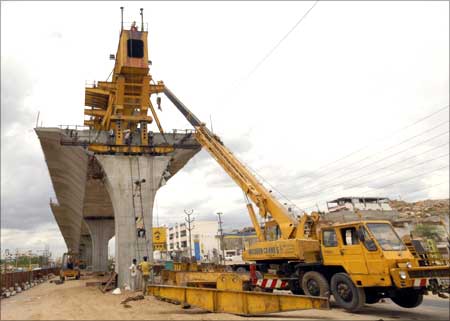
26 out of 80 operational projects are in no position to service debt.

Fiscal deficit, the gap between government's expenditure and revenue, stood at 4.5 per cent in FY14, lower than 4.9 per cent in FY13.

On the fiscal deficit front, its president for research flagged concerns over the revenue collections from the taxation front and also about the government not being able to achieve its Rs 40,000-crore (Rs 400-billion) divestment target.

According to the report, export-oriented sectors like IT services, pharmaceuticals and textiles will, in aggregate, report EBITDA margin expansion of nearly 100 bps, while margin is likely to decline by about 50 bps for other sectors during this period.

Megha Engineering and Infrastructure, the little-known Hyderabad-based firm that in recent years won the prestigious Zojila tunnel deal among other projects, forayed into city gas and acquired a media group, was the second largest donor to political parties using electoral bonds.

According to the study spanning 11 key sectors, aggregate industrial investments would continue to grow despite the current economic slowdown amid expectations of a relatively muted GDP growth. The study stated that aggregate industrial investments would grow at a moderate pace over the next three years, with total investments projected at Rs 10,50,000 crore.
Strong demand in the domestic market, coupled with an increase in raw material prices, is pushing up steel prices. According to SteelMint, a market intelligence and price reporting firm, the list price of flat steel has seen an increase of Rs 750-2,000 per tonne for October deliveries. The long steel price witnessed an increase of Rs 1,500 per tonne towards the end of September.

The Centre recently released the first advance estimates of kharif crops that, barring tur dal, showed a dip in production due to uneven monsoon and other natural calamities including pest attacks in cotton. The first Advance Estimates, released a few weeks back, are usually initial projections on the crop size and, more often than not, are revised as more inputs come from the fields. But, the findings have rung alarm bells in several quarters. The Centre, along with many others, is confident that as more details come, the estimates will be revised upwards.

Rekha Jhunjhunwala's net worth has increased by more than 7 per cent, or Rs 2,865 crore, compared to less than 1 per cent rise in the BSE Sensex.

Any government support or incentive to help exporters deal with high freight and insurance costs is unlikely.

FMPs remain an option for investors who believe interest rates could head downward over time and wish to lock in the current rates. TMFs have very low expense ratios, which makes them cost-efficient.

The Interim Budget for 2024-25 (FY25) to be presented on February 1 is likely to assume 10-10.5 per cent nominal gross domestic product (GDP) growth against 8.9 per cent estimated for FY24 by the National Statistical Office (NSO). "We were waiting for the First Advance Estimates GDP numbers for FY24. "We will finalise the nominal GDP growth assumption for FY25 Interim Budget in a couple of days.
McGraw-Hill and S&P India on Monday revised upwards their offer price by about 14 per cent to Rs 775 per share to acquire up to 65.57 per cent stake in credit rating agency Crisil.\n\n

Tyre stocks have been on a tear over the past six months, with average returns exceeding 45 per cent. Except for Apollo Tyres, which has seen a slight correction in the last month and a half, limiting its gains to 16 per cent, listed peers such as MRF, CEAT Tyres (formerly Cavi Elettrici e Affini Torino), and JK Tyre & Industries have delivered returns exceeding 30 per cent during this period. Production-related constraints and sluggish demand in Europe, where sales are expected to remain flat, coupled with high valuations, have contributed to Apollo Tyres' underperformance. The tyre sector's gains can be attributed to robust growth trends driven by the replacement market, which constitutes more than two-thirds of sales.
Economy is slated to grow by 7.1 per cent this fiscal after the excellent monsoon although fiscal deficit may overshoot the target, credit rating agency Crisil said on Monday.

Investments worth more than Rs 80 trillion are expected in roads, railways and urban infrastructure between now and FY30 and the supply chains helping to build this core infrastructure are also readying to cash in on the growth. In the first half of the current financial year, orders worth more than Rs 2.6 trillion were tendered in the roads and railways segment alone, according to data sourced from ICRA Ratings and Research. "India's transportation infrastructure sector is in high gear, and we enjoy a sizable share of it," said S V Desai, whole time director and senior executive vice president (Civil Infrastructure) for Larsen & Toubro.

The 13th Finance Commission had last year set a capital expenditure-to-GDP target of 4.5 per cent by FY15.

The March quarter (Q4) of the ongoing financial year (FY23) may see cement companies report better financial numbers as input costs ease, pricing action resumes, and cement demand remains firm. While companies have been cautiously optimistic about their outlook, analysts and sector experts remain bullish. In its latest report on the cement sector, brokerage IDBI Capital said that it expected earnings before interest, tax, depreciation, and amortisation (Ebitda) per tonne for cement companies to improve by Rs 200-300 sequentially in Q4.

A prolonged break in monsoon rains in most parts of the country is threatening to hit the yield of kharif crops. It could even delay the upcoming rabi sowing. Major agricultural states, such as Maharashtra, Madhya Pradesh, Andhra Pradesh, Punjab, and Gujarat, have witnessed a deficit of 30-80 per cent in southwest monsoon rainfall in August compared to the long-period average for the month. Meteorologists see no big revival in monsoon rains from hereon, though they forecast "some activity" over the Bay of Bengal on September 5-6.

India's cement demand has consistently shown double-digit growth over the past few quarters, primarily driven by infrastructure spending. However, dealers and industry executives note that state elections, festival season, and, in some markets, weddings and pollution may temporarily disrupt this demand story. While the festival season typically sees a slowdown in construction activity, some dealers anticipate this lull extending throughout the entire month as multiple states enter election mode.
 © 2026 Rediff.com - Advertise with us - Disclaimer - Privacy Policy - Sitemap - Feedback - About us - Terms of use - Grievances