
A banking Trojan malware has been detected in the Indian cyberspace that is lurking to attack bank customers using Android phones and has already targeted those from more than 27 public and private sector banks, the country's federal cyber security agency said in a latest advisory.

Computer emergency response teams will be strengthened with ethical hackers who will respond to cyberattacks.

The NCW has written to the Delhi Police to expedite its action in the case against the 'Bulli Bai' app, floated for trolling and harassing the victims, to ensure that such crimes do not recur.

The Delhi police on Sunday registered a case based on a complaint filed by a woman journalist alleging that she was being targetted by an unidentified group of people on a mobile application named 'Bulli Bai' created on GitHub platform.

Besides monitoring and interception, the amended Act deals with the appointment of Indian Computer Emergency Response Team, which deals with computer security and situations arising from cyber attacks.
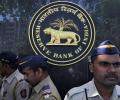
The Reserve Bank has asked troubled digital wallet firm MobiKwik, which is facing data breach allegations, to get a forensic audit done without any delay. Though the Gurugram-based firm has been claiming that its systems are secure and that there is no basis to the allegations of data breach, a group of hackers on Tuesday said that they accessed personal and financial data of nearly 10 crore MobiKwik customers. On Wednesday, sources in the know of the development told PTI that the RBI has ordered an immediate forensic audit of the company's systems by a certified auditor. When contacted, an RBI spokesperson refused to comment. MobiKwik refused to give a direct answer to a query on whether the RBI has ordered a forensic audit.

The government has also demanded information on vulnerability exploited by attackers and modus operandi of the attack, and sought details of remedial measures taken by Twitter to mitigate the impact of the hacking incident.
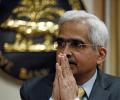
Economic activity has regained momentum from late-May after the dent caused by the second wave of COVID-19, and the pandemic's impact on the overall asset quality has been less than expected, Reserve Bank Governor Shaktikanta Das said on Thursday. However, Das flagged rising data breaches and cyber-attacks as among the risks for the recovering economy, along with others like firming global commodity prices. The governor also said the second wave had a "grievous toll" on the country.

According to WhatsApp, the spyware was developed by Israel-based NSO Group and had been used to snoop on about 1,400 users globally, including 121 users from India.

The government has warned the users of social networking sites such as Facebook, Myspace and Twitter of a virus that is spreading through these sites targeting the members.

According to statistics of the Computer Emergency Response Team (Cert-In), which handles computer securities incidents in the country, 612 websites were defaced in March compared to 214 websites in February. Website defacement is a form of malicious hacking. It is usually the substitution of the original home page by a system cracker that breaks into a web server and alters the hosted website creating one of his own.
Shiv Sainiks are protesting against certain 'hate-communities' on Orkut, which allegedly contained derogatory material about Shivaji and Thackeray family.

The attack also refreshed the memories of a virus attack on an Iranian nuclear facility.

'They (the ransomware attackers) are not after any VVIP data.' 'Had that been the case, they would have quietly installed a different malware.'
Cisco Systems and Indian Computer Emergency Response Team on Tuesday signed a memorandum of understanding on IT security co-operation in the country.
With growing instances of cyber attacks on the country's vital systems like power, railways, aviation and defence, the government on Monday announced the setting up of an expert vigilance agency to tackle any possible hacking or virus attacks.

The country's cyber security agency CERT-In has advised Facebook users to strengthen their account privacy settings after a recent global 'data scraping' incident in the social media platform affected about 61 lakh Indians.

The Delhi Commission For Women on Monday asked the police officials to appear before it later this week in connection with a probe into objectionable content on 'Bulli Bai' and 'Sulli Deal' apps.
The dreaded mass-mailing worm expected to strike computers across the world today has kept the Indian Computer Emergency Response Team, set up by the Department of Information Technology, on its toes.

The home ministry also ordered a probe by the Computer Emergency Response Team-India to ascertain whether there was hacking of government software systems as there have been several instances where licences of NGOs under scrutiny were renewed automatically.

India and Singapore on Tuesday elevated their ties to the 'strategic partnership' level and signed bilateral agreements for enhanced defence cooperation and in areas like cyber security, shipping and civil aviation.

The ED may soon register a money laundering case to probe if dubious funds were used for allegedly fuelling caste-based protests in the wake of the alleged gang-rape and death of a Dalit woman in Uttar Pradesh's Hathras, officials said.

A new breed of hackers has emerged, whose main aim is not necessarily financial gain but causing disruption

Govt, telecom, defence sectors most attacked by cybercriminals

Domino's India data that included sensitive customer information such as their names, phone numbers, and credit card details has allegedly been breached and put on sale on the dark web. According to tweets by Israel-based Co-Founder and Chief Technology Officer of cybercrime intelligence firm Hudson Rock, Alon Gal, the data is worth 13 terabytes (TB). He tweeted on Sunday that the data includes as many as 180 million order details, including 1 million credit card details. The data, said Gal, was up for sale on the dark web. The threat actor, he said, was asking for $550,000 for the data.

The government websites host information for public dissemination.

According to statistics released by Facebook, the Indian government topped the list of nations seeking removal of specific content from the social networking site.

The Indian authorities feared that these apps were transferring consumer data to locations outside the country, especially China, in an unauthorised and surreptitious manner. With servers in India, the data of local consumers would be stored in the country.

The attack is not focused towards any particular industry but it is widely spread across industries
Operating systems are increasingly subject to cyberattacks, as many are built around legacy technologies with weaker protocols
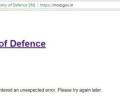
Chinese characters were seen on the website, indicating that Chinese hackers may be involved in it.

The 'severely' spreading virus of the Trojan family has been detected conducting its clandestine operations at the point of sale counters placed at retail terminals after the RBI made it mandatory in December last year for debit cards holders to punch in their PIN every time they make a purchase.

Given the security dilemma prevailing between India and China, India should curb the operation of Chinese telecom companies in India, asserts Dr Rup Narayan Das.

The Indian Air Force has asked its personnel and their families not to use Chinese 'Xiaomi Redmi 1s' phones, as it believes these phones could be transferring data to their servers in China and hence be a security risk.

Beware! Use of words such as 'attack', 'bomb', 'blast' or 'kill' in tweets, status updates, emails or blogs may bring you under surveillance of security agencies as the government will soon launch 'Netra', an internet spy system capable of detecting malafide messages.

Facebook blocked 5,832 pieces of content during July-December 2014 on orders of the Indian government.
The audacity of the virus has been categorised as 'severe' and cyber experts say such a malicious programme has been detected for the first time which asks for a ransom of an estimated Euro or $300 to unlock the genuine files of a user through 'anonymous pre-paid cash vouchers'.

With the use of e-wallets gaining momentum after the note ban, e-wallet service providers have doubled down on developing new security features in their apps. Sharath Chowdary reports.

The notice came after reports that political parties had used the data analytics firm during elections.

It said the ransomware called 'WannaCry' or 'WannaCrypt' encrypts the computer's hard disk drive and then spreads laterally between computers on the same LAN.
 © 2026 Rediff.com - Investor Information - Advertise with us - Disclaimer - Privacy Policy - Sitemap - Feedback - About us - Terms of use - Grievances