
'What we need to watch is how Saudi Arabia's financial assistance will be used by Pakistan. If the funds go to build their military hardware and operations, it should worry us.'

The country's largest carmaker Maruti Suzuki India expects auto sales to bounce back to the glory days of 7 per cent growth by FY 27, helped by the proposed GST rate cut which is expected to bring down car prices by 3.5 to 8.5 per cent.

New investors should avoid short-term, tactical entries and instead go for staggered buying via ETFs to manage volatility.

Capital investment by the private sector is likely to rise 21.5 per cent to Rs 2.67 lakh crore in 2025-26 aided by robust macroeconomic fundamentals, and a 100-bps policy rate cut, according to an RBI article. Despite global uncertainties, Indian firms entered the 2025-26 fiscal year with healthier balance sheets, higher cash buffer, improved profitability, and greater access to diversified funding sources, said the article 'Private Corporate Investment: Growth in 2024-25 and Outlook for 2025-26' published in the Reserve Bank of India's (RBI's) August bulletin.

The ratio of MF assets under management to total bank deposits has more than doubled in 10 years.

The representatives of youth-led Gen Z, which spearheaded the anti-government protests, held meetings with the top military brass to finalise a transitional government, but the talks hit a roadblock on the issue of who will head it.

The transmission of the February and April rate cuts is now complete, validating the central bank's monetary stance and contributing to a revival in credit growth, said Reserve Bank of India (RBI) Governor Sanjay Malhotra on Friday. "We now have preliminary figures for June credit rates, and we find that for new loans, the rates are lower by at least 50 basis points (bps)... within two months of our 50-bp cut, we are in June, and the whole of the monetary policy transmission has happened.

Who else will take on the might of Microsoft, Google, and Amazon if not the Adanis, Ambanis, Birlas, or Tatas?, asks R Jagannathan.

The bail plea of fugitive diamonds trader Mehul Choksi, wanted in India in connection with over Rs 6300-crore fraud in the Punjab National Bank (PNB), has again been turned down by a court of appeal in Belgium, just ahead of his extradition hearing before a court in that country, officials said. The court rejected the appeal on strong reasons conveyed by the CBI to the Belgian prosecution that Choksi had escaped from many jurisdictions earlier as well to evade legal proceedings and may flee to another country if let out on bail, they said.

'The US reciprocal tariff has added another element of uncertainty and the central bank may prefer to wait and get further clarity.'

Gold prices are likely to remain in a consolidation phase in the near term, but the overall bias will continue to stay positive amid heightened expectations of a US Federal Reserve rate cut in its September policy meeting, analysts said. Traders will closely track US macroeconomic data, such as Q2 GDP, PCE inflation, and speeches from Fed officials, which will provide more insights into the monetary policy stance of the Federal Reserve and the trajectory of the bullion sentiment, they added.

Last fortnight, State Bank of India Chairman C S Setty lifted the veil on a subject long spoken of in corporate corridors: Why can't our banks finance mergers and acquisitions (M&As)? Change is in the air: Indian Banks' Association (of which Setty is the chairman) is to "make a formal request" to Mint Road to make way for it. Thus far the exclusive turf of foreign banks even though its funding remains offshore - as in, it's not on these entities rupee-book (and a few select shadow banks) - a most lucrative segment in the investment banking suite, M&As, will be homeward-bound.

'This will be our first large-size bank partner, and hence, the partnership will be a game-changer for us.'

Gold prices are expected to witness further consolidation in the coming week as investors brace for a slew of events, ranging from central bank meetings, including the US Federal Open Market Committee (FOMC) meeting's outcome, to global trade negotiations, analysts said.

Uncertainties over the impact of the United States' (US') tariffs on India, along with the ongoing transmission of past rate cuts, prompted the members of the Reserve Bank of India's Monetary Policy Committee (MPC) to maintain the status quo during the August meeting, the minutes showed. While some of the external members highlighted their concern over growth, the internal members cited the one-year headline inflation rate overshooting the 4 per cent target.

Markets regulator Sebi has proposed introducing a single window access for low risk foreign investors seeking to participate in the Indian securities market, a move aimed at simplifying compliance and enhancing the country's attractiveness as an investment destination.
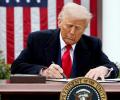
"We are contributing about 18 per cent, which is more than the US where the contribution is expected to be much less -- about 11 per cent or something. We are doing very well and we will continue to improve further," RBI governor Sanjay Malhotra said, replying to a question on Trump's recent comments.

For the time being, the RBI is done with the cuts. A cut in October, which many are still predicting, is not certain. Of course, if growth nosedives, the script will be different, expects Tamal Bandyopadhyay.

Equity markets this week will turn their focus on the RBI's interest rate decision, Q1 earnings from several blue-chip firms and tariff-related news for further cues, analysts said. Moreover, trading activity of foreign investors and trends in global equity markets will also drive investors' sentiment.

Since February 2025, the RBI has reduced the policy rate by 100 basis points. In its previous policy review in June, it had trimmed the repo rate by 50 basis points to 5.5 per cent.

Mixed views were expressed by top economists on the Reserve Bank of India's (RBI) Monetary Policy Committee's (MPC) decision to hold the repo rate at 5.5% and maintain a neutral stance. While some say the decision was as expected and one more rate reduction is expected this fiscal, there is also a view that rate cut by MPC was warranted given the evolving global situation.
Reserve Bank will "wait and watch" the evolving situation before deciding on any further rate cut, Governor Sanjay Malhotra has said as he emphasised that both growth and price stability are equally important. With inflation on a downward trend, the RBI's Monetary Policy Committee (MPC) has been reducing the benchmark repo rate and has adopted a neutral stance, which also gives the flexibility to either cut or hike the rate going forward. The central bank has cummulatively reduced the repo rate by 100 basis points since February.
The Reserve Bank of India (RBI) has extended the trading hours for the interbank call money market from July 1, and that of repo and tri-party repo markets from August 1. Market participants said the decision is intended to help reduce the large Standing Deposit Facility (SDF) balances held by banks with the RBI, thereby addressing liquidity mismatches.

United States President Donald Trump has warned that countries aligning with the BRICS economic bloc will face additional 10 per cent tariffs on their goods, as he seeks to protect the dollar's global dominance.

The Asian Development Bank (ADB) on Wednesday lowered India's growth forecast for FY26 to 6.5 per cent from 6.7 per cent on account of trade uncertainty and higher US tariffs that are expected to impact exports and investment. Despite the downward revision from the April 2025 Asian Development Outlook (ADO), India remains one of the fastest-growing major economies in the world.

The high-value Rs 2000 notes worth Rs 6,099 crore are still in circulation even after two years of the Reserve Bank withdrawing the currency, according to official data released on Tuesday. Rs 2000 banknotes continue to be legal tender.

Indian economy remains a key driver of global growth on the back of sound macroeconomic fundamentals and prudent policies, the Reserve Bank said on Monday. In its bi-annual Financial Stability Report (FSR), the central bank also said elevated economic and trade policy uncertainties are testing the resilience of the global economy and the financial system.

Stock investors will track the ongoing conflict between Iran and Israel, Brent crude oil prices, inflation data and the US Fed interest rate decision for further cues this week, analysts said. Tariff-related news would also dictate trends in the equity market, experts noted.

India's forex reserves rose $2.29 billion to $698.95 billion for the week ended June 13, the RBI said on Friday. The overall reserves had increased by $5.17 billion to $696.65 billion for the previous reporting week ended June 6.
No experts, clearly, were involved in the design of these new tariffs, which have been the subject of bemused wonderment across the world in how completely they ignore logic, rationality, fairness, and economic theory, observes Mihir S Sharma.

Large tariffs by the United States administration and elevated geopolitical risk have increased near-term global financial stability risks, and along with weather events pose downside risks to domestic growth, Reserve Bank of India (RBI) Governor Sanjay Malhotra said in the foreword to the Financial Stability Report released on Monday.

The International Monetary Fund (IMF) has said its executive board granted $1 billion in assistance to Pakistan this month after finding out that the country met all conditions and targets for it.

This translates into an annual return of 40 per cent, suggests a recent note by the World Gold Council.

India's consumer price index (CPI)-based retail inflation rate is likely to have cooled further in June, thus remaining below the 4 per cent target of the Reserve Bank of India (RBI) for a fifth consecutive month, giving the central bank wiggle room to focus on growth. Economists reckon that the decline is on account of easing prices in various categories of goods, especially food items, and a favourable base effect.

Trading activity of foreign investors and crude oil prices would also remain in the limelight during the week, experts noted. "This week brings a series of important economic data releases from India and the United States, which are likely to influence market sentiment and central bank outlooks.
The Reserve Bank on Thursday affirmed its commitment to continue with its supervisory measures aimed at early identification of risks and vulnerabilities. The central bank would also focus on enhancing cyber resilience and capabilities of Supervised Entities (SEs) by implementing the recommendations of the inter-regulatory Working Group, which has uniform baseline cybersecurity guidelines for financial entities, it said in its annual report.

'That way you're not hostage just to US sort of exports to India.'

India's economy is expected to grow 6.4-6.7 per cent during the current financial year driven by strong domestic demand, even as geopolitical uncertainty poses downside risks, the newly appointed CII president Rajiv Memani said on Thursday.

The high-value Rs 2000 notes worth Rs 6,181 crore are still in circulation after two years of the Reserve Bank withdrawing the currency, according to official data released on Monday. Rs 2000 banknotes continue to be legal tender.

India's macroeconomic health is in a "relative goldilocks situation", and although the risk of higher landed oil prices, due to insurance cost surges and closure of choke points due to the brief Israel-Iran war, has receded, it is "too soon to sound the 'all clear' for the rest of the year", the Finance Ministry said on Friday.
 © 2026 Rediff.com - Investor Information - Advertise with us - Disclaimer - Privacy Policy - Sitemap - Feedback - About us - Terms of use - Grievances