
The Central Board of Indirect Taxes and Customs (CBIC) announced the implementation of the Eligible Manufacturer Importers (EMI) scheme from April 1, allowing eligible importers to defer customs duty payments.
The revised guidelines are aimed at curbing discretionary practices by field officers, especially the tendency to seek documents not mandated under the law.

The government is finalising a major GST overhaul with automated refunds, pre-filled returns, and analytics-based scrutiny to simplify compliance and boost liquidity for MSMEs.
In a recent clarification, the Central Board of Indirect Taxes and Customs (CBIC) provided insights into the goods and services tax (GST) treatment of transactions involving vouchers. According to the CBIC, vouchers can be categorised into two types.

The principal commissioner has been made responsible for developing and approving any intelligence, conducting search, and completing investigations and relevant subsequent actions, including at the lower field formations, points out T N C Rajagopalan.

Banks are receiving requests for cancellation of approved car loans, in view of the implementation of GST rate cut, which will lower the price of passenger vehicles and also lead to subsequent reduction in the amount needed to purchase them. It is to be noted that the 56th GST Council meeting earlier this month, approved substantial reduction in the GST rate for cars for up to 1,200 cc to 18 per cent from the existing 28 per cent.

Nearly 96 per cent of new applicants will benefit from this simplified approval route.

The Central Board of Indirect Taxes and Customs (CBIC) has stepped up its watch on the import of unbranded gold jewellery amid a spurt in seizures on international borders and from importers. During FY24, the CBIC and Directorate of Revenue Intelligence (DRI) jointly seized about 5 tonnes of gold, 30 per cent more than what they did in FY23. In FY23, 3.5 tonnes of gold was confiscated.
Central GST (CGST) field offices will remain open on March 29-31, the Central Board of Indirect Taxes and Customs (CBIC) said on Friday. The CBIC directive came days after a similar directive from the Central Board of Direct Taxes (CBDT) regarding income tax department offices "to facilitate completion of pending departmental work.

'In case a particular industry has not passed on the benefits and if we receive complaints, we will take up the matter with the industry body concerned.'

The Delhi High Court has directed Customs officials to ensure that old and personal jewellery of travellers, including ornaments being worn by them during travel, are not unnecessarily detained at airports and they are not harassed. The court was hearing a batch of more than 30 petitions raising issues on the procedure for detention of goods belonging to the tourists travelling to India, of both Indian and foreign origin, by the Customs department.
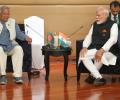
India has exempted Bangladeshi exports to Nepal and Bhutan as such trade facilitation is mandatory for landlocked countries under the framework of provisions of the World Trade Organisation (WTO).
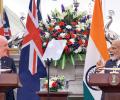
India and New Zealand have signed a pact to institutionalize their defence ties and vowed to boost cooperation in the Indo-Pacific. Prime Minister Narendra Modi raised concerns about anti-India activities by some illegal elements in New Zealand with his Kiwi counterpart Christopher Luxon. The two sides also signed six agreements to enhance cooperation in areas including education, sports, agriculture, and climate change. They also agreed to prepare a roadmap for cooperation in the defence industry sector and explore early implementation of cooperation in the digital payments sector.

The government's initiative to migrate SEZ data from NSDL software to ICEGATE system for streamlined reporting of import data caused double counting of gold imports, resulting in inflated figures and the issue has now been largely rectified, government sources said. The downward revision has provided the actual picture of trade deficit (difference between imports and exports), which was earlier looking very high. The deficit for November will now be revised downwards from $37.84 billion to about $32.8 billion. Similarly, there will be a revision in overall import numbers as well.
In a relief for foreign firms giving loans to Indian subsidiaries, tax authorities have said goods and services tax (GST) will not be imposed on them, subject to some caveats. Additional fees, commissions, or related payments - over and above the amount charged as interest - on these loans will attract GST at 18 per cent, the Central Board of Indirect Taxes and Customs (CBIC) has said.

The US Trade Representative noted that India's average applied tariff rate stood at 17% per cent, the highest of any major world economy.

About 1.2 trillion tax evasion cases have been detected and as many as 59,000 entities identified for verification in order to ascertain whether they are fake.

The central government's fiscal deficit during 2023-24 at 5.6 per cent of the GDP was better than previous estimates of 5.8 per cent on account of higher revenue realisation and lower expenditure, according to official data released on Friday. In actual terms, the fiscal deficit -- or gap between expenditure and revenue -- was Rs 16.53 lakh crore, or 5.63 per cent of the GDP, which grew 8.2 per cent in 2023-24.

In order to reduce government litigations, the Union Finance Minister Nirmala Sitharaman on Saturday said the GST Council has fixed a monetary limit for filing appeals by the tax department before the various appellate authorities. It has recommended a monetary limit of Rs 20 lakh for GST Appellate Tribunal, Rs 1 crore for the High Court and Rs 2 crore for the Supreme Court for filing of appeals by the department before these legal forums, she said after the 53rd GST Council meeting held in New Delhi.
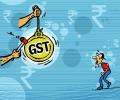
Over 100,000 small and medium-sized businesses are non-compliant with e-invoicing norms under the goods and services tax (GST) regime, a mandatory requirement for businesses with an annual turnover of over Rs 5 crore. E-invoicing provides real-time access to invoices that are prepared by the supplier on the purchase of goods, allowing faster accessibility to input tax credit, thereby limiting the manipulation of fake credit as it has to be generated before the transaction. "The default has been reported mainly in businesses with a turnover between Rs 5 crore and Rs 20 crore," a senior official informed

Insurance companies may soon face goods and services tax (GST) audits as tax authorities plan a "deep dive" into their business practices to check for the possibility of a raft of tax-linked irregularities. Several insurance companies are being probed for wrongly availing of the input tax credit without the underlying supply of goods and services based on fake invoices generated by their channel partners and intermediaries. "We want to deep dive into the overall business and see if there are further taxation issues besides commissions, which are already being investigated," a senior official of the Central Board of Indirect Taxes and Customs said.
'We crossed Rs 1.7 trillion in three months this financial year.'

Vivek Johri, the Chairman of Central Board of Indirect Taxes and Customs (CBIC) on Friday said that the cash recovery of approximately Rs 150 crore from searches in Kanpur at several locations related to Trimurti Fragrance is the 'biggest haul ever'.
GST authorities have identified about 17,000 non-existent GSTINs and cancelled over 4,900 registrations in the ongoing pan-India drive against fake registration, a senior tax official said on Wednesday. Currently, there are 1.40 crore businesses registered under Goods and Services Tax, nearly double the number of businesses registered in indirect tax regime pre-GST rollout. Central Board of Indirect Taxes and Customs (CBIC) member Shashank Priya said in the drive against fake registration, till July 4, over 69,600 GST Identification Numbers (GSTINs) have been selected for physical verification by field tax officers.

Supplying food to schools under mid-day meal scheme, pre-schools and anganwadis is exempt from GST, the Central Board of Indirect Taxes and Customs (CBIC) has said. Issuing a set of clarification on certain decisions taken by the GST Council in its 43rd meeting on May 28, the CBIC said it had received representations regarding applicability of GST on the issues as to whether serving of food in schools under mid-day meals scheme would be exempt if such supplies are funded by government grants and/or corporate donations. Under the goods and services tax (GST), any catering service, including mid-day meals, provided to an educational institution is exempt from the levy.
As taxpayers face technical glitch on the GST portal, the government on Tuesday said it is considering extending the April tax payment deadline and has directed Infosys for early resolution of the problem. The Central Board of Indirect Taxes and Customs (CBIC) said a technical glitch has been reported by Infosys in generation of April 2022 GSTR-2B and auto-population of GSTR-3B on portal. "Infosys has been directed by Govt for early resolution. Technical team is working to provide GSTR-2B & correct auto-populated GSTR-3B at the earliest," the CBIC tweeted.

The Appellate Authority for Advance Rulings (AAAR) of Gujarat has held that papad fryums would not attract any goods and services tax (GST) as they are similar to traditional round papads in all respects. In this connection, the appellate authority modified the ruling of the authority for advance rulings (AAR), which had ruled that Fryums would attract 18 per cent GST. The AAAR held that Fryums is a brand and not a generic name of the product, Harpreet Singh, partner, indirect taxes at KPMG in India said while explaining the order.

The finance ministry has said that the Goods and Services Tax will not apply on room rents of 'sarais' (inns) or properties managed by religious and charitable institutions. The clarification was issued by the Central Board of Indirect Taxes and Customs (CBIC) on Thursday evening to clear the confusion with regard to the levy of GST on room rents. This clarification by the Finance Ministry came following a demand from various quarters including AAP MP Raghav Chadha that the GST on rooms rented by religious institutions be withdrawn.

However, where the directors' remuneration is in the nature of professional fees and not salary, GST will be levied on a reverse charge basis.
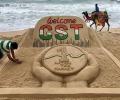
Businesses with monthly turnover of over Rs 50 lakh will have to mandatorily pay at least 1 per cent of their GST liability in cash, the finance ministry said as it moved to curb evasion by fake invoicing. The Central Board of Indirect Taxes and Customs (CBIC) has introduced Rule 86B in Goods and Services Tax (GST) rules which restricts use of input tax credit (ITC) for discharging GST liability to 99 per cent. "... The registered person shall not use the amount available in electronic credit ledger to discharge his liability towards output tax in excess of 99 per cent of tax liability, in cases where the value of taxable supply ... in a month exceeds Rs 50 lakh," the CBIC said.

The government has allowed import and export of COVID-19 vaccines without any value limitation, in order to ensure speedy clearance and distribution. The Central Board of Indirect Taxes and Customs (CBIC) has amended the regulations to facilitate the import/export of COVID-19 vaccines through courier, at locations where the Express Cargo Clearance System (ECCS) is operational. "Imports and exports of vaccines in relation to COVID-19 has been allowed without any value limitation," said the amended Courier Imports and Exports (Electronic Declaration and Processing) Amendment Regulations, 2020.

The CBIC has come out with guidelines on blocking of tax credit by GST field officers, saying that such blocking should be on the basis of 'material evidence' and not just out of 'suspicion'. The guidelines laid down five specific circumstances in which such credit could be blocked by a senior tax officer. These include availment of credit without any invoice or any valid document, or availing of credit by purchasers on invoices on which GST has not been paid by sellers.

Mumbai, which adds 37 per cent to the total direct tax mop-up, has reported tax collection of Rs 4.93 trillion so far, against the full-year target of Rs 5.35 trillion.

In the year-long crackdown on tax evasion, the GST authorities have unearthed over Rs 35,000 crore of tax fraud committed by misuse of input tax credit provision under the Goods and Services Tax (GST) regime. During the 2020-21 financial year, the CGST zones and the Directorate General of GST Intelligence (DGGI) booked about 8,000 cases involving fake ITC of over Rs 35,000 crore, a statement from CBIC said. Under the GST regime, at the time of paying tax on output, entities can reduce the tax they have already paid on inputs.
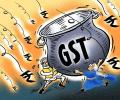
GST collection grew by 12 per cent in April to Rs 1.87 lakh crore, the highest monthly mop-up since the rollout of the indirect tax regime. The gross GST revenue collected in the month of April 2023 is Rs 1,87,035 crore of which CGST is Rs 38,440 crore, SGST is Rs 47,412 crore, IGST is Rs 89,158 crore (including Rs 34,972 crore collected on import of goods) and cess is Rs 12,025 crore, the finance ministry said in a statement. The previous high collection of Rs 1.68 lakh crore was in April last year.

Crypto exchanges have been asked to furnish details this month itself.
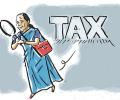
The gross tax revenues have touched 65 per cent of the Budget estimates at Rs 17.81 lakh crore during the first eight months of the current fiscal till November, propelled by corporate and personal income tax mop-up, according to the Economic Survey 2022-23 presented in Parliament on Tuesday. The survey, authored by Chief Economic Advisor V Anantha Nageswaran, said the 'substantial reforms' in India's taxation ecosystem post-2014 and policy reforms have removed the distortionary incentives from the economy. Reforms like GST, reduction in corporate taxes, exemption of sovereign wealth funds and pension funds from taxes, and removing Dividend Distribution tax have reduced the tax burden on individuals and businesses.
Six years after the rollout of the biggest indirect tax reform in India, Goods and Services Tax (GST) revenue of Rs 1.5 lakh crore every month has become a new normal and tax officers are focusing on dealing with fraudsters who are adopting newer modus operandi to game the system, causing loss to the exchequer. To apprehend black sheep, who operate as syndicates and create fake entities on the basis of forged documents to claim input tax credit (ITC), tax officers have started using data analytics, artifical intelligence and machine learning aiming to curb evasion, which was over Rs 3 lakh crore since inception of GST. It was over Rs 1 lakh crore in 2022-23. Thinktank Global Trade Research Initiative (GTRI) said the most critical pending GST reform is upgradation of GST Network to prevent fake supplies and fraudulent claims of Input Tax Credit (ITC).

Widening of the tax base, doing away with cess and surcharge, improvement in compliance and moderation in tax for emerging sectors are some of the suggestions submitted to the Finance Ministry ahead of the Budget by Think Change Forum (TCF). Experts are of the opinion that there is a need to grow tax revenues for the government to drive economic growth and make investments in developmental activities, TCF, the think tank said in a statement. Towards this end, poor compliance was identified as a weak link in achieving targeted collections leading to complex issues like overtaxing, complicated tax structures, rising litigation, among others.
Deciding the goods and services tax rate on fryums papad could be a messy affair with the Appellate Authority for Advance Rulings (AAAR) of Gujarat now ruling that the ready-to-eat product would draw 18 per cent rate. In that connection, it slightly modified the ruling of the state-based Authority for Advance Rulings (AAR). The AAR had also ordered that these products would draw 18 per cent GST but under a different classification.
 © 2026 Rediff.com - Investor Information - Advertise with us - Disclaimer - Privacy Policy - Sitemap - Feedback - About us - Terms of use - Grievances