
'The real question is how best to leverage technology to deliver better services, all the way to the last mile, where we still haven't been able to get across the financial literacy that can enable us to unlock the potential of the entire country.'

'Credit growth in India remains in double digits, even though corporate borrowing is subdued.' 'Corporate credit is weak because companies are cash-rich and cautious amid global uncertainty.'

'There is a challenge in repositioning yourself, maybe reinventing yourself.'

Recent years have been turbulent for the insurance industry due to direct and indirect tax reforms, regulatory overhaul and other external pressures. The events cumulatively slowed growth rate to single digits from the high teens seen earlier.

The exemption of individual life and health insurance premiums from the Goods and Services Tax (GST) enables the insurance industry to make products affordable and attractive, said Ajay Seth, chairman of Insurance Regulatory and Development Authority of India (Irdai) at the Business Standard BFSI Insight Summit 2025.

The return on investment (RoI) from technologies such as artificial intelligence (AI) will take time to materialise, and the immediate priority should be to increase spending on building governance frameworks around AI, top bank executives said.

The reduction in goods & services tax (GST) on individual life and health insurance premiums has been called a "landmark step" for making insurance affordable and inclusive. In a panel discussion at the Business Standard BFSI Insight Summit 2025, Anup Bagchi, managing director (MD) & chief executive officer (CEO) of ICICI Prudential Life Insurance; Mahesh Balasubramanian, MD & CEO of Kotak Life Insurance; Tarun Chugh, MD & CEO of Bajaj Life Insurance; and Ratnakar Patnaik, MD of Life Insurance Corporation of India (LIC), listed what else the industry needs to reach more people.

'When you think of cross-border payments, the first things that come to mind are risk, compliance, taxation, speed, and cost.'

'Other sectors that manage the savings pools of Indians are giving tough competition to life insurance companies.'

'I will not be surprised if there is a 7 per cent handle in front of the decimal place for the full financial year.'

In today's rapidly evolving digital payment landscape, security concerns remain a top priority for stakeholders across sectors.

From CEOs to RBI governors, cricket's rich imagery and strategy resonate deeply with leadership, uncertainty, and decision-making across industries and global diplomacy, points out Suveen Sinha.

'The problem is that the bubble may not only be in valuations, but also in investors' minds.'

'While investors need to be prepared for making some losses, they should not lose big money chasing euphoria amid fear of missing out.'

'Whether I am optimistic or pessimistic is not the issue; I am just going by the evidence available.' 'The Indian economy and financial sector are now well-placed and very resilient in dealing with any kind of spillover coming from the external world.'

'You cannot have only one product or one market or one customer segment.'

Walmart-owned fintech firm PhonePe said it has crossed 500 million lifetime registered users on its platform. With this milestone, 1 in 3 Indians are now on PhonePe. The company said it is the first Indian internet company to have reached this scale globally. This milestone has been achieved in just over 7 years since the PhonePe UPI (Unified Payments Interface) payments launched in August 2016.

Between March 2022 and September 2023, HDFC Bank added 56,310 employees.

While the economy seems to be on a firm growth path, the fight against inflation is not over yet. Shaktikanta Das seems to be in no hurry. After playing well through a five-year Test match, he doesn't want to get out hit wicket, observes Tamal Bandyopadhyay.

The governor made it clear that the RBI is aware of what's happening and acts accordingly, but doesn't make a noise about that, points out Tamal Bandyopadhyay.

'The focus needs to shift towards the ability to collect payments, particularly in tier-3 to tier-4 areas where acceptance is still lacking.'

'Just the amount of work which is there just to become more and more successful in banking. For this to happen you need to have leaders who understand technology.'

The regulatory changes brought in by the insurance regulator and the amendments proposed to the Insurance Act by the Centre may herald a new dawn for the sector in India. This may result in insurers bringing out more consumer-led products, top honchos of general insurance companies of the country concurred at the Business Standard BFSI Insight Summit 2022.

Regulatory capacity, hyperactivity and excessive prescription are the biggest challenges the financial sector is facing, said Meleveetil Damodaran, former chairperson, Securities and Exchange Board of India (Sebi). Speaking at the Business Standard BFSI Summit on Wednesday, Damodaran highlighted the need for simpler, clear, and continuous regulations in the financial sector. He opined that the industry had felt it challenging to keep pace with the changing regulations.

In order for life insurance customers to attain maximum benefits, it is crucial for the persistency ratio to be far higher than its current level, top executives of the industry said at the Business Standard BFSI Insight Summit on Thursday. The persistency ratio is a metric that measures the number of policyholders who continue paying renewal premium and is gauged at varying stages in the life of a policy. A higher persistency ratio is seen as an indicator of an insurance product that caters satisfactorily to the needs of a customer.

Financial institutions are 300 times more vulnerable to cyberattacks than any other industry.

India has a huge untapped population which doesn't have facilities for financial aid and insurance, and it is perhaps plausible to look at the option of having niche players catering to smaller sectors akin to non-banks and microfinance institutions in lending, said Rakesh Joshi, member (Finance & Investment), Insurance Regulatory and Development Authority of India (Irdai). Speaking at the Business Standard BFSI Insight Summit, Joshi said, "Today, most of our insurance companies operate at a national level. There is arguably a case for having differentiated operations, which cater to niche sectors the same way we have non-banking financial companies (NBFC) and microfinance institutions in lending." "The capital requirement for niche players may not be as large as those having national ambitions. "Enabling these niche players, which require lower capital, will enhance the penetration in areas which hitherto had not seen traction from large players," he said.

'If you want it to grow well and serve the true needs of the economy, it needs a lot of freedom and flexibility, which comes in terms of the reform objective set by the regulator.'

But the industry's chief executives remain confident of the long-term growth potential of NBFCs in India, given their specialised lending on the asset side, last-mile reach, and a well-capitalised balance sheet. "Over the years, NBFCs have faced many crises.

Exuding confidence in sustaining the tempo of credit growth, public sector bankers said on Wednesday that consolidation in the public sector bank (PSB) space has given them a robust base to scale. The privatisation of PSBs can be done through divestment of government stake to a wider base of investors without haste. There is nothing to worry about at this point (high credit offtake) as underwriting standards and risk management are much better.

The price of bitcoin, the bestselling cryptocurrency, has shrunk nearly three times this year to mark the fate of such digital assets. Crashing prices, regulatory uncertainty and taxes have put Indian crypto exchanges in troubled waters. Finance Minister Nirmala Sitharaman's budget for FY23 announced a 30 per cent tax on any income from the transfer of virtual digital assets.

'People trust India and Indians a lot more than they trust China and the Chinese.'

'As our per capita income increases and various demographic segments emerge, the need for various kinds of protection and risk covers will become even more explicit.'

'Rather than experimenting with CBDCs, we must come up with a very simple and straight design.' 'Dematerialise your currency/cash and with that dematerialised rupee allow all the transactions digitally.'

'The pitch for India is flat, the ball for India is old, the sun for India is out, and the bowlers are not bowling too well.' 'I think only we can get ourselves out.'

The fundamental issue between banks and fintech would be who will own the customer and who will be the service provider.
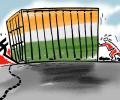
India has been relatively insulated from the severe headwinds in the West. However, with a third of the global economy expected to slip into recession in calendar year 2023, the impact will strongly be felt on India's exports and trade economy, leading economists said in a panel discussion at the Business Standard BFSI Insight Summit in Mumbai on Wednesday. The panel comprised former Reserve Bank of India executive director and former Monetary Policy Committee member Mridul Saggar, State Bank of India Chief Economic Advisor Soumya Kanti Ghosh, Citibank India Chief Economist Samiran Chakraborty, ICRA Chief Economist Aditi Nayar, and IndusInd Bank Chief Economist Gaurav Kapoor. The topic of the panel discussion was No recession in sight: Is India decoupled from developed economies?

The Lok Sabha elections in 2024 are not a consideration when it comes to monetary policymaking, said Reserve Bank of India governor Shaktikanta Das to underscore the central bank's commitment to controlling inflation. "It's not possible for me to comment what we do in the next MPC (Monetary Policy Committee), but one thing I can tell and I would like to make it very clear-that the fact of elections coming up in 2024 is not a factor at all so far as monetary policymaking is concerned. "Monetary policymaking is for checking (and) controlling inflation," Das said at the Business Standard, BFSI Insight Summit.

RBI Governor Shaktikanta Das kept the red flag on cryptocurrencies flying, warning that the next financial crisis can be triggered by private cryptocurrencies if such speculative instruments are allowed to grow.

'Hacking of an ID or an account will have the same impact on a user in a city and one in a small town.' 'Security is like a railroad, you create it to last for every customer.'
 © 2026 Rediff.com - Investor Information - Advertise with us - Disclaimer - Privacy Policy - Sitemap - Feedback - About us - Terms of use - Grievances