
Many countries including the United States and France have offered help to India in its ongoing operations to bring out bodies in the sunken submarine INS Sindhurakshak.

Rescuers from the Indian Navy on Monday extricated one more body from INS Sindhurakshak, taking the number of victims recovered from the fire-devastated submarine to seven even as professional savers from reputed companies commenced preliminary survey activities.

The defence minister told the Rajya Sabha that at the moment, "We cannot say conclusively about the exact cause of the incident. Our armed forces work on a war footing on these aspects and they are also anxious over this issue."

Eight personnel of the 21 Para Regiment, which had undertaken a daring operation just inside Myanmar territory following the Manipur ambush, were among 67 for whom President Pranab Mukherjee on Friday approved Gallantry awards.

The Indian Navy on Sunday said that they have gained access to the forward compartment of the ill-fated submarine INS Sindhurakshak by breaking open the jammed hatches.

Expressing hope of reusing the sunken INS Sindhurakshak submarine, the Navy on Tuesday said its record was "not all that bad" in terms of accidents when compared to other navies in the world, soon after it was pulled up by Defence Minister AK Antony for the mishap.
.jpg)
Navy Chief Admiral D K Joshi, while speaking about the explosion on board the Indian Navy's submarine INS Sindhurakshak, said there was "nothing to be hidden if there were any errors" behind the incident.

An eminent Indian official has been named on a United Nations inquiry panel set up by the world body's chief Ban Ki-moon to probe the presence of arms in UN premises in the Gaza strip and the damage to its facilities during the conflict between Israel and Palestinian factions.
The report said a dedicated organisation for dealing with safety issues awaits government's sanction.
.jpg)
Seven Indian Navy personnel were injured on Wednesday and two officers unaccounted for in a mishap on board Russian-origin Kilo Class submarine INS Sindhuratna, 80 kms off the Mumbai coast.

Nearly 18 months after an explosion on board submarine INS Sindhurakshak sunk the vessel, killing 18 personnel, Navy Chief Admiral R K Dhowan on Wednesday indicated that human error besides other factors could have led to the tragedy.

A Delhi court on Friday framed charges against five persons, including three former naval officers and an ex-IAF Wing Commander, in the 2006 Naval War Room leak case.
Eight years after CBI filed the charge sheet in a case relating to leakage of information from Naval war room, a court today framed charges against Ravi Shankaran, Abhishek Varma and four other former senior defence officials under Official Secrets Act.

In wake of the blasts on the INS Sindhurakshak, the Navy has ordered extensive checks on weapon-related safety systems on all its submarines, Defence Minister A K Antony told Lok Sabha.

Preliminary investigations have indicated that blasts on submarine INS Sindhurakshak were caused by "possible ignition" of armament, Defence Minister A K Antony said.
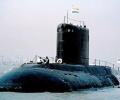
The sinking of INS Sindhurakshak is the worst accident in India's 47 years of submarine operations history and a big setback to its submarine operations, reports RS Chauhan

The Central Bureau of Investigation has faced the ire of a special court which imposed Rs 10,000 cost on it for "unnecessarily" delaying the proceedings by not appointing a prosecutor in the 2006 Naval War Room leak case in which five persons, including three former naval officers and an ex-Wing Commander, face trial.

The Indian navy suffered yet another mishap on Friday with gas leakage in an under-construction warship in the Mazagaon Docks here, claiming the life of a Commander and hospitalisation of two dockyard employees.

The explosion aboard the country's frontline submarine 'Sindhurakshak' was quite a setback, said former commanders and top naval experts, even as they expressed hope that the Indian Navy would soon be able to set things right.

'It was almost as though there was widespread relief that the defence bureaucracy, and the minister, could find someone willing to shoulder the blame for everything that had gone wrong with the services under Antony's charge -- the poor preparedness of the forces, slow acquisitions caused by indecision, cancellation of contracts and whimsical blacklisting of defence contractors over the tiniest suspicion that they may have paid speed money or kickbacks.'
 © 2026 Rediff.com - Investor Information - Advertise with us - Disclaimer - Privacy Policy - Sitemap - Feedback - About us - Terms of use - Grievances