
The BDCA is yet another dose of insidious placebos administered on the people of India by their own government that has been in perpetual denial over the steady incremental loss of strategic Indian territory, says R N Ravi

Will the Border Defence Cooperation Agreement, India and China signed in Beijing on Wednesday, end repeated Chinese intrusions into Indian territory? China expert Srikanth Kondapalli explains why he is not hopeful

Border incursion, the finalisation of the Border Defence Coordination Agreement (BDCA), a new mechanism suggested by China last year for improving security at the borders, pending the final settlement of the territorial dispute, top Antony's agenda for talks.

Playing down the continuing standoff at the Ladakh border region, China's military on Thursday said such incidents are "sometimes inevitable" but the situation is under "effective control" with the joint efforts of the two sides.

In a rare honour, Prime Minister Manmohan Singh would visit and address China's ruling Communist Party's Central School during his visit in Beijing next week besides holding in-depth talks with Chinese leaders.

The Border Defence Cooperation Agreement inked between India and China on Wednesday facilitates establishment of a hotline between the military headquarters of the two countries, besides border personnel meeting sites in all sectors receiving broad directive not to tail each others' patrols along the disputed borders.

"Our worry is that a small mistake, an accidental exchange of fire at night, might lead to an unintended escalation," a senior officer confessed

China on Monday said Defence Minister A K Antony's visit Beijing has given both countries an opportunity to enhance their "strategic cooperative partnership" and jointly maintain peace and tranquillity in the border areas through increased military-to-military coordination.

India and China on Wednesday signed in all nine agreements, including the Border Defence Cooperation Agreement and one on strengthening cooperation on trans-border rivers, after restricted and delegation-level talks that lasted over two hours as Prime Minister Manmohan Singh and Premier Li Keqiang met for the second time this year for talks which the Indian leader described as "fruitful and productive".

Virtually defending the latest incursion by the People's Liberation Army in the Chumar sector in Ladakh, China on Thursday said its troops were patrolling on its side of the Line of Actual Control and asserted that "status quo" should not be changed pending a final settlement.
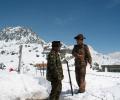
Against the backdrop of recent incursions by the Chinese troops, India and China on Saturday held a flag meeting in eastern Ladakh where the Indian side is understood to have raised concerns over detention of its nationals by the People's Liberation Army.

China on Tuesday said border talks with India have yielded "initial results", enabling the two neighbours to properly handle their differences over the vexed boundary issue and maintain peace along the frontier.

'Leaders of the two nations have reportedly agreed to set up a hotline between their respective military headquarters,' state-run Global Times daily reported on Wednesday.

Operationalisation of a new border defence agreement to deal with recurring troop incursions along the LAC besides improving defence ties, is expected to top the agenda of General Bikram Singh as he starts a rare visit by an Indian army chief to China from Wednesday.
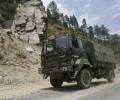
China has reacted cautiously to India's proposal for the establishment of mountain strike corps along the Sino-Indian border, while the official media in Beijing ignored the development.

Army Chief General Bikram Singh, who is in China on a four-day official visit, on Thursday held talks with People's Liberation Army Chief of General Staff Fang Fenghui in Beijing.
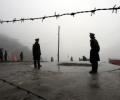
India is concerned about periodic provocative incursions by Chinese troops that have resulted in "eyeball-to-eyeball confrontations", but was hopeful that the border issues will eventually be settled.

Both India and China have realised that if border incursions keep reoccurring, other issues of mutual interest will remain unstable. Sheela Bhatt reports

Against the backdrop of recent incursions by Chinese troops into India, the two countries are working to conclude a new border defence agreement with an aim of signing it when Prime Minister Manmohan Singh travels to Beijing possibly in October.

Carrying a message of "peaceful cooperation" from his President for the new Prime Minister, Chinese Foreign Minister Wang Yi on Monday exuded confidence that both the countries have the capabilities to deal properly with the contentious issues such as boundary dispute.

The Border Defence Cooperation Agreement with China needs closer scrutiny, says Rup Narayan Das.

India and Russia are involved in talks to sort out the nuclear liability issues before they sign an agreement for setting up Units III and IV of the Kudankulam power plant in Tamil Nadu during Prime Minister Manmohan Singh's annual summit with President Putin in Moscow next week.

'China refuses to talk to India on nuclear or ballistic missile issues and conclude any de-targeting agreement as Beijing did with Russia or a non-targeting agreement with the US.'

Sheela Bhatt, who is travelling with Prime Minister Manmohan Singh on his two-nation visit, analyses the outcome of crucial talks between the PM and his Chinese counterpart in Beijing.
.jpg)
Both India and China have demonstrated levels of maturity in diffusing tensions and ensuring that the border remains by and large incident free, says Seema Mustafa

'Clearly, there is a wide gap between the stated intentions of China's top leadership to improve relations with India and the PLA's aggressive border management,' says Brigadier Gurmeet Kanwal (retd).

India and China decided to seek a fair and rational solution to their border dispute on Saturday as they focused on the proposed border defence cooperation agreement to avert incursions like the one witnessed in Leh region last month.

Prime Minister Narendra Modi's visit to Arunachal Pradesh on Friday, February 20, irritated the Chinese government so much that it summoned the Indian ambassador to register its protest against Modi visiting a territory China claims as Southern Tibet.

The India that needs strategic alliances, defence cooperation and engaging meaningfully with neighbouring countries is quietly moving ahead with confidence, says Tarun Vijay
 © 2026 Rediff.com - Advertise with us - Disclaimer - Privacy Policy - Sitemap - Feedback - About us - Terms of use - Grievances