
The Softbank-backed company has set a price band of Rs 72 to Rs 76 per share for the maiden share sale and is expected to test the appetite for new-age loss-making companies.
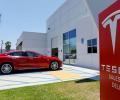
'Gujarat is the frontrunner at present.'
'However, Tamil Nadu's robust automobile ecosystem and Telangana's aggressive incentives make them strong contenders.'
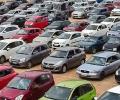
Auto industry volumes have grown by 2.5 per cent overall, led by domestic sales of three-wheelers, two-wheelers and passenger vehicles (PVs) in the first quarter of this financial year. Analysts predict an 18 per cent growth in revenues for automotive original equipment manufacturers (OEMs) and profit growth of 69 per cent year-on-year (YoY). However, on a sequential basis, a decline in revenues as well as earnings before interest, taxes, depreciation, and amortisation (Ebitda) margins is expected.

For the younger Bajaj sibling, life after Bajaj Auto is all about revving up the financial services business.

He is survived by two sons, Rajiv Bajaj and Sanjiv Bajaj, and a daughter Sunaina Kejriwal.
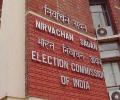
From steel tycoon Lakshmi Mittal to billionaire Sunil Bharti Mittal's Airtel, Anil Agarwal's Vedanta, ITC, Mahindra and Mahindra, and a lesser-known Future Gaming and Hotel Services were among the prominent buyers of the now-scrapped electoral bonds for making political donations.

IndusInd Bank was the top gainer in the Sensex pack, rising over 4 per cent, followed by HCL Tech, Bajaj Auto, Tech Mahindra, L&T and Kotak Bank.
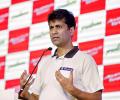
As a 75-year-old septuagenarian, Bajaj Auto has adapted itself as a nod to competition, regulations, and changing buyer preference. It will continue to do so, said its managing director Rajiv Bajaj at the launch of the all-new Pulsar 250. This was in response to a question on the company's preparedness for disruption by electric two-wheeler start-ups.

Bharti Airtel was the top loser in the Sensex pack, slipping around 1 per cent, followed by Tata Steel, HDFC Bank, Infosys, HDFC, Bajaj Auto and PowerGrid.
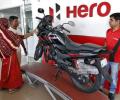
Hero MotoCorp, India's largest two-wheeler maker, has seen a decline in its market share in rural areas since 2018, losing ground to major competitors such as TVS Motor Company, Bajaj Auto, and Honda Motorcycle & Scooter India (HMSI), according to data from JATO Dynamics reviewed by Business Standard. Hero's share of rural two-wheeler sales in India has dropped from 40.4 per cent in 2018 to 33.3 per cent in 2023. In contrast, Bajaj's share increased from 12.7 per cent in 2018 to 13.9 per cent, HMSI's from 21.8 per cent to 22.2 per cent, and TVS' from 15.5 per cent to 17.8 per cent. Suzuki Motorcycle India has also seen its share rise from 1.7 per cent to 2.5 per cent.
Operating margins have been the primary driver of corporate earnings in India in recent quarters, despite revenue growth suffering from weak consumer demand. Companies across sectors have reported a sharp improvement in earnings before interest, tax, depreciation, and amortisation (Ebitda) margins over the past two years, benefiting from lower commodity and energy prices. Higher margins more than compensated for slower revenue growth, resulting in double-digit growth in net profit for five consecutive quarters.

'The Nifty index looks to be 20 per cent overvalued as per our model after moving up more than 10 per cent in the last two months.'
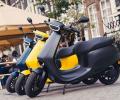
India's incumbent two-wheeler players, led by TVS Motors, are flexing their muscles, having crossed the registration of 10,000 electric two-wheelers for the first time in November this year, according to data from Vahan, the website of the ministry of road transport and highways. The two key incumbent players, TVS Motors and Bajaj Auto, now account for around 15 per cent share of registrations in the month of November. The number will only go up with Hero MotoCorp now joining the bandwagon with its Vida range of electric scooters.

Many promoters still consider the cash in the company as their money and are averse to sharing this pie with minority investors, points out Akash Prakash.

Closely watched by the world for any escalation, the Iran-Israel conflict is already showing early signs of stress for India Inc - longer deliveries, doubling freight rates, extended working capital cycles, and higher costs. For those yet to feel the heat, there is growing apprehension and nervousness over future developments, observed industry executives.

Kotak Bank was the top loser in the Sensex pack, shedding over 1 per cent, followed by ICICI Bank, Tech Mahindra, Bajaj Auto, Mahindra and Mahindra, SBI and Axis Bank. NSE Nifty tumbled 66.25 points to 15,748.45.

Bajaj Finance was the top gainer in the Sensex pack, rising around 5 per cent, followed by IndusInd Bank, Tata Steel, ITC, Bajaj Finserv, Tech Mahindra and Infosys. On the other hand, Maruti, Bajaj Auto, Nestle India, PowerGrid and Axis Bank were among the laggards.

Tata Steel was the top loser in the Sensex pack, shedding around 4 per cent, followed by Kotak Bank, Bajaj Auto, M&M, Bharti Airtel, Reliance Industries, IndusInd Bank and Maruti. NSE Nifty declined 70.75 points to close at 16,983.20.
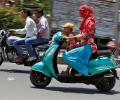
The two-wheeler sector has been underperforming its peers on the volumes front for over five quarters now. Even in the March quarter, Bajaj Auto and Hero MotoCorp posted a 17-24 per cent YoY decline in volumes, the sharpest in the listed auto universe. The ongoing impact of frequent price hikes, all-time high fuel prices, and muted rural sentiment has led to the lacklustre showing by two-wheeler makers. What has aggravated the situation for two-wheeler companies, which get almost all their sales from the internal combustion engine or ICE-based units, is the traction for electric two-wheelers (EV).

PowerGrid was the top gainer in the Sensex pack, rising around 4 per cent, followed by NTPC, Tata Steel, Bharti Airtel, Sun Pharma and Bajaj Finserv. On the other hand, IndusInd Bank, Asian Paints, Infosys, Bajaj Auto and Maruti fell up to 2.59 per cent.

Which entrepreneur would willingly part with her or his hard-earned money for grasping, self-serving politicians? asks Debashis Basu.

IndusInd Bank was the top loser in the Sensex pack, shedding over 3 per cent, followed by Tata Steel, Bajaj Auto, HCL Tech, Sun Pharma and Tech Mahindra. On the other hand, HDFC twins and Bajaj Finance were the gainers.
Tata Steel was the top loser in the Sensex pack, plunging over 8 per cent, followed by SBI, Dr Reddy's, Kotak Bank, Sun Pharma, Bajaj Auto and L&T. NSE Nifty declined 118.35 points or 0.71 per cent to 16,450.50.
After lagging behind other segments in the automotive (auto) space over the past few years, two-wheelers are expected to reverse their volume underperformance. After witnessing a 36.3 per cent volume decline over the 2018-19 (FY19) through 2021-22 (FY22) periods, the sector staged a recovery in 2022-23 (FY23), with volumes rising 17 per cent. While volumes are still a quarter lower than the FY19 peak of 21 million units, a double-digit growth trajectory is expected to prolong.
Two-wheeler exports from India fell by 17.8 per cent to 3.65 million units in 2022-23 (FY23), according to data released by the Society of Indian Automobile Manufacturers (Siam) on Thursday. This decline is due to a rise in global inflation and the weakening of economies and currencies in key export markets of Africa, Latin America (LatAm), and South Asia. In contrast to FY23, two-wheeler exports from India jumped 35.4 per cent to 4.44 million units in 2021-22 (FY22).

Nestle was the top loser in the Sensex pack, shedding over 2 per cent, followed by Maruti, Bajaj Finserv, Bajaj Auto, TCS and L&T. NSE Nifty slipped 8.60 points to 17,353.50.
Titan was the top gainer in the Sensex pack, rallying over 5 per cent, followed by Bajaj Auto, Bajaj Finserv, SBI, Nestle India, ITC, Axis Bank and Tata Steel. Nifty rose 46 points to its fresh closing peak of 17,991.95.
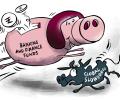
Even as banks and finance companies are reporting record-high earnings, their weighting in the benchmark National Stock Exchange Nifty50 Index has seen a downward trajectory. Investors expect a stronger performance from other sectors in the new year. Currently, banking, financial services and insurance (BFSI) companies collectively hold a weighting of 34.5 per cent, down from 36.7 per cent at the end of December 2022 and a record high of 40.6 per cent at the end of December 2019. This represents the sector's lowest weighting in the index since December 2021 when it stood at 33.7 per cent.

PowerGrid was the top loser in the Sensex pack, shedding around 3 per cent, followed by Asian Paints, Axis Bank, Kotak Bank, Bajaj Auto, SBI and M&M.

Bajaj Finserv was the top loser in the Sensex pack, shedding over 2 per cent, followed by Infosys, Tech Mahindra, UltraTech Cement and IndusInd Bank. On the other hand, Dr Reddy's, Bajaj Auto, Sun Pharma, Asian Paints and NTPC were among the gainers. NSE Nifty lost 41.50 points to end at 15,680.

Fresh selling in noon deals, on account of the derivatives expiry of the November series, saw the index drop to a low of 18,930 - down 361 points from the day's high. The Sensex finally ended with a gain of 64 points at 19,003. The NSE Nifty ended at 5,635, up 17 points.
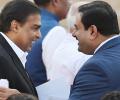
Mukesh Ambani, the patriarch of Reliance Industries (RIL), and Gautam Adani, the chairman of Adani Group of companies, have secured the top positions on the Fortune India Rich List, created in partnership with Waterfield Advisors, with respective wealth of $99.7 billion and $63.71 billion. With a wealth of $34.6 billion, the Mistry family of Shapoorji Pallonji Group holds the third position on the list, while the Poonawalla family, owners of vaccine maker Serum Institute, with a wealth of $32.9 billion, stands fourth. Stockbroker and founder of D-Mart-branded grocery stores, Radhakishan Damani, claims the fifth spot on the India Rich List with a wealth of $23.4 billion

ONGC was the top loser in the Sensex pack, shedding around 4 per cent, followed by NTPC, PowerGrid, M&M, Nestle India, SBI and HCL Tech. On the other hand, HUL, Bajaj Auto, Bharti Airtel, Bajaj Finserv were among the gainers.
Maruti was the top gainer in the Sensex pack, rallying over 6 per cent, followed by M&M, Bajaj Auto, NTPC, Reliance Industries and HDFC Bank. NSE Nifty advanced 1.90 points to record 17,855.10.
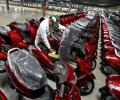
What has hit sentiment further is a draft proposal by the government to increase vehicle insurance premiums for financial year 2022-23 (FY23). Third-party motor insurance premiums have not been increased over the last two years and if this is approved, insurance costs for specific segments could rise by a fifth. The worst impacted is the 350cc and above two-wheeler segment, where premiums are up 21 per cent. Royal Enfield (Eicher Motor) is the market leader in the segment. The premiums in the 150-350cc two-wheeler category are also being inc
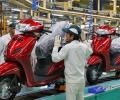
Honda Motorcycle and Scooter India (HMSI), the country's second-largest two-wheeler manufacturer, is planning to launch its first electric vehicle (EV) here by March next year, said CEO & MD Atsushi Ogata on Monday. The company would also enter the low-end motorcycle market in March by launching a 100cc engine bike at a price that will "positively shock" customers, he said while speaking with reporters, after launching the Activa with Honda Smart Key. HMSI's first EV, an electric scooter, will have a fixed battery and the second model will have two swappable batteries, Ogata explained.

To come up with first EV by 2025, expects market to grow two to three-fold in the next ten years.
L&T was the top loser in the Sensex pack, shedding around 2 per cent, followed by Reliance Industries, Bajaj Finserv, IndusInd Bank, SBI, Maruti, Axis Bank and Bajaj Auto.

The no-equity partnership will develop a range of mid-capacity 250-750cc motorcycles.

Bajaj Auto was the top loser in the Sensex pack, shedding around 2 per cent, followed by TCS, HDFC Bank, Axis Bank, Reliance Industries and Tech Mahindra. On the other hand, Tata Steel, Bajaj Finserv, Bharti Airtel and NTPC were among the gainers. NSE Nifty dropped 38.10 points to close at 15,689.80.
