
The postmortem reports in connection with the Batla House encounter has revealed that the two alleged terrorists, 17-year-old Mohammad Sajid and 24-year-old Atif Ameen, had been hit by a blunt object before they died in the crossfire with the Delhi police.
Indian Mujahideen terrorist Atif Ameen and an absconder were on Thursday charged by the police with planting bombs at posh Greater Kailash market in New Delhi on September 13 following a conspiracy hatched by Pakistan-based mastermind and IM founder Amir Raza Khan. In a charge sheet filed before chief metropolitan magistrate Kaveri Baweja, the police alleged that Ameen, who was killed in an encounter in south Delhi's Batla House area, had planted bombs.
The 24-year-old Azamgarh youth allegedly submitted a BSc degree certificate from Allahabad University for taking admission in a post-graduation course in human rights, Joint Commissioner of Police (Special Cell) Karnal Singh told PTI.

Inspector Sharma of the Special Cell of Delhi was killed during the 2008 Batla House encounter in Jamia Nagar in south Delhi.

He was a member of Azamgarh (Sanjarmur) module of the IM and was based in Nepal where he was teaching at a school.

The Delhi police on Friday said it was not shying away from any inquiry into the Batla encounter case as it felt it had acted for the betterment of the country.

A Delhi court on Thursday held that the September 19, 2008 Batla House encounter was genuine. Vicky Nanjappa tells you how the court came to this conclusion.

The Delhi Police appear to be on a weak footing in the Batla House encounter case. The verdict in the case will be delivered on July 25, reports Vicky Nanjappa

Ariz Khan, who has been awarded death penalty for the murder of Delhi Police Inspector Mohan Chand Sharma in connection with the sensational 2008 Batla House encounter case was allegedly associated with the Indian Mujahideen.
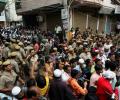
The politics of polarisation became part of the political landscape of the national capital after the Batla House encounter.

Congress leader Digvijay Singh, who had sparked a political storm by claiming that Batla encounter was fake, on Thursday said that he still stood by his statement and refused to apologise for it.

A dossier on the Indian Mujahideen, which was prepared following its resurrection post the Batla House encounter, had termed the outfit as a "start to finish jihad factory."
Suspected Indian Mujahideen terrorist Shahzad Ahmed, convicted in the 2008 Batla House encounter case, was sentenced to life imprisonment on Tuesday by a Delhi court for killing decorated police officer M C Sharma and injuring two other cops.
.jpg)
With the court convicting the lone militant in the controversial Batla House encounter for murdering Inspector M C Sharma, the slain cop's family on Thursday said it proved his martyrdom was genuine and the politicians who had raised doubts were wrong.

Lone suspected Indian Mujahideen operative Shahzad Ahmad was today convicted in the 2008 Batla House encounter case by a Delhi court for murdering a police inspector and assaulting other officers.
The lone alleged Indian Mujahideen militant facing trial in the 2008 Batla House encounter case in New Delhi has pleaded innocent before a Delhi court while refuting police's claim that he had confessed to his role.
A new report has questioned the trial court verdict convicting Shahzad Ahmad in the Batla House encounter case, speaks in length about why the verdict in the Batla House encounter is wrong. The 24-page-report, titled Beyond reasonable doubt? The Conviction of Shahzad Ahmad which has been put out by the Jamia Teachers' Solidarity Association, states that the findings of the court are based on conjectures. Vicky Nanjappa explains.
 © 2026 Rediff.com - Advertise with us - Disclaimer - Privacy Policy - Sitemap - Feedback - About us - Terms of use - Grievances