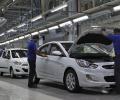
Rising automobile exports are reflective of the increasing acceptance of India-manufactured vehicles across global markets, according to Economic Survey 2025-26.

The share of first-time luxury customers in BMW's portfolio has risen sharply -- from around 43 per cent in 2024 to nearly 49 per cent in 2025. In some models, the figure is even higher.

Kant, a retired 1980-batch Indian Administrative Service (IAS) officer of Kerala cadre, was appointed as India's G20 Sherpa in July 2022, months before India assumed the G20 Presidency.

Reliance Industries Limited has been granted approval to set up a battery manufacturing facility for up to 10 GW under the Rs 3,620 crore-Production Linked Incentives (PLI) scheme for ACC Battery Storage, the government said on Wednesday. The Ministry of Heavy Industries had received bids from seven bidders under global tender for Production Linked Incentives (PLI) scheme for 10 GWh Advanced Chemistry Cell (ACC) manufacturing, with a maximum budgetary outlay of Rs 3,620 crore, announced on January 24, 2024.
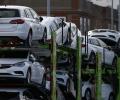
The production linked incentive scheme (PLI) for automobile and auto components has so far attracted a proposed investment of Rs 67,690 crore, said Economic Survey 2023-24 tabled in Parliament on Monday. A capital of Rs 14,043 crore has been invested till end-March 2024, it stated. Applicants have proposed employment generation of 1.48 lakh, against which 28,884 of jobs have been generated till March 31, 2024, the Economic Surevy 2023-24 stated.

Commerce and Industry Minister Piyush Goyal has visited the manufacturing facility of US-based electric vehicle major Tesla at Fremont, California and said that the company would be doubling its auto components imports from India. The minister is in the US on a four-day visit. The world's largest electric car producer Tesla Inc's chief Elon Musk met Prime Minister Narendra Modi in June in New York and after the meeting Musk had said that he planned to visit India in 2024.
India will never provide company or enterprise-specific incentives in the electric vehicle sector, a top government official said on Friday, amid a push from American electric carmaker Tesla for special sops to set up its factory in the country. If the government has to consider providing incentives then it will only be for all EV makers and entrants who want to come to India, the official said. The official added that inter-ministerial discussions have happened on the customs duty concession demand of the US-based electric car maker Tesla, but "we never" came to any conclusion on those.
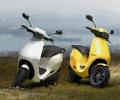
The launch of a range of electric motorbikes (e-bikes) by Bengaluru-based Ola Electric, a first for the company, has disconcerted the industry because the low price the firm claims to be offering has the potential to disrupt the market. On August 15, Ola unveiled its Roadster series e-bike with a starting-price at Rs 74,999. This new pricing undercuts the previous lowest price in the category, which was Rs 110,000.
India will not tailor its policies to suit US EV maker Tesla, and its laws and tariff rules will be formulated to attract all-electric vehicle manufacturers from across the world to set up a base in the world's fastest-growing economy, Commerce and Industry Minister Piyush Goyal said. Tesla has been seeking an initial tariff concession that would allow it to offset 70 per cent customs duty for cars priced less than $40,000, and 100 per cent for cars of higher value.

The Ministry of Heavy Industries announced on Tuesday that it has received bids from seven players for the re-bidding tender of the 10 gigawatt-hour (Gwh) tranche of the Advanced Chemistry Cell (ACC) manufacturing production-linked incentive (PLI). "The list of bidders (in alphabetical order) who have submitted bids in response to this tender are ACME Cleantech Solutions, Amara Raja Advanced Cell Technologies, Anvi Power Industries, JSW Neo Energy, Reliance Industries, Lucas TVS, and Waaree Energies for a cumulative capacity of 70 Gwh," the ministry said in a statement. After the re-auctioning for the manufacturing unit was announced in January, the pre-bid meeting was held on February 12, the ministry said.
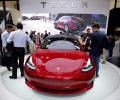
US-based electric vehicle maker Tesla is looking to source components worth around $1.9 billion this year against $1 billion last year, Commerce and Industry Minister Piyush Goyal said on Wednesday. The minister said that going forward, demand for electric vehicles will increase and it will help in pushing the growth of the sector. "Tesla already last year bought one billion dollars of components from I think all of you sitting here.... I have the list of companies who supply to Tesla.

'If businessmen should be included in the political process -- which is essential in my opinion -- they need to have the freedom to express themselves and to take stands against the government of the day, without fear of reprisals and attacks on their business.'

The government is considering the option of inviting fresh applications to bid for the fourth slot which fell vacant after one of the initial candidates who qualified, Hyundai Global Motors, exited from the production-linked incentive (PLI) scheme for advanced chemistry cell battery storage with a capacity of 20 GwH. Earlier, stakeholders had expected that the vacant slot would be offered to waitlisted players ranked on their technical and financial offer. A final decision will be taken soon.

In a big push to the production-linked incentive (PLI) scheme, the government has nearly doubled (increase of 81 per cent) the allocation in five key industry segments from Rs 8,405 crore in the Revised Estimate of FY24 to Rs 15,198 crore in the Interim Budget for FY25. The segments cover over eight PLI schemes, including mobile phones, IT hardware, pharma (PLIs for medical devices, intermediates and pharmaceuticals), food processing, telecom hardware and, auto and auto components. In FY24, DPIIT officials, however, said that the disbursements would be much higher at around Rs 11,000 crore than what has been budgeted for the year.

RIL subsidiary Reliance New Energy Solar, Ola Electric, Hyundai Global Motors Company and Rajesh Exports have been approved for receiving incentives under the Rs 18,100 crore Production Linked Incentive (PLI) scheme for battery manufacturing in India, sources said on Thursday. "The ministry had received bids from 10 companies with a capacity of 130 GWh. Reliance, Ola Electric, Hyundai and Rajesh Exports have qualified for ACC batteries," a source said. Other companies which had applied for the PLI scheme for Advanced Chemistry Cell (ACC) batteries were Lucas-TVS, Mahindra & Mahindra, Amara Raja Batteries, Exide Industries, Larsen & Toubro and India Power Corporation Limited.

The Centre on Wednesday scrapped the mandatory human safety tests for electric vehicle (EV) batteries required to qualify for incentives under various government schemes. The ministry of heavy industries, in its fresh guidelines, has made compliance with the ministry of road transport and highways (MoRTH's) prevailing EV battery testing standards the only requirement to get incentives under the Centre's various incentive schemes.

Ola Electric has finalised its second phase of expansion, under which it will increase its plant capacity fourfold - from 1 million two-wheelers per annum to 4 million. This will also include motorcycles, said a top executive of the company. It will also build a plant with a 5 Gwh of advanced chemistry cell battery storage capacity in the same super factory located on the outskirts of Bengaluru.

To ramp up domestic battery manufacturing capacity and reduce the dependence on imports, the government has initiated talks with a few lithium-rich countries to supply the mineral to Indian companies, industry sources informed Business Standard. The Ministry of External Affairs (MEA) held a meeting with the ambassadors of countries, including Argentina, Chile, and Bolivia, among others, to put forth its request.

Discussions are also going on to bring PLI scheme for toys, furniture, bicycles and containers. The objective of the scheme is to make domestic manufacturing globally competitive, create global champions in manufacturing, boost exports and create jobs.
The government is likely to extend fiscal incentives for production of toys, bicycles and leather and footwear in the forthcoming budget as it looks to expand production linked incentive (PLI) scheme to cover more high-employment potential sectors, sources said. The government has already rolled out the scheme with an outlay of about Rs 2 lakh crore for as many as 14 sectors, including automobiles and auto components, white goods, pharma, textiles, food products, high efficiency solar PV modules, advance chemistry cell and speciality steel. The scheme aims to make domestic manufacturing globally competitive and create global champions in manufacturing, and it is yielding solid results, sources said.
India's production-linked incentive (PLI) scheme, which aims to make domestic manufacturing globally competitive, has attracted investment worth over Rs 45,000 crore and has also created three lakh jobs, NITI Aayog CEO Parameswaran Iyer said on Monday. The government has rolled out the scheme with an outlay of about Rs 2 lakh crore for as many as 14 sectors, including automobiles and auto components, white goods, pharma, textiles, food products, high efficiency solar PV modules, advanced chemistry cell and speciality steel. "The PLI programme has already started showing results.
Four companies - Rajesh Exports, Hyundai Global Motors Company, Ola Electric Mobility and Reliance New Energy - are eligible for receiving benefits under the production-linked incentive (PLI) scheme for advanced chemistry cell battery storage, the heavy industries ministry said on Thursday. The allotment was made for a total of 50 GWh of battery capacity to the four successful bidders. These firms, the ministry said, will receive incentives under India's Rs 18,100 crore programme to boost local battery cell production.

A vast majority of the business leaders believe that the Production Linked Incentive (PLI) schemes have been beneficial and expect an extension to other sectors in the coming years, a Deloitte Survey said on Friday. An overwhelming number of survey respondents hope the budget will fuel growth across industries by building strong domestic demand and focussing on capital expenditure and believe that it would define the 'Amrit Kaal'. "Critical to this growth will be the pace of capital expenditure, infrastructure development, and the need to boost infrastructure financing through private partnership. 60 per cent of respondents suggested raising funds through Indian Government Bonds," the survey said.
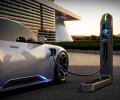
With a million-odd electric vehicles (EVs) - two-wheelers, e-rickshaws, buses and passenger cars - expected to hit the road this calendar year, the shift from gasoline-powered vehicles has become irreversible. Now the question is whether the supply chain is ready for this shift. Key components - the high-powered lithium-ion battery and the cells which go with it, the electric motor, and the electronics powered by chips - account for nearly 60 per cent of the cost of an EV.
At Prestige Polygon Towers in Chennai's Teynampet, hectic preparations are on for a mega global investors' meet under the aegis of Guidance Tamil Nadu (the state investment promotion agency) scheduled for January 2024. Asked about the key focus areas of the meet, the agency's managing director and chief executive officer, V Vishnu, said the state was betting big on electric mobility. This is no surprise, given that the state has signed electric vehicle (EV)-related memorandums of understanding (MoUs) with several companies in the recent past that may bring in investments worth around Rs 33,000 crore with the potential to create over 43,000 job opportunities.
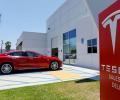
Making it clear that relaxations will not be provided to US-based electric vehicles major Tesla unless it participates in manufacturing activities in India, Union Minister Krishan Pal Gurjar on Tuesday said there cannot be a situation where the market is India but jobs are created in China. The minister of state for heavy industries also told the Lok Sabha during Question Hour that the company is yet to apply for schemes as per the government's policy. Last year, the Elon Musk-led company sought a reduction in import duties on electric vehicles (EVs) in India but the Ministry of Heavy Industries asked the firm to start manufacturing its iconic EVs in the country before any tax concessions can be considered.

The Union Cabinet on Wednesday approved a Rs 26,058 crore production linked incentive (PLI) scheme for auto, auto-components and drone industry to enhance India's manufacturing capabilities, Union Minister Anurag Thakur said on Wednesday. The PLI scheme will incentivize the emergence of advanced automotive technologies' global supply chain in India.
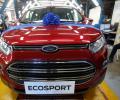
Ford, which had announced to quit the Indian market last year, said it was exploring the possibility of using one of its plants in India to produce electric cars for exports.
Engineering giant Larsen & Toubro (L&T) is looking to divest its exposure to road and power concessions and incubate digital and e-commerce businesses as part of its new five-year plan ending 2025-26 (FY26). The base year for the plan is 2020-21 (FY21). The blueprint, called Lakshya 2026, is intended to help the company exit sub-scale businesses, concentrate on high-technology (tech) manufacturing, construction and green energy projects, and increase its share from information technology (IT) and digital services. The lending operations of the financial services business, meanwhile, will be reorganised, with focus on retail lending.
'I have personally been very keen on investing in lithium ion battery technology for some time.'

Reliance Industries Ltd's focus on the next hypergrowth opportunities in clean tech and its path to decarbonisation has the potential to spur re-rating, raises clarity on investment cycles and reduces investor worry, brokerages said. RIL chairman Mukesh Ambani at the company's 'Green AGM' on Thursday committed Rs 75,000 crore over the next three years to set up an integrated Green Energy Giga Complex across 5,000 acres in Jamnagar, Gujarat which will contain four giga factories. The complex, which would be one of the world's largest renewable manufacturing facilities, would have an integrated solar photovoltaic module factory, an energy storage battery factory, electrolyser manufacturing for hydrogen production, and manufacturing of fuel cells so that hydrogen can be used in transportation.
 © 2026 Rediff.com - Investor Information - Advertise with us - Disclaimer - Privacy Policy - Sitemap - Feedback - About us - Terms of use - Grievances