
The correction seen in the stock markets thus far is insufficient and there are significant downside risks, given the way macroeconomic data is shaping up, a Nomura equity strategist said on Thursday. "The markets are trying to look through the current stress we see in the macros. There are potential risks to the market. "Our estimates assume no major impact on growth and earnings. "The market should have been at least 5 per cent lower than it is now.

After lagging behind benchmarks and broader indices over the past five years, real estate investment trusts (Reits) have outperformed them since the start of 2024. The four listed Reits have posted an average return of 16 per cent year-to-date, compared to 9.9 per cent for the S&P BSE Sensex and 11 per cent for the National Stock Exchange Nifty.

Food delivery and quick commerce (qcom) service application (app), Zomato, now commands a market capitalisation (mcap) higher than automobile giants Tata Motors and Bajaj Auto. Zomato, whose shares closed 1.18 per cent lower on Thursday at Rs 288.45 per share, has an mcap of Rs 2.78 trillion, according to BSE data. By comparison, Tata Motors' mcap stood at Rs 2.74 trillion, while Bajaj Auto's was Rs 2.5 trillion on the BSE.

Among the Sensex firms, IndusInd Bank, Maruti, Titan, Reliance Industries, NTPC, Mahindra & Mahindra, Larsen & Toubro, Kotak Mahindra Bank and HDFC Bank were the major laggards. UltraTech Cement, JSW Steel, Axis Bank, Tata Consultancy Services, Wipro and ITC were the major gainers.

The controlling shareholders of smaller and mid-sized companies are reducing their stakes at levels seldom seen since the 2008 global financial crisis. Over 20 per cent of companies listed on BSE MidCap and BSE SmallCap have seen a decline in promoter holdings for five consecutive quarters, reveals data from DSP Mutual Fund, shared with Business Standard. In the latest June quarter, the figure stood at 22.6 per cent.

From the 30 Sensex firms, Mahindra & Mahindra, JSW Steel, Maruti, Tata Steel, Larsen & Toubro, ICICI Bank, Power Grid, Nestle, Bharti Airtel and Adani Ports were the biggest gainers. Tata Consultancy Services emerged as the only laggard.
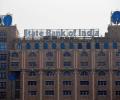
SBI Q3FY24 result review: A higher-than-factored weakness in the October-to-December quarter (Q3) results of State Bank of India (SBI), for financial year 2023-24 (FY24), has prompted brokerages to cut earnings estimates for the ongoing financial year. They, however, have maintained 'Buy' ratings on the stock, revising target price upwards in some cases, owing to the stock's recent underperformance relative to its peers.
Riding on a bull run, equity investors became richer by Rs 128.77 lakh crore in the 2023-24 fiscal, driven by robust fundamentals of the Indian economy, increased investment inflows and promising corporate earnings. After a muted performance in 2022-23, equity markets made a remarkable recovery in FY24, giving handsome returns to investors. The 30-share BSE Sensex climbed 14,659.83 points or 24.85 per cent in 2023-24.

A buoyant equity market, coupled with an improved performance of mutual funds (MFs) on the returns chart, has heightened retail investors' appetite for equities. In the past few months, equity MF schemes have seen a surge in fresh investments through both lump sum (one-time investments) and systematic investment plan (SIP) routes. During the August-September 2023 period, equity MF schemes recorded net lump sum investments of Rs 35,270 crore, compared to just Rs 5,550 crore in the previous three months, according to data from the Association of Mutual Funds in India (Amfi).
 © 2026 Rediff.com - Investor Information - Advertise with us - Disclaimer - Privacy Policy - Sitemap - Feedback - About us - Terms of use - Grievances