
The Indian economy is rapidly normalising towards pre-pandemic activity levels, even as uncertainty exists about coronavirus mutations and repeated infection waves, industrialist Kumar Mangalam Birla said on Wednesday. Vaccination is picking up pace, which would improve India's resilience against a potential third wave, the chairman of Aditya Birla Group said while virtually addressing shareholders at the AGM of group firm UltraTech Cement Ltd. Moreover, various steps taken by the RBI and the government have helped in containing the economic disruptions of the pandemic, Birla added.

Shares of small-cap companies have been on a roll with the S&P BSE Small-Cap index hitting a new high in intra-day deals on Thursday. The rally has been fueled by an up move in stocks of chemicals, cement, graphite electrode makers, pharmaceuticals and information technology (IT) shares. In the past two weeks, since March 25, the index has outperformed the market by gaining 7.3 per cent. In comparison, the S&P BSE Midcap index was up 6.1 per cent, while the S&P BSE Sensex gained 3.6 per cent during the same period.

The Indian economy will suffer lasting damage from the coronavirus crisis and after an initial strong rebound in FY22 (fiscal year ending March 2022) growth will slow to around 6.5 per cent a year over FY23-FY26, Fitch Ratings said on Thursday. "A combination of supply-side scarring and demand-side constraints - such as the weak state of the financial sector - will keep the level of GDP well below its pre-pandemic path," it said in commentary on the Indian economy. Fitch said India's coronavirus-induced recession has been among the most severe in the world, amid a stringent lockdown and limited direct fiscal support.

Will 2022 be a year of contrasting narratives -- one filled with caution and the other with continued optimism?

With the increased death rate in the ongoing second wave of Covid-19, domestic cement companies are in no better condition than they were in the April-June quarter of FY21 when the country faced nationwide lockdown. "This wave has had high death rate which has impacted the business. "We are in no better situation than last (year) April. "Deaths of drivers, dealers, contractors and also employees have hit the industry really very hard since April (FY22)," M Ravinder Reddy, director of Bharathi Cements said.
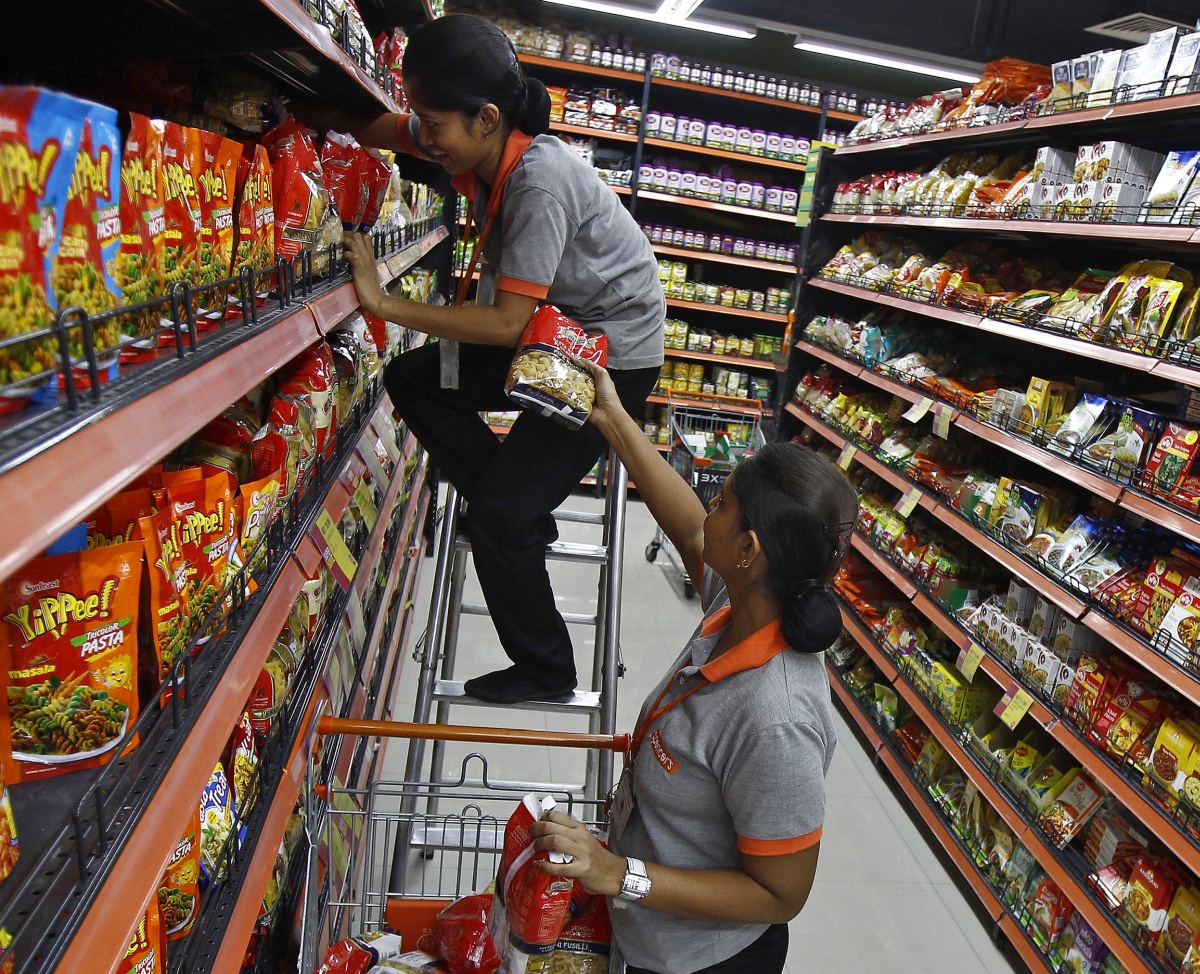
However, rural demand continued to remain a concern for FMCG companies during the quarter.

The market capitalisation of BSE-listed companies jumped to a record high of Rs 2,40,04,664.28 crore on Tuesday, driven by a rally in stocks that also saw the benchmark Sensex touching its lifetime peak of 53,887.98 points. Rallying for the second consecutive day on Tuesday, the 30-share BSE index closed at a fresh closing peak of 53,823.36 points, a jump of 872.73 points or 1.65 per cent. During the day, it zoomed 937.35 points to 53,887.98 points.

Tata Consultancy Services (TCS) will hand out across-the-board salary increments for 2021-22, becoming the first IT services company to do so. The salary hike roll-out will benefit nearly 4.7 lakh employees of the company. The average increment band for offshore employees is expected to be 6-7 per cent as per norms, sources privy to the development told PTI. This would be the second salary hike within six months by TCS.

The economy, though projected to grow 9.6 per cent in the next financial year in year-on-year growth term, may grow just 1 per cent in real terms to Rs 147.17 lakh crore as against Rs 145.66 lakh crore in 2019-20, at the 2011-12 prices, according to a report by India Ratings. The size of the economy, as per the National Statistical Office's data, had stood at Rs 145.66 lakh crore in 2019-20, at the 2011-12 prices. According to the rating agency, the country's gross domestic product (GDP) is expected to contract 7.8 per cent to Rs 134.33 lakh crore in 2020-21, but may grow 9.6 per cent to Rs 147.17 lakh crore in 2021-22.

The government has developed an asset monetisation dashboard for monitoring real-time progress of its ambitious Rs 2.5 trillion-plus pipeline, and providing visibility to investors. The portal has been prepared as the government tries to provide a one-stop shop to investors keen on taking over assets of government departments and ministries.

Check out some of the stocks that will react on the basis of their numbers in the near term.

Debt-ridden telecom operator Vodafone Idea on Friday reported widening of its consolidated loss to Rs 7,230.9 crore for the third quarter ended December 2021. The company had posted a loss Rs 4,532.1 crore in the same period a year ago. Consolidated revenue from operations declined by 10.8 per cent to Rs 9,717.3 crore from Rs 10,894.1 crore in the year-ago period.

Some of these nations are India's biggest export market. India is also dependent on these countries to meet its energy needs.


The first quarter earnings season will dictate the trend in the equity markets in this holiday-shortened week amid absence of major macroeconomic drivers, say analysts. Besides, lacklustre global markets may increase volatility in the market, they added. Equity markets would remain closed on Wednesday for Bakri-Id.

'The spurt in demand for Ayurvedic products has exhausted our production capacity.'

IT major Wipro on Thursday reported a 35.6 per cent jump in consolidated net profit to Rs 3,242.6 crore for the June 2021 quarter. Wipro had registered a net profit (attributable to equity holders) of Rs 2,390.4 crore in the year-ago period, as per Indian Accounting Standards (Ind-AS). Its revenue from operations increased by 22.3 per cent to Rs 18,252.4 crore in the reported quarter from Rs 14,913.1 crore in the same period last fiscal, Wipro said in a regulatory filing.

'There is still scope for selective stockpicking.'

A looming global shortage of diesel in Europe presents India with more than one opportunity to profit from strong margins. A shortage of the fuel, a key contributor to inflation, has been exacerbated by the conflict in Ukraine, and western sanctions on Russian fuel supplies. The slowdown in natural gas supply means the West needs diesel to heat their homes this winter.

Indian GDP will grow at 8.5 per cent in 2021-22, and the rate will accelerate further to 9.8 per cent in 2022-23, a foreign brokerage said on Tuesday. The GDP had contracted by 7.3 per cent in the pandemic-hit FY21, and is widely expected to grow at a faster pace due to the base effect in 2021-22. The Reserve Bank of India (RBI) expects a 9.5 per cent growth in 2021-22, and the same to slow down to 7.8 per cent as things normalise.

A few years ago, when top officials of Indian state-run refiners went to Dubai to negotiate a crude oil supply contract, a senior official from state-owned Saudi Aramco told them, "We can negotiate on anything, but I am the last man standing for you. "Nobody can offer the range of crudes we do with certainty," an official who was part of the negotiating team recalls. Perhaps that explains why Saudi Arabia is less concerned about losing its place as India's premier oil supplier to an upstart like Russia, which emerged from nowhere to become India's biggest crude oil supplier in September and October.

It's a busy season for Indian producers of orthodox tea. As Sri Lanka, the world's largest supplier of orthodox tea, struggles with its worst economic crisis, a window of opportunity has opened up in neighbouring India. Calls to Indian planters and exporters from foreign buyers of Sri Lankan orthodox tea are pouring in and the buoyant sentiment is reflecting in prices at auction centres. Orthodox tea refers to loose-leaf tea which is produced using traditional or orthodox methods such as plucking, withering, rolling, oxidation and drying.

After a gap of three years, direct tax collections -- which include corporate tax and personal income tax -- have exceeded the Budget estimates for FY'22, indicating economic recovery.

GST collections in February grew 18 per cent to over Rs 1.33 lakh crore in February even as the Omicron wave dented the month-on-month collection momentum. This is for the fifth time in the current fiscal that the Goods and Services Tax (GST) collection has crossed Rs 1.30 lakh crore mark. Also, this is the first time, cess collection has crossed the Rs 10,000 crore mark, signifying recovery in certain key sectors, especially automobile sales, the finance ministry said on Tuesday.

'As valuations of large-caps appeared to be out of whack, investors started lapping up quality mid-caps and small-caps, which were available at relatively comfortable valuations.'

The third-quarter financials didn't excite market watchers. But equity investors can still make money if they invest in the right stocks.

Gautam Adani on Tuesday said his ports-to-energy conglomerate never slowed or stopped investing in the country as the group's success is based on its alignment with the India growth story. Speaking at the annual shareholder meeting of the group companies, he said the previously announced $70 billion investment in new energy business will help turn India from being a net importer of oil and gas to an exporter of clean energy. "Never have we walked away from investing in India, never have we slowed our investments," he said. "We believe our scale, our diversified business, and our track record of performance positions us very strongly to continue to perform well in a variety of market conditions."

Mutual funds, as experts and custodians of another set of retail investors' savings, play a speculative game they are neither supposed to nor equipped to do, cautions Debashis Basu.

Recently, TPEM's first born electric concept, Avinya broke cover. The model promises a minimum range of 500 kilometres and advanced technology features, aimed at buyers in India and outside. TPEM, the newly formed entity may also consider a separate dedicated sales channel for the EVs with a distinctive corporate identity once the volumes reach a critical mass and throughput is large enough for the dealers to be profitable, said Chandra. Elaborating further on the hiring strategy he said, "We will hire from everywhere-wherever the talent of the required competency is available."

Finance Minister Nirmala Sitharaman will kick start the customary pre-Budget consultation exercise with stakeholders from Wednesday by holding the first such meeting with experts of agriculture and agro-processing industry. She will be seeking inputs from various stakeholders, including industry bodies, farmer organisations and economists for reviving consumption and boosting growth hit by the COVID-19 pandemic. The growth this year is expected to be in the double-digit during the current fiscal.

Many years during which monsoons were poor saw high returns, while normal or excess rainfall has also coincided with poor calendar year gains.

Despite the demonetisation of 2016 and the rise in digital transactions that followed, the economy's dependence on cash has remained as high as ever. So when the Reserve Bank of India (RBI) introduced a pilot project of its version of digital cash - called the central bank digital currency (CBDC) - on December 1, many questions were asked. Can the CBDC replace physical cash, even partially? Can it match cash in terms of convenience? Are CBDC transactions truly anonymous?

Currently, TCS is India's second most valuable firm after Reliance Industries, which has a market cap of nearly Rs 12.9 trillion.

The divestment process, however, will not be an easy affair as there are multiple stakeholders, including the employee unions, whose concerns will have to be addressed.
HDFC Bank was the top gainer in the Sensex pack, rallying over 4 per cent, followed by SBI. IndusInd Bank, ICICI Bank, Axis Bank and HDFC were also among the gainers. NSE Nifty soared 269.25 points to 15,175.30.

India's current account slipped into a deficit of $9.6 billion or 1.3 per cent of GDP in the September quarter, the Reserve Bank said on Friday. The current account, which records the value of exports and imports of both goods and services along with international transfers of capital, was in a surplus mode both in the quarter-ago and year-ago periods. India's current account surplus had stood at $6.6 billion or 0.9 per cent of GDP in the April-June 2021 quarter, while in the year-ago period (Q2FY22), the surplus had stood at $15.3 billion or 2.4 per cent of the GDP, the data said.

The move towards indigenisation of defence procurement creates new opportunities for India's military industrial sector. The Government of India (GoI) has so far released five lists of items for positive indigenisation - these should be manufactured in India, rather than imported. Each item on these lists represents an opportunity for some local firm.

Nepal's decision to ban the import of non-essential items amid depleting forex reserves may hit Indian exports. The country's central bank - Nepal Rastra Bank - last week instructed commercial banks not to open letters of credit (LCs) for importing non-essential items. This is to prevent further decline of the country's foreign exchange reserves. However, it has not issued any formal communication yet.

The asset quality of non-banking financial companies (NBFCs) deteriorated in April-September 2021 (H1FY22) owing to the second wave of the pandemic. Their gross non-performing assets (NPAs) rose to 6.8 per cent in September 2021 from 6 per cent in March 2021. The Reserve Bank of India's (RBI's) annual Trend and Progress report (FY21) said the sector might have to grapple with higher delinquencies as and when policy measures unwound. The pandemic posed significant challenges to NBFCs during the first wave (2020) also.

'At current valuations, we believe large-caps offer better downside support.' 'Hence, we are suggesting a small tilt towards them.'
