
The report notes that equities had faced pressure from elevated valuation premiums, subdued nominal gross domestic product (GDP) and earnings growth, sustained foreign portfolio investor (FPI) selling, artificial intelligence (AI) infrastructure euphoria, and external shocks including US tariffs and a spike in crude oil prices due to geopolitical tensions in West Asia. However, several of these factors are now reversing.

Analysts at Morgan Stanley have updated their outlook for the Indian markets, and they now expect the Sensex to hit the 107,000 mark by December 2026 in a bull-case scenario, translating into an upside of 26 per cent from current levels.


Retail inflation declined to a three-month low of 5.1 per cent in January, mainly due to subdued prices of vegetables, fruits and other food items, according to government data released on Monday. The fall indicates that retail inflation is inching towards the Reserve Bank's comfort level of 4 per cent. The Consumer Price Index (CPI) based inflation was on the rise for two straight months after touching a trough of 4.9 per cent in October 2023. In December, it stood at 5.69 per cent.

The task of Union Finance Minister Arun Jaitley to keep inflation under check, even when the country reeled under severe drought for two years in a row, and reduce the current account deficit, was made easier by low crude oil prices.

The faster-than-expected rise in interest rates by the US Federal Reserve (US Fed) shook global financial markets in early 2022. And now the ongoing war between Russia and Ukraine has lifted commodity prices, with Brent crude oil hitting a 14-year high of $139 a barrel in intraday trade. All these developments have sent the equity markets across the world into a tailspin.

Indian frontline benchmarks - the S&P BSE Sensex and the Nifty50 - have rallied around 12 per cent each since June-end and outperformed their global peers by a wide margin. On Thursday, the US Fed hiked interest rates by another 75 basis points (bps) - the third such hike this year - and surprised the markets by projecting further sizable hikes in the coming months. With the latest hike, the Fed fund rate (FFR) now stands in the range of 3 - 3.25 per cent and is highest since January 2008.

It's the first time in my memory that I have seen a negative expected return for equities, notes Akash Prakash. Hopefully, this implies the consensus is being too negative, and markets, as usual, will surprise everyone and deliver the least likely outcome.
We know that the boom years are over; do we know what is coming next?

India Inc's profit share in the country's GDP at 15-year low in 2018. Since 2013, net profit for top 500 companies has remained in the range between Rs 4 trillion and Rs 4.8 trillion despite steady growth in nominal GDP.

In the current fiscal so far, retail inflation stabilised around 5 per cent, while wholesale price-based inflation averaged around 2.9 per cent during April-December.
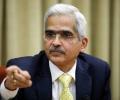
RBI governor Das flags growth slowdown, deputy raises alarm on inflation

The government may have to resort, eventually and however unwillingly, to printing money, abandoned as policy and practice in the 1990, predicts T N Ninan.

The 30-share Sensex ended 79 points lower at 26,909 and the 50-share Nifty closed 25 points lower at 8,102.

RBI lowers GDP forecast for FY16 to 7.4%

'The estimates of tax forgone on this item run into hundreds of billions.' 'And there is neither fairness nor rationality to support continuing with this tax holiday for just one class of investors, those who put their money in shares,' says T N Ninan.

Over the past four quarters, the Sensex companies' earnings trajectory has improved sharply because of a weak rupee.

It goes without saying that the best performers are in the private sector, says TN Ninan.
.jpg)
Traders say the outlook for the rupee has improved on the back of a sharp narrowing in the current account deficit after government and central bank emergency measures such as curbing gold imports.

Beijing did not announce expected policy support over the weekend

'The lessons learnt from the triple disaster have put Japan's energy future On the right path,' notes Dr Rajaram Panda.
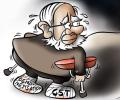
While GST and insolvency laws are among the major achievements of the Modi government, the list of failures include demonetisation, toxic banks, manufacturing hiccups and most prominently bizarre job creation figures. Mihir S Sharma takes a look at the four years of Modi government.

A combination of farm loan debt waivers by state governments and the implementation of the pay commission award could entail some fiscal slippages and pose a risk to inflation

Japan's Nikkei fell 0.5% and South Korea's Kospi lost 1.3%.

One should not time the market before investing
China's CSI300 stock index shed 1.1 per cent, hitting a five-week low, while shares of Hong Kong-listed Chinese companies sagged 0.9 per cent.

Flash floods triggered by incessant rains have claimed 26 lives in Gujarat in the past 48 hours while four lives have been lost in Rajasthan, authorities said on Wednesday.

Several types of investment risks can threaten your portfolio -- some are easier to avoid than others

After a brief lull, intermittent rains lashed Chennai and its suburbs on Sunday, while the weatherman predicted more showers in Tamil Nadu over the next 48 hours.

No prime minister of India ever had greater experience of running a state than Narendra Modi.

Some type of global shock adds to the allure of the dollar.
.jpg)
Throughout a quarter century of proxy war, India has shown tremendous restraint in the face of grave provocation. It is inconceivable that any other nation would have refrained from launching trans-LoC operations to eliminate terrorist training camps and interdict known routes of infiltration, says Brigadier Gurmeet Kanwal (retd).
