

'When I met the prime minister, he asked me, "Dr Ganguly, what do you do with people in your company who lie to you?"'
'I said, "Prime Minister, we counsel them and give them a gentle warning. If they lie again, they are sacked".'
'"This is my problem," Rajiv responded. "I can't sack people in government".'
A revealing excerpt from former Hindustan Lever Chairman Dr Ashok S Ganguly's We Are Our Future: Reflections On Life.

Key Points
- Rajiv Gandhi sought people outside the traditional political ecosystem, reflecting his discomfort with entrenched power structures and inherited advisers.
- Rajiv's leadership style was marked by personal warmth and intellectual curiosity.
- His peers from Doon School and his close friends often said of him, 'He is what you see.'
Rajiv Gandhi was seeking someone who was not part of the traditional political system. He was surrounded by his mother's political advisors and then with his own, besides the usual ministers and bureaucrats.
There was growing speculation that he had begun to distrust certain individuals close to him, including a well-known political figure he had himself brought into the fold.
Did Rajiv Gandhi have weaknesses? Of course, as indeed we all do. He had inherited a job which he did not desire at the behest of his mother and in the aftermath of a personal tragedy.
He was keen to use advanced technologies to boost the slow-moving operational and logistical processes within the government, putting together a list of national priorities and timetables to speed up actions and implementations.
He announced the formation of the Prime Minister's Science Advisory Committee, to which I was appointed as a member alongside other dignitaries. But the ingrained ways of working were not amenable to change, and the attitude of the bureaucrats was an inheritance of the imperial civil service.
One of my friends described it as 'Slowness is not the purpose, thoroughness is.' I also accepted Rajiv's invitation to serve as part-time chairman of the board at IIT Kanpur.
Another cloud over that period was the scandal involving the Bofors gun purchase. I did not know any of the other names being mentioned in connection with the controversy, but I remain firmly convinced that Rajiv Gandhi would not have been involved. His peers from Doon School and his close friends often said of him, 'He is what you see.'
He was open, honest, sincere and keen to learn. When he took over as prime minister, he lacked the necessary experience. He was ready to bear the consequences for those whom he believed were his friends -- those he trusted.
But were some of them really his friends? While the facts and conclusions have remained elusive, the episode unjustly damaged reputations, fuelled more by speculation and innuendo than by verifiable evidence.
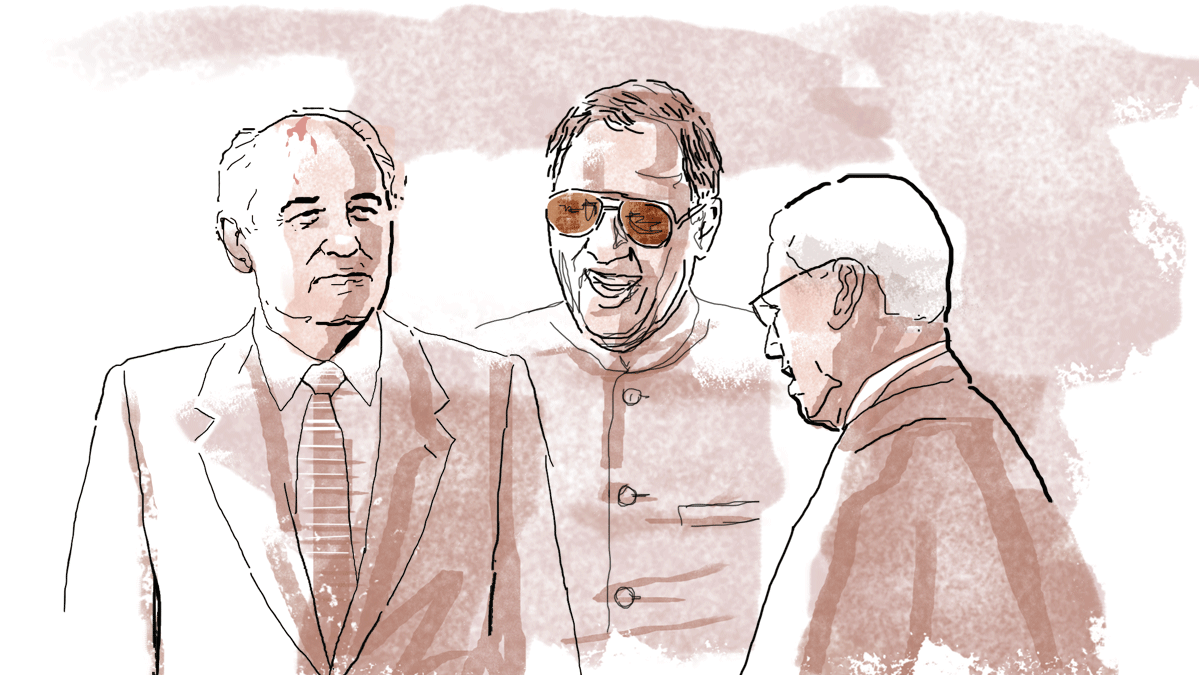
Meeting Mikhail Gorbachev
A notable event in Delhi at that time was the State visit of President Mikhail Gorbachev. Rajiv Gandhi had invited the president for a private evening at his residence, where he had scheduled a presentation on science and technology as part of the programme.
The head of DRDO, the head of SAC-PM and I were to share India's advances in certain areas of science. Besides the Russian president and his interpreter, Prime Minister Gandhi was present as the host. The 45 minute session turned out to be quite lively and enjoyable, and went beyond the stipulated time.
After we concluded, President Gorbachev requested us to prepare a summary of the presentations and discussions, to be made available to him the next morning at 5 am!
We had earlier planned to open a bottle of champagne in private and celebrate the unusual evening. However, the note was delivered to President Gorbachev's residence before 2 am, and we went to bed, postponing the champagne for another occasion.
Gopi Arora turned out to be my saviour
Among Rajiv Gandhi's trusted lieutenants was senior civil servant Gopi Arora, with whom I developed a relationship of confidence, trust and friendship over time.
From time to time, I found myself confronted by Rajiv's enthusiasm for me to join his government, even temporarily.
The roles he proposed ranged from an ambassadorship or a high commissioner's post for a three-year term to other responsibilities of my choosing.
I could never quite bring myself to explain that these proposals were beyond my reach -- bound as I was to a full-time role in the private sector, with a modest salary that helped support both my family and my ageing parents.
Discussions about my remuneration or high taxation were something I firmly avoided. I was resolute in my conviction that my strengths aligned with the expectations of the private sector and that I would likely be a failure in any form of public service.
I was also aware that I would exceed my predecessor's tenure as chairman of Hindustan Lever. I knew that if I stayed too long, I would eventually need to seek a new challenge for myself.
I had already identified and prepared my successor, and had also begun exploring what I wanted to do next -- before I risked overstaying my welcome. These discussions never quite seemed to rest.
We grew accustomed to fresh propositions surfacing from time to time. I was awestruck by the persistence! Eventually, Gopi Arora turned out to be my saviour.
A refusal to bend the rules
During Rajiv Gandhi's tenure as prime minister, there was one particular senior Cabinet minister whom I remember, albeit not quite so fondly, as I do so many others of that time.
His brother had joined Hindustan Lever as a management trainee and later left the company to become a stockist. At one point, he had defaulted on his dues and was cautioned. On a subsequent and repeat event, the company had discontinued his services.
Soon after, I received a call from the senior minister, asking why his brother's services had been terminated. I said I did not know, but I would find out and call him back.
Upon enquiring with the concerned department, I was told that the decision had been taken as per company policy: if a stockist defaulted on two consecutive payments, supplies were stopped.
I called back the minister and explained the company rule. I said that even as a chairman, I did not have the authority to override policy rules for an individual case.
The minister seemed upset, but his brother's service remained suspended. I forgot about the incident and did not tell Rajiv or Gopi about it, as I considered it a matter within my domain of responsibility.
'Dr Ganguly, nothing will happen tomorrow'
About three months later, one evening, I was having a cup of tea with Gopi at the India International Centre, where the company had an apartment, when I received a call from one of our directors in Bombay.
He said, 'We have been informed that a raid is being planned on our company and offices the next morning. We can approach the courts and get a stay.'
I put the phone down, and my concerned demeanour must have given me away because Gopi asked me what the problem was. I told him the entire story. He left shortly after that.
That evening, my bedside phone rang. It was the prime minister. He informed me, 'Dr Ganguly, nothing will happen tomorrow.'
I was both embarrassed and relieved, and told him I wasn't used to getting phone calls from the prime minister. He laughed and said, 'Nothing to worry about. By the way, we haven't had tea for a long time. Let's meet soon.'
I told him it was quite strange
On another occasion, I was due to meet the prime minister, but following a whopping electoral loss in Haryana, I felt it best to postpone. I called his secretary, Vincent George, to ask if we could reschedule this meeting. George called me back within five minutes to inform me that Mr Gandhi was keen to see me as scheduled.
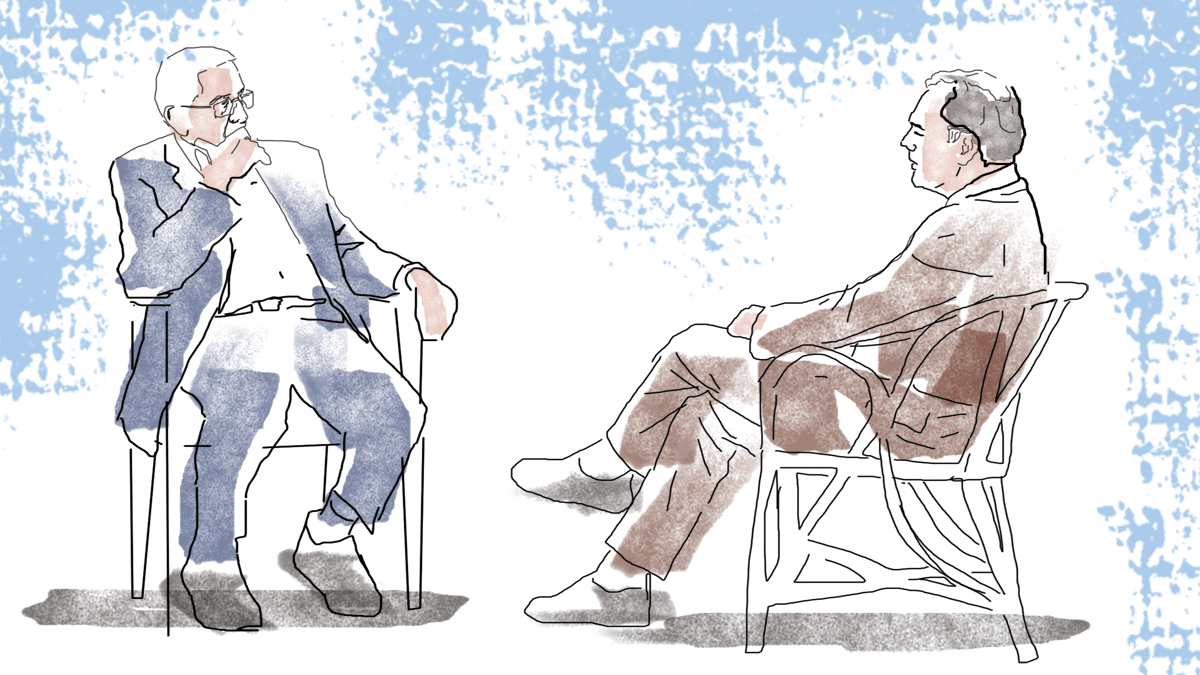
When I met the prime minister, he asked me 'Dr Ganguly, what do you do with people in your company who lie to you?'
I said, 'Prime Minister, we counsel them and give them a gentle warning. If they lie again, they are sacked.'
'This is my problem,' Rajiv responded. 'I can't sack people in government.'
I told him that it was quite strange. I wondered aloud how an institution could function under such constraints.
When Rajiv wanted me to stand for election
General elections were announced in 1991, and campaigning was already in full flow. One evening in 1990, while I was at our residence in London, I received a telephone call from Pranab Mukherjee, former finance minister.
The call carried a rather ominous tone. He said he was calling on behalf of Rajiv Gandhi, who wished me to return to India and file my nomination from an important constituency in North Calcutta.
I am not sure if Rajiv Gandhi knew I was not a Calcutta Bengali. I politely reminded Pranab-babu that it was a ridiculous suggestion because I did not belong to the city. I did not even know the city well, certainly not North Calcutta.
Pranab-babu and I had known each other for many years, and he answered with characteristic politeness. He said he would convey my answer to Rajiv and told me that my next call would be from Mr Gandhi himself.
In less than half an hour, another long-distance call came through. I was momentarily tempted not to answer, but that would be out of character. I took the call and heaved a sigh of relief when I heard Gopi Arora's voice, 'Hello Ashok, Rajiv-ji wishes to have a brief chat.'
I requested Gopi if I could speak to him for a few minutes first, and explained the absolute improbability of the proposition. I knew I was putting him in an awkward situation. I ended by saying, 'You will have to tell Rajiv-ji what I have just said, but please don't put me in an impossible situation.'
Gopi was silent for a moment, probably weighing my words. Finally, he said, 'Ashok, I will try my best to avoid embarrassing you and Rajiv-ji. We've been friends long enough for me to try at least,' he said to my tremendous but temporary relief.

I have rarely shed tears, but on that day, I did
During the campaign in India, I spoke to Rajiv a couple of times every month. The last time I spoke to him was a few days before he was assassinated by a Sri Lankan Tamil Eelam suicide bomber.
During our final conversation, Rajiv had requested that I visit Delhi for a day at the end of May in 1991. I promised him I would, but that promise remained unfulfilled.
I have rarely shed tears, but on that day, I did. After our return to India in 1997, I renewed my contact with Gopi Arora. He had already retired from service, but we remained trusted friends until his retirement and demise.
However, Rajiv Gandhi lost his prime ministership in 1989 -- undone, in part, by the machinations of those who claimed to be his friends and supporters.
Excerpted from We Are Our Future: Reflections On Life by Ashok Ganguly, published by Westland India, with the kind permission of the publishers.
Feature Presentation: Aslam Hunani/Rediff


 © 2026