

Bina Das, 21, got up at her graduating ceremony to assassinate the governor of Bengal. He escaped and she was imprisoned for 9 years.
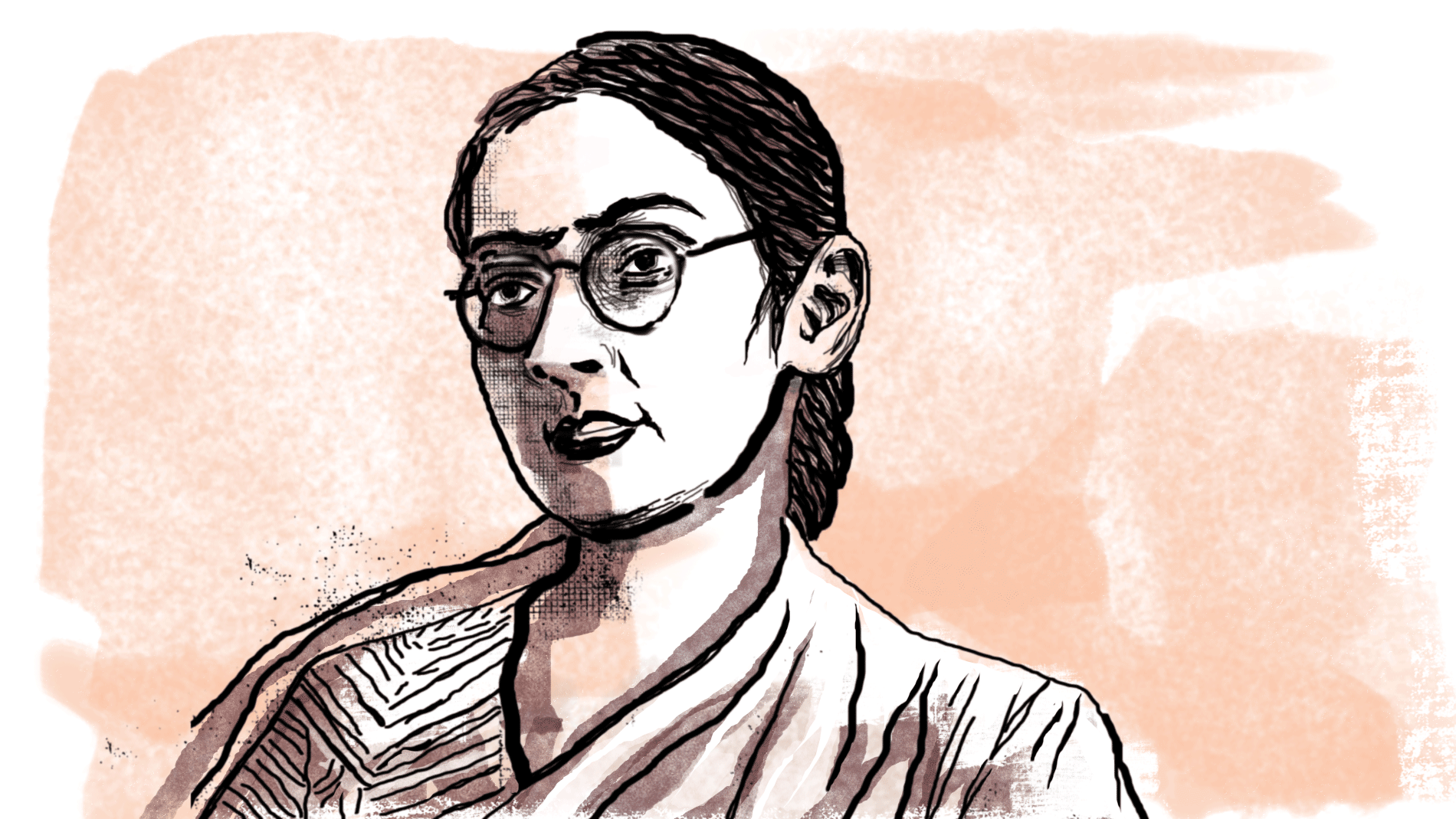
Key Points
- College student Bina Das tried to assassinate the British governor at the convocation ceremony.
- She fired five shots and was imprisoned for 9 years for attempt to murder. She was later imprisoned for 3 years during the Quit India Movement.
- Bina Das died a lonely death. Her body was found by the roadside.
On February 6, 1932, the convocation hall of Calcutta University was full of graduating students, dressed in scholar robes, eager to receive degrees from the British governor of Bengal, Sir Francis Stanley Jackson.
Bina Das, 21, a student of Bethune College, was among the group of graduating students. But obtaining a bachelor's degree from a colonial oppressor was the last thing on her mind.
Since she was a child, her mission had been only this -- the freedom of India.
Seated in her chair, she felt the revolver hidden in the folds of her robe. A member of the Chhatri Sangh, a semi-revolutionary organisation for women started by her sister, she had procured the weapon from another woman revolutionary.
As Jackson delivered his speech, Bina Das got up from her chair, aimed the revolver and fired five shots.
Jackson, who had played 20 Test matches for England, ducked at the nick of time, saved himself and continued with his speech. An aside: Jackson, Wikipedia informs us, 'spotted the talent of Ranjitsinhji when the latter, owing to his unorthodox batting and his race, was struggling to find a place for himself in the university side, and as captain was responsible for Ranji's inclusion in the Cambridge First XI and the awarding of his Blue.'
9 years in jail
Bina Das was arrested, stood trial and was imprisoned for nine years for attempted murder.
Her confessional statement ran into five pages and was banned from publication by the British government.
'My object was to die, to die nobly fighting this despotic government which has kept my country in infinite shame and suffering. Is life worth living in an India groaning under the tyranny of a foreign government or is it not better to make one's supreme protest by giving one's life away,' she said in her well-drafted confession which was a scathing indictment of British repressive rule.
Though banned, the confession was widely circulated for nearly 50 years indicating the impact of her actions which was to shake the foundations of the British empire.
Bina Das served nine years in the Midnapore, Alipore and Hijli jails and led a hunger strike inside Midnapore jail against violence by the jailor. She also met Mahatma Gandhi during his visit to Alipore jail and later worked in relief camps in Noakhali during the post-Partition riots.
Life after Independence
She joined the Congress on release after her first imprisonment in 1939 and continued organising anti-British protests.
She was imprisoned again for three years in Presidency jail during the Quit India Movement in 1942.
After Independence, she married Joytish Bhowmick and contested elections in Bengal. She was an MLA from 1946 to 1951.
Later, disillusioned with the Congress, she left the party and became a teacher.
She was honoured with a Padma Shri in 1960 and wrote two memoirs Shrinkhal Jhankar (Ringing Chains) and Pitridhan.
A sad and lonely death
After her husband's passing in 1986, she spent her last days in Rishikesh and died a lonely death.
Her body was found by the roadside in December 1986.
Degree conferred after 80 years
In 2012, her graduation degree that had been upheld by the British was posthumously conferred at the convocation ceremony that year. Pritilata Wadedar, another revolutionary whose degree was similarly withheld, was also awarded her degree posthumously.
Wadedar had taken cyanide before the British could arrest her after she and fellow revolutionaries burnt a European club that banned 'dogs and Indians' from entry.
Revolution ran in Bina Das's blood
A school topper, Bina Das's parents were members of the Brahmo Samaj. Subhas Chandra Bose was her father's student and often visited their home.
Her brother and elder sister were freedom fighters.
As a school girl, she refused to shower flowers at the viceroy's wife's feet who was to visit the school and left the rehearsal in a sign of revolt.
Bina Das recruited youngsters and organised protests and boycotts against the Simon Commission. She was just 17 then.
A stamp was released in her memory in 2021.
Feature Presentation: Aslam Hunani/Rediff


 © 2026