

'There is no substantive basis for Bangladesh-Pakistan relations. The only real link they can have is mischief, with Pakistan's intelligence agency using Bangladesh to create trouble along our eastern borders.'

Bangladesh has been in deep political turmoil for several months, following mass protests, street violence and a breakdown of public order.
The situation worsened after then prime minister Sheikh Hasina fled the country on August 5, 2024 amid growing unrest and accusations of authoritarian rule.
An interim government led by Nobel Laureate Muhammad Yunus was formed, but instead of restoring stability, Bangladesh has seen continued violence, mob rule, attacks on minorities and State institutions.
Last week student leader Sharif Osman Hadi, a prominent face of the anti-Sheikh Hasina protests, died after being shot by unknown assailants.
Sections of the Bangladeshi media alleged that the Indian government had a hand in the killing and that the killers had escaped to India.
Against this backdrop of political chaos, rising extremism and strained India-Bangladesh relations, Syed Firdaus Ashraf/Rediff spoke to Amitabh Mathur, former special secretary, Cabinet Secretariat. Mr. Mathur dealt with Bangladesh for several years during his tenure in the Cabinet Secretariat.
"Since August 2024, Bangladesh has seen mob rule. There is complete anarchy. Mobs even marched to the supreme court and issued orders to judges. The chief justice was also forced out. The police are ineffective, and the army has been maintaining order for the past 14 months."
What explains the sudden rise in violence and anti-India sentiment in Bangladesh?
Anti-India sentiment has existed in Bangladesh for some time, but it has recently become more intense.
This is largely due to the Jamaat-e-Islami and similar parties, as well as student groups with roots in Jamaat.
As far as violence is concerned, it is linked to the upcoming elections.
Forces that do not want early elections feel they will not win, so they would want the present interim government arrangement to continue.
Does this mean the current interim government under Muhammad Yunus does not want to hold elections in February?
I am not talking about the government as such, but about forces that seem to be running amok without effective control from the government or anyone else.
Why is India being blamed for the Sharif Osman Hadi killing?
India is an easy scapegoat. When your image is poor in a country, people are ready to believe anything negative about you. There is clearly mischief involved.
I read in the media that a Bangladeshi official claimed, without any evidence, that Hadi's attacker escaped to India insinuating India is behind his murder.
India has done nothing in this matter. Why would India want to do anything like that?

From the statements made by various minority groups in Bangladesh it feels they are insecure.
A human rights organisation in Bangladesh, Ain O Salish Kendra, stated that there have been 220 cases of lynchings in the last one year.
As far as lynchings are concerned I do not have direct access to such data nor can I say anything about its reliability.
However, it does appear that the (minority) community feels insecure, both individually and collectively, as seen from statements made by various minority groups in Bangladesh.
I guess there is truth in that, but I cannot comment on the lynching figures or their reliability as I do not have data.
Has India's decision to give Sheikh Hasina asylum caused problems, especially after a Bangladesh court sentenced her to death in absentia? What should India do?
First, the judicial process and court sentence against Sheikh Hasina and others is farcical.
The accused are not allowed their own lawyers, their lawyers are not properly heard, and in some cases the accused who are senior leaders of Awami League have been manhandled in court.
They were brought handcuffed to court wearing helmets. As for India, it is doing what it should do.
I have read that Bangladesh has requested her return and that the Government of India is examining the request from all angles.
There is a treaty, and its clauses will be examined to see whether a case exists to send her back or not.

What can India do to improve relations with the current Bangladesh leadership, given its unfriendly behaviour towards India?
The current arrangement in Bangladesh is temporary. It is an interim government that is here today and may not be there tomorrow.
Therefore, we cannot plan long-term relations with such a government. Bangladesh needs to resolve its internal issues on its own.
We are not a party to that. We will keep a loop on developments in Bangladesh and hope whatever happens there does not impact us.
And as a neighbour that is our legitimate expectation. After free and fair elections, I do not think the Indian government will hesitate to deal with whichever government comes to power after free and fair elections.
Which party do you think will come to power?
I really have no idea who will come to power. However, media reports suggest that the Bangladesh National Party (BNP) is likely to win the elections.

Two newspaper offices, the Daily Star and Prothom Alo, were targeted by mobs. Why do you think this happened? Were they seen as pro-India in Bangladesh therefore they were targeted?
I do not for a moment believe these newspapers are either pro-India or anti-India. Both these newspapers have always supported a secular Bangladesh with a pluralistic and syncretic culture.
They have always opposed violations of the rule of law and corruption. They have been persecuted by successive regimes, whether Awami League, BNP. Their offices were burnt under the current administration of Yunus.
These are respected newspapers that stand for truth, and they are paying the price for this for the past 20 to 30 years.
Muhammad Yunus is seen as a major disappointment. Why do you think he failed?
I never believed he had the ability to govern. People may have had high expectations because of his work at Grameen Bank, but he had no administrative experience.
I did not expect him to succeed. I had no illusions about him. What is more disappointing is his role in trying to rewrite or redefine the character of Bangladesh.
He has ignored or looked the other way the attacks on (1971) liberation symbols.
Media reports say he claimed he would carry forward Hadi's ideals, which included rewriting the liberation narrative.
This makes him a major disappointment for Bangladesh.
How did fundamentalists gain strength in Bangladesh and defeat secular forces?
This opportunity arose due to misgovernance and the shrinking of space for centrist democratic forces under Sheikh Hasina.
She bears some responsibility for the rise of these (Islamic fundamentalist) elements.
When space for centrist politics is denied, dissent naturally shifts towards extremes, whether left or right.
In Bangladesh, it moved to the right. Even though Professor Yunus is in command, he looks the other way and there is mobocracy.
Since August 2024, Bangladesh has seen mob rule. Mobs even marched to the supreme court and issued orders to judges.
The chief justice was also forced out. There is complete anarchy. The police are ineffective, and the army has been maintaining order for the past 14 months.
Sheikh Hasina's supporters are still embedded in the police, leaving the interim government helpless and dependant on the army. Isn't it?
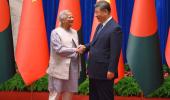
If Yunus is so helpless and unaware, why is he still in that position? He continues to enjoy power and ceremonial honours.
There are reports that Hadi believed in a 'Greater Bangladesh' that included parts of India. Is this true?
Everybody has right to daydream, but I do not think this will turn into our nightmare. Such elements do exist. What is dangerous is that the Yunus-led government has given space to Pakistanis.
There is no substantive basis for Bangladesh-Pakistan relations, as Bangladesh has surpassed Pakistan on most socio-economic indicators.
The only real link they can have is mischief, with Pakistan's intelligence agency using Bangladesh to create trouble along our eastern borders.
But then we are capable of protecting ourselves and securing our borders.

How can India secure itself in the future, given porous borders and meandering rivers between India and Bangladesh?
We are prepared. Our army, the BSF, and our political system are capable of handling such challenges.
The key difference between us and them is that we have a strong and functioning democracy.
Which power can control fundamentalists in Bangladesh? Is it even possible?
We should not look for quick fixes. A process has begun in Bangladesh, and we support a process that leads to free and fair elections. Let a new government come to power.
We must take a long-term view. This is not a simple repair job of plumber or electrician; it takes time.
You got to wait for the people of Bangladesh to make their own mind in the upcoming elections in February 2026.
What does the average Bangladeshi think of India?
If you read the Bangladeshi press, it appears that India is blamed for a lot of things.
At the same time, there is also a great deal of goodwill towards India among ordinary people of Bangladesh.
These things ebb and flow so we should not jump to conclusions because at the moment there is some hate.




 © 2026