

'Women in crime can turn on and off emotions like a tap.'
'Something that comes in the way of their goals can be eliminated without a second thought.'
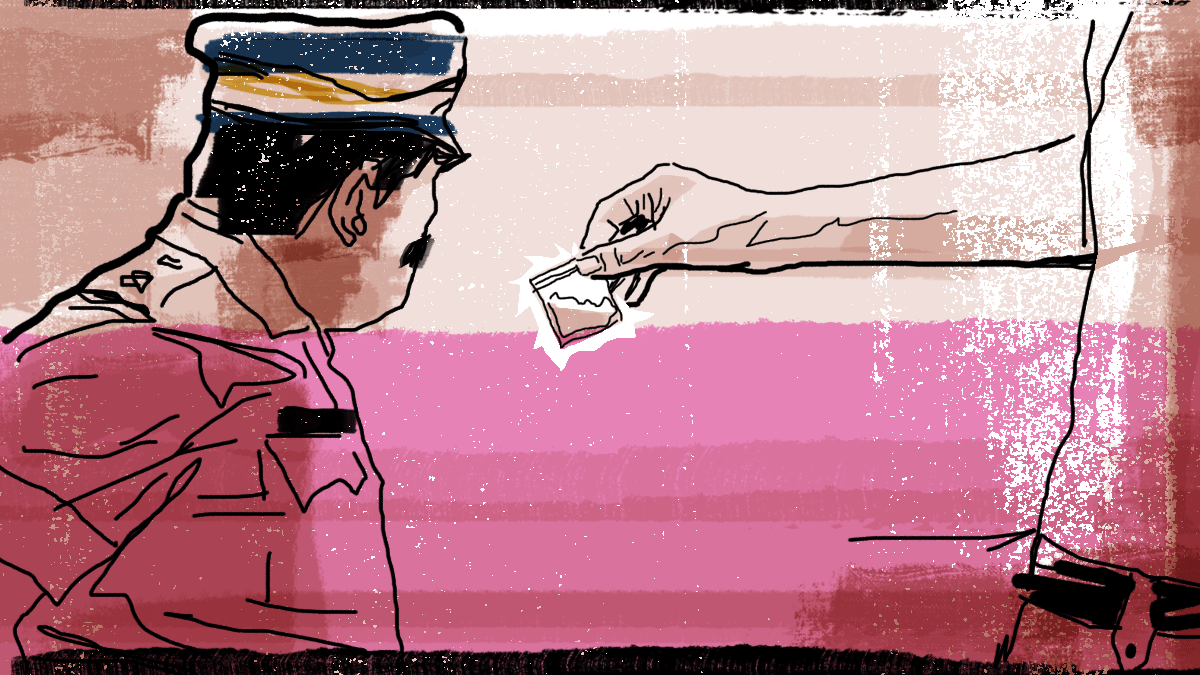
Key Points
- 'It is not poverty alone that drove women like Sonu Panjaban or Saira Begum from G B Road to the flesh trade and kidnapping, but also their greed and lust for power. These women were heartless.'
- 'Saira Begum was singlehandedly responsible for kidnapping over 5,000 women from Nepal, Jharkhand and West Bengal into Delhi's GB Road.'
- 'While some women in crime are battle-scarred like Phoolan Devi, most women who come into crime are hardened people with no room for emotions in their repertoire.'
In the dark, labyrinthine world of India's underbelly, where ambition, betrayal and survival intersect, Mafia Queens of India stands as a chilling chronicle of women who defied stereotypes and carved their own criminal empires.
Co-authored by Velly Thevar and S Hussain Zaidi, the book Mafia Queens of India does more than narrate crime stories -- it dismantles the myth of the 'abla naari (helpless woman)'.
In this candid interview with Syed Firdaus Ashraf/Rediff, Ms. Thevar offers fascinating insights into the psyche of women who rose from obscurity to notoriety.
A bad man can be tamed but a bad woman can't be tamed: This was a very intriguing sentence in your book in the chapter 'Cleopatra's Consent'.
The Cleopatra chapter has a lot of my (husband and) co-author Hussain Zaidi's perception on women. His women do not have grey shades and he never cuts them any slack.
I don't think there is a bad man or a bad woman when one talks of a criminal. A criminal is not gender-specific. A criminal is a criminal.
However, having said that, when Hussain met Cleopatra in Kerala, he felt very deeply about her. He felt that she carved a niche for herself despite having a mentor like don Vardarajan and she rose from the ashes of Dhanushkodi after she lost her home in a flood.
Personally, I found her transformation towards the fag end of her life, very motivating. From a woman who came up with the brilliant idea of an army of eunuchs to serenade Papamani, the liquor mafia queen from (south central Mumbai's) Antop Hill to chiselling Vardarajan Mudaliar to a don to reckon with is no small feat.
I liked the fact that she upgraded her skills post Vardarajan's demise. She became a voracious reader of religion and philosophy. She saved youngsters from the insidious grip of ISIS. It was like she was trying to absolve herself from an unsavoury past with a dangerous don.
Perhaps she was bogged down with the burden of guilt for being equally responsible for all the decisions on life and death that Vardarajan Mudaliar took. Vardarajan was, after all, not a real life Dayavan like his portrayal on celluloid.
If you take Jaya Chheda, she was incorrigible -- a picture perfect example of a criminal mastermind at work. Poisoning your husband without his knowledge with the sole intention of usurping his matka empire. Now that is not only devious, but machiavellian.
She had everything going for her but she wanted the world and the universe. Bumping off her husband en route to her climb to success came naturally to her.
What is the common link among the 12 mafia queens you have portrayed in the book?
There is no common link, but everyone mentioned in the book was looking for some lifeline to grab, like Sivakasi Jayalakshmi. She was good looking and when she or all the other women who got an opportunity (to move on from their regular lives) they jumped into it feet first.
They never thought about the repercussions of the path they were choosing. In doing so, all of them took decisions on impulse except for Jaya Chheda and Nowhera Shaikh. These two were plotting and planning (for crime).
Do these mafia queens feel joy in controlling other people's lives or did they do what they did because of poverty or some other reason? What drove them to do this?
In the case of Sonu Punjaban she liked to have control over all girls under her. Sonu Panjaban was a sadist. She was not merely a brothel madam but also someone who was involved in kidnapping of minor girls from Delhi. She ran her fiefdom in Delhi's Garstin Bastion Road like a combative queen.
Her comeuppance happened because of a persistent policewoman who kept chasing the case of a kidnapped and lost young woman.
It is not poverty alone that drove women like Sonu Panjaban or Saira Begum from G B Road to the flesh trade and kidnapping, but also their greed and lust for power. These women were heartless.
If you hear the police phone tapping transcripts of Sonu Panjaban which they used to nail her, you would be shocked by her callousness -- she punctuated every word she spoke with a barrage of expletives. Sonu Panjaban's arrest brought the curtains down on a sex racket that operated across several state lines.
While poverty drove women like Saira Begum into the business of prostitution, it was a case of victims becoming aggressors later on. This lady from Hyderabad was singlehandedly responsible for kidnapping over 5,000 women from Nepal, Jharkhand and West Bengal into Delhi's GB Road.
Saira was a sex worker herself before she emancipated herself by using Nepali women as a ladder for her success story.
In his writing career S Hussain Zaidi has published only one co-authored book and that was with Jane Borges for Mafia Queens of Mumbai. What made you join him in writing this book?
Early in his career in the mid-nineties and late nineties, when he met writer Vikram Chandra, he was also introduced to Tanuja Chandra, Vikram's sister. Tanuja, a filmmaker who was working with Mahesh Bhatt at the time, wondered if she could make a series for television on women in the mafia.
I was Hussain's go-to-person for such ideas and that is how I came up with a project on a bunch of mafia women and their stories for Tanuja. At that point I was working as a journalist and had covered news items about some of these women.
Later, I joined The Telegraph newspaper as a journalist and I was not able to follow up on the stories of the women I had zeroed it upon.
Hussain used this research to write Mafia Queens of Mumbai (part one) when he had some spare time while working as an editor in Asian Age and his co-writer Jane Borges was also working with the same newspaper as a copyem>'or at the time.
How did you shortlist these women?
Many of the names in Mafia Queens of India were the idea of my brother Krishna Kumar. Husain brought to the table another varied bunch of names and we weeded out some before shortlisting the ones who made the cut.
Your book mentions dacoit Kusuma Devi who killed more men than Phoolan Devi and lived longer too as Phoolan Devi's rival. Why do you think she didn't become as known as Phoolan Devi?

Phoolan Devi's shoes are too big to fill. She has become a legend. A director of the stature of Shekhar Kapur immortalised her in the movie Bandit Queen.
Furthermore, the trajectory of her life including her political stint and her transformation made her a household name.
Phoolan's story had a lot of symbolism in it. Lower caste girl raped by upper caste men and then her revenge against the same men who watched as mute bystanders without coming to her aid.
Kusuma did not receive similar publicity.
In fact, another female dacoit, Seema Parihar, also killed 70 people before surrendering, but again she is overshadowed by Phoolan Devi though television and social media gave her the spotlight.
Do you feel the lady behind Hira Gold had any business plan? Was she genuine or did she just want to swindle money?
Nowhera Sheikh was a fraud who used the tool of religion to woo Muslims into her Heera Gold ponzi schemes.
Imagine her audacity in claiming that she imported raw gold from Ghana which she processed in Dubai. Nobody checked the veracity of her claim but almost 70 percent of Muslims south of the Vindhyas put money in her schemes and lost it. She used the local maulanas who had an outreach with the community to get customers into joining her fraud schemes.
She started her operation in a very small way from Tirupati. She realised just like politicians use Muslim vote banks, she can use them as economic banks to fool them. She fooled everyone through religion by saying 'halal ki kamai'.
In other words, towards an interest free world because bank interest is forbidden in Islam.
If someone doubted her fraud financial scheme she would quickly tell them the concept of tawakkul. Tawakkul in Islam refers to complete trust and reliance on Allah in all matters of life while simultaneously putting in one's best effort.
She was very intelligent and always donned a burqa. She knew the language of money and how to take it out from others. One in 10 homes of Mumbai Muslims invested in Heera Gold and lost money.
It is my conservative estimate that this Heera Gold fraud is of Rs 5,000 crore (Rs 50 billion) plus. The scame went on (for more than 10 years) till everything blew up in her face.
Will the people who invested in Heera Gold get their money back?
The money is gone.
Sadly like in other countries where laws are stringent, we have no such State-backed-cushion-support.
Sivakasi Jayalakshmi dumped her husband and then her lovers. How come it was so easy for her to do? Didn't emotion matter to her?
Jayalakshmi's lower middle class background was a frustrating one. She was married to a man who was not ambitious and who did not like her ambition.
When she wanted to start her home food cooking business, he dissuaded her. Eventually the perpetual hand to mouth existence, trying to make-do with a meagre sum of Rs 6,000 to Rs 8,000 forced her hand to quit the relationship.
However, at some point she realised that she stood a cut above the rest when it came to her looks and her fair skin. She tapped into it.
Eventually she stumbled into the den of the P gang or Policemen of Tamil Nadu and they were so smitten with her that they did her bidding. They thought they were exploiting her but she ended up using them as tools to further her interests.
Does emotion not matter to her because she was cheating one man after another?
Women in crime can turn on and off emotions like a tap. Everything that matters most to them will carry some emotion while something that comes in the way of their goals can be eliminated without a second thought or feeling.
While some women in crime are battle-scarred like Phoolan Devi, most women who come into crime are hardened people with no room for emotions in their repertoire. Bringing emotions into play hampers their choices.
When Jayalakshmi realised she was amassing wealth by playing the girlfriend-of-the-cop card in jewelry stores, it was like Khulja sim sim of the Alladin's cave.
In fact, she used her proximity card with policemen as a facilitator to solve disputes too. I thought she was very intelligent because to fool an ordinary man is easy, but to fool a hardened policeman requires a lot of skill and smartness.
She was also tenacious. And it was not like there was just one cop eating out of her hands. There were a slew of uniformed men cutting across police hierarchy who were slave to her whims and fancies. This requires a lot of deftness.
An ordinary woman could not have pulled off something like this. Some of them even allowed her small indulgences like her earnest desire to don a police woman's uniform.
Men have been exploiting women for ages but here a woman turned the tables on the adage. She exploited men and she played them against each other, everyone vying for her attention. I think she did not revel in her power over so many men, as much as she did in the financial emancipation that it bought for her.
Jayalakshmi fooled so many men and that too so easily for long. What makes men trust such women?

The men in Jayalakshmi's life did not trust her. But they were inexorably drawn to her like a moth to a flame. They just fell for her charms.
A couple of the policemen did try to box her in by keeping her as their exclusive 'woman', but she was not to be tamed. She wriggled out easily out of such relationships. In the back of their mind the policemen knew it was a trap, but then men are men.
A man is instinctively drawn to a woman who makes advances at him. It is in man's nature.
What would you advise men in such a situation as a woman author?
I think it is a misconception that women are the weaker sex. As illustrated in this book, women are far more wily and dangerous and have more cunning and cruelty in them than most men.
Women can outwit men and they can use and dump men the way men have been doing for ages. And men will be men, they cannot keep away from the wiles of a woman.
Even in Phoolan's case, her lover Vikram Mallah's bosses suspected that she was responsible for the rise of Vikram Mallah's independence and leadership role and when they came from jail, they murdered Vikram Mallah and gang raped her in Behmai.
Even dacoit Kusuma Devi in your book became her own boss.
Kusuma seemed to be harbouring a Phoolan Devi syndrome.
Unlike Phoolan Devi, Kusuma needed the anchor of a man. First it was Madho Mallah, her childhood sweetheart turned dacoit and after he was killed, she bungled and ended up killing a senior police officer on a weak pretext.
Then she went and aligned with a man called Fakkad Baba who sang the Ramcharitramanas at night and murdered during the day. She lived with this man, until they surrendered to the police.
Is it so? Why do we have these concepts of 'abla naari, bechari' type of mindset?
The abla naari (helpless women) concept is not outdated. Women can be their own worst enemies, captive to their thoughts. They weaken themselves with the need for validation by men.
Wanting a man and an anchor in your life to keep you grounded seems practical and even romantic, but women need to know when to walk out of corrosive relationships. When she silently suffers she is the abla-naari.
In the case of women in crime, there is no concept of abla-naari.
The wiring is complex for women who decide to cross a particular threshold. Though it was said at the time when the Jayalakshmi story got exposed that being a woman, the male reporters of Tamil Nadu had a field day classifying her as a seductress, et all.
That in the end Jayalakshmi came out stinking while the policemen were let off the hook.
The Jayalakshmi saga would have continued for many years if some of the duped jewellers had not reported the crime. She kept buying jewelry using policemen's names and it did come to bite eventually. The same happened with matka queen Jaya Chheda. Her utter greed made her a demon in a woman's garb.
What is your next book project?
I have finished a book on India's most infamous and dreaded terrorist, Yasin Bhatkal. It is scheduled for release by June. I am also co-authoring a book on gutka.






 © 2026