

'The move to appoint a person with a profile, markedly lower than the leader Nitin Nabin will replace, has the potential to put the brakes on the careers of several others in the party and government in the positions they currently hold,' points out Nilanjan Mukhopadhyay.
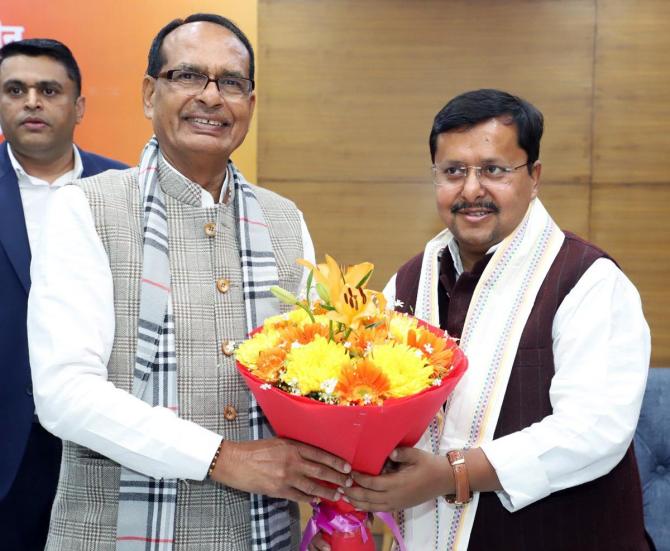
By appointing Nitin Nabin as its working president, the Bharatiya Janata Party leadership has partially pulled out a template from its past tradition of making a generational change the moment several top party leaders turn closer to the informal 'retirement age' of 75 in the party.
But the BJP has also not completely followed the past practise which would have enabled the party to 'correct' its 'inconsistent' track record on being true to the principle, non-verbally elucidated by Prime Minister Narendra Modi in May 2014.
Back then, the exclusion of party veterans Lal Krishna Advani and Murli Manohar Joshi from the Union Cabinet was justified by citing their 'age'.
To comprehend these contentions, one has to step back to 2009. In December that year, the party made a generational change in its parliamentary wing when Advani made way for Sushma Swaraj to become Leader of the Opposition in the Lok Sabha.
This was preceded, a day earlier, by a similar transition in its organisational wing when the then 52 year old, largely unknown in the Indian capital's corridors of power, a different Nitin with the surname of Gadkari and political grounding in Nagpur took over from the relatively older Rajnath Singh.
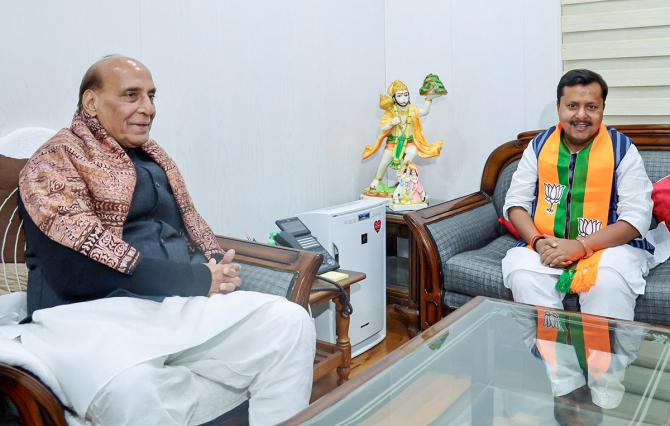
The development completed the process which began post the 2009 Lok Sabha election debacle of the party when Rashtriya Swayamsevak Sangh chief Mohan Bhagwat indicated that it was time that a younger leader and someone who was not entrenched in Delhi's durbar politics took charge of the BJP.
Bhagwat himself assumed his position a few months earlier after the decline in the health of the then sarsanghchalak, K S Sudarshan. Bhagwat's elevation had been natural, given that he was the sarkaryavah or general secretary, for several years.

Now, although another 'Nitin' assumes charge -- besides being barely 45 years old, he is also known only to those who track the party closely -- albeit as 'Working' chief of the party, Bhagwat has not, like earlier, chanted his call for a younger leadership in the party's parliamentary wing and thereby the government.
This is uncharacteristic for a leader who has caused and thereafter 'cleared' the confusion over his stance on the 'retirement at 75' principle. Possibly, this stems from the fact that like Modi, he too is past that age.
There are two primary reasons for Bhagwat's strategic silence for the moment: One, the BJP is in power unlike in 2009 when it was defeated in the second consecutive parliamentary polls.

Now, because the party is the primary wielder of all governance levers, also ideologically committed to the RSS, the Sangh Parivar has benefited immensely in the past 11 years. Bhagwat would not want to rock the boat at this juncture.
Two, and more importantly, Prime Minister Narendra Modi today is the all-powerful leader who effectively 'holds' every office in government and party, even though this set-up is formally labelled as a National Democratic Alliance.
In the history of the BJP, and even its predecessor, the Jana Sangh, power has not been concentrated in the hands of a single leader like it is now. Every decision is made by one individual and this is later projected as a collective choice.
Take, for instance, the party's parliamentary board. Neither was this body officially convened to 'select' the working president nor did the parliamentary party, consisting of the newly elected Lok Sabha members, meet after the 2024 polls, to formally elect Modi as its leader. All that was transacted was a meeting of the lawmakers of the NDA constituents.

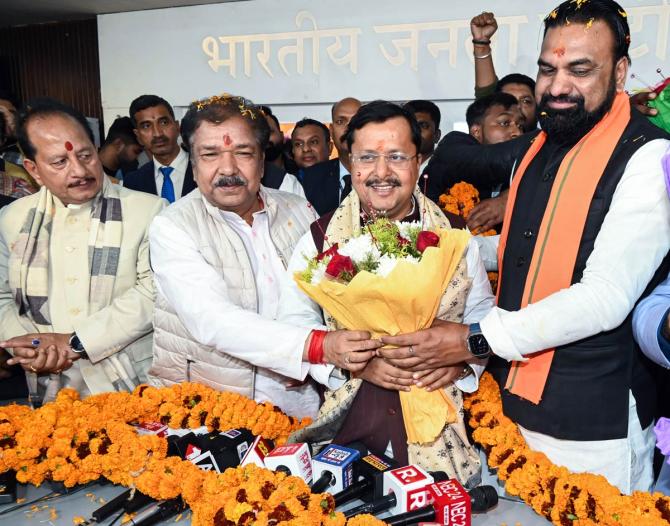
In the case of Nabin too, his appointment was announced over social media with a no-further-explanations-release. A formal statement, signed by Arun Singh, a national general secretary of the party, was attached. It merely stated the party's 'Parliamentary Board has appointed Shri Nitin Nabin, Cabinet Minister, Bihar Government as National Working President of the party. The appointment comes into immediate effect.'
The first response of the majority of people outside the party was elementary -- 'who is he?' The second response was to Google his name and read up about him in Wikipedia and other similar web sites.
It did not take much effort to figure out that he was a figuratively diminutive leader who owed his position to being a dynast -- he first became a member of the Bihar assembly months after Nitish Kumar embarked on the chief ministerial phase of his political career in November 2005.

This was because his father Navin Kishore Prasad Sinha, who represented Patna (West) constituency for four consecutive terms since 1995, died unexpectedly following a sudden heart attack. Till then, Nabin, who barely qualified to contest the polls by turning 25 months prior to his father's death and the by-poll that followed, had done precious little in politics.
Party insiders mention he remained a backbench legislator till he caught the eye of the central leadership, effectively a euphemism for the party's power-duo, at a party meeting in Patna during the turbulent phase of the party's relationship with Nitish Kumar before the 2020 state assembly election.
This enabled him to first become a minister in 2021 with the charge of road construction and later get additional charge of urban development and housing in 2024, which continued till his appointment.
But he made a mark in the eyes of the leaders with his handling of the party's electoral campaign in Chhattisgarh in 2023, a poll in which the BJP regained power from the Congress. Described as a quiet low-profile party leader, adept at following specified instructions, Nabin's anonymity is what has secured this office for him.
It follows a pattern of appointments of several BJP leaders to their positions, almost unknown outside their loyal and party circles. This includes the chief ministers of Madhya Pradesh, Rajasthan, Chattisgarh, Uttarakhand and Haryana.
Modi has spent considerable time in his tenure, disparaging Congress leaders to precede him to the PMO. But he picked up the habit of appointing less-known and hardly popular leaders as executive heads of states, from the very leaders he runs down incessantly.
For instance, in the 1980s, Indira Gandhi embarked on a CM-changing spree in Andhra Pradesh. This was noted by the famous cartoonist R K Laxman who in one of his creations, caricatured her as inspecting a guard of honour of assembled Congress leaders and at one point, she turned to one and said, 'Hey you out there, you are the next CM... What's your name?'
In this case the joke on Modi is with a slight variance -- he bursts into laughter when aides inform him that people were scrambling for their phones to Google his choice!
It is a paradox that even though Modi may be at the height of his power, yet the instinctive insecurity noted by many, still makes him wary of appointing people with a public profile to those positions from which they would be able to wield power -- CMs, party office bearers and so on.
The move to appoint a person with a profile, markedly lower than the leader Nabin will replace, also has the potential to put the brakes on the careers of several others in the party and government in the positions they currently hold.

The new BJP president will in a few months appoint a new organisational team and there is little doubt that these will names that are most likely to be passed to him, and these are likely to include the clutch of leaders of the day. Because no political leader curates the battlefield for a possible successor, Modi's move has to be seen as a step to further solidify his position.
Having not given any indication of his desire to bow out of office without such an eventuality being due to either an electoral upset or nature's call, Modi possibly visualises his innings as a infinitely continuing one.
In such a situation, courtiers are the best appointees for positions that could suddenly become crucial. Politics, of course, is a game of endless possibilities. But at the moment, the current lens is what matters.
Nilanjan Mukhopadhyay's latest book is The Demolition, The Verdict and The Temple: The Definitive Book on the Ram Mandir Project. He is also the author of Narendra Modi: The Man, The Times. His X handle is @NilanjanUdwin




 © 2026