

With deep sorrow we mourn the death on Thursday morning of long-time Rediff Columnist Mr N Sathiya Moorthy after a brief illness.
This is Mr Sathiya Moorthy's final column which he filed before he was admitted to hospital.

Even as Tamil Nadu's Chief Minister M K Stalin indicated that the millions of beneficiaries of his social sector initiatives -- derisively dubbed by some as freebies -- are a committed vote-bank for his kind of 'Dravidian model' leadership, he seems unaware that the 'silver sieve' is leaking at the bottom, and heavily.
If you call it a 'golden sieve' instead, the situation can only worsen in electoral terms.
If however, many commentators give his DMK combine a better chance of winning this year's assembly polls in an emerging four-cornered contest, it owes to the perception that they remain united whereas the Opposition AIADMK-BJP alliance is at sixes and sevens even as actor-politician Vijay's new-found TVK is still groping in the dark, clueless, directionless.
True, the DMK alliance is a victorious war-machine through three elections in a row -- 2019 and 2024 (Lok Sabha) and 2021 (state assembly).
Yes, the chances of major hiccups in seat-sharing talks are also remote, if not non-existent.
However, the anti-incumbency attaching to the four-plus years of DMK rule impacts them all in elections as much despite any of them not having any share in power -- nor a share in accompanying responsibility.
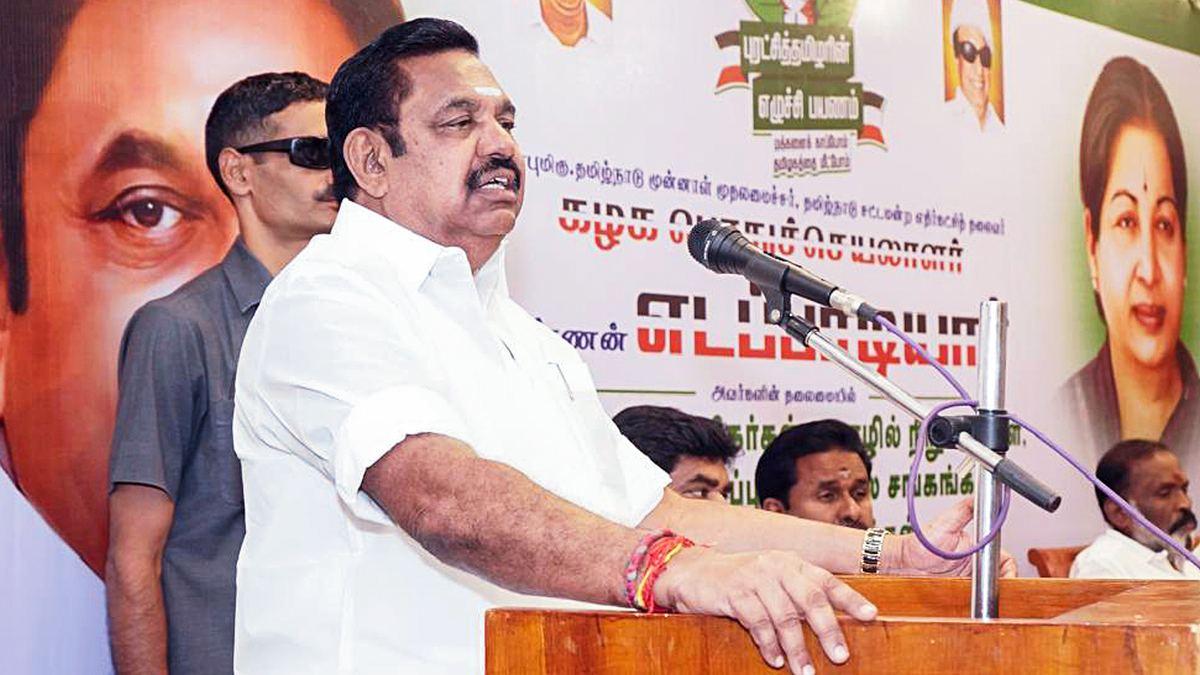
In comparison, rival AIADMK boss and chief ministerial aspirant Edappadi K Palaniswami (EPS) has not made things easier for self, the party and the BJP-NDA ally owing to his adamant attitude at multiple levels.
One is his refusal to work with AIADMK veterans he had sacked, as desired by his second-rung, and also the BJP ally, starting with party chief strategist and Union Home Minister Amit Shah.
This has lost for the combine the benefits otherwise accruing to it from EPS' early whirlwind state-wide campaign, that too rightly over anti-incumbency affecting the DMK big time.
In doing so, EPS also lost the great opportunity to rework the relations between the second-rung leaders and cadres of the AIADMK and the BJP.
Their understanding was broken after EPS forced the AIADMK to walk out of the BJP combine ahead of the 2024 Lok Sabha polls, only for both to draw a blank separately. But throughout his campaign tour, he was the only main speaker, there was no place on the dais or elsewhere for his BJP and other allies.
Despite reviving the alliance in April 2025, a full year ahead of the assembly polls, the two leaderships have failed to assuage AIADMK cadres' continued suspicions over the ideological and electoral outcomes of the BJP's hard-line Hindutva agenda.
The 'Thiruparamkundram Deepa Thoon controversy' was only the latest, not necessarily the last one before the polls.
At heart, AIADMK cadres, too, are opposed to hardline Hindutva, as communal harmony -- different from caste violence -- has penetrated into every village through centuries. But they also understand the impossibility of their electoral situation, as proved by the 2024 Lok Sabha polls.
Neither the AIADMK nor the BJP-NDA, contesting separately, could win a single seat.
The former polled the lowest ever 20 per cent vote-share, worse than the 21 per cent for Jayalalithaa in 1996. The BJP-NDA obtained a total of 18.5 per cent.
Without providing for shrinkage but only for possible accretion, Shah has put their collective score at an arithmetically accurate 41.50 per cent, enough to have a run for the top slot in a four-cornered contest.
EPS has since started quoting Shah to his cadres without acknowledging the authorship, if it's one.
Yet, this 20 per cent for the AIADMK is a committed vote-bank at least for the upcoming poll.
The NDA figures are misleading. While the contest still continues over the actual vote-share of the BJP leader, the total includes those of allies, especially sacked AIADMK veterans O Pannerselvam (OPS) and T T V Dhinakaran, with his own Amma Makkal Munnetra Kazhagam (AMMA).
Shah's strategy is to convince/force-argue EPS into letting the likes of them return to the NDA fold even if granting them re-admittance into the AIADMK.

But that is only one side of the demoralisation coin for the AIADMK-NDA combine.
The BJP is yet to regain the missing enthusiasm that went away with the sacked state unit president K Annamalai, again in April 2025.
As party chief, he was not without flaws, especially in humiliating and at times 'hitting below the belt' of perceived challengers within the state party.
He has to take his share of the blame even more for insulting AIADMK icons like MGR and Jayalalithaa, and giving EPS an extra handle to demand his removal for the revival of poll alliance that Amit Shah desired.
Yet, Annamalai is one of the very few Opposition leaders in recent times who went hammer and tongs against his political target once fixed.
The DMK was his assignment from the top, and not a day went by without Annamalai capturing media headlines with something new against the ruling DMK on the corruption front -- at times accompanied by volumes of documents that he claimed was proof and evidence. None questioned him, none verified them.
During his forced vana vasam, Annamalai still remains the most talked about state BJP leader. He has also finally realied that it is difficult for a third front to win assembly elections in the state.
Of course, he is targeting actor-politician Vijay's TVK, but this was the leitmotif behind his targeting the AIADMK and EPS when they were together.
That is to say, by running down the two Dravidian majors (with a little help from central agencies), he could lead a third, reworked BJP-NDA front to electoral success. He has finally given up his hopes on the matter, at least for now.

By ensuring that Annamalai's place was taken by one-time AIADMK minister, Nainar Nagendran, and at the same time, losing the initial steam on state-wide anti-incumbency campaign, in favour of internal shenanigans even more, EPS has lost the plot, if at all he had any to begin with.
Now that the elections are possibly just around hundred days away, the two party leaderships would get busy with seat-sharing talks of multiple kinds at multiple levels.
That takes energy and more so, their time. They may recover the campaign plot, but might have lost precious time, which anyway they actually had – but not anymore.
After all the hullabaloo kicked off by the TVK since birth in February 2024, the post-Karur stampede dust, too, seems to be settling down for Vijay. He cannot get away with his customary ten-minute public speeches, which are also few and far in between -- cinematic punch-dialogues, one-liners and disrespectful teasers at the chief minister ('Stalin Uncle'/'Stalin Sir), none of which has made the 30-35 per cent of the state's swing voters to look up at him with any kind of seriousness.
Likewise, despite AIADMK veteran K Sengottiyan crossing over to the TVK, it is anybody's guess if Vijay and his front-line yes-men from the past months have learnt their basic lessons in politics and poll management -- or, has given the other his time, space and access to the supreme leader as often required.
The recent Puducherry public rally, the first one after the Karur tragedy, 72 days earlier, gave the impression that Vijay may not be as much of a crowd-puller as his free-for-all road-shows had shown.

Against all these, NTK's actor-politician founder Seeman has been ploughing a lone furrow and consciously so.
Seeman should get the credit of contesting without allies, one election after another, on his own, increasing his vote share at every turn though with no hope of winning a seat.
Through all this, he has displayed the kind of 'staying power' that no other party or leader had shown in Dravidian Tamil Nadu in the past three-plus decades.
This is questionable in the case of Vijay and the TVK, as none inside or outside the party has seriously thought about the possibility of their losing the assembly elections, not badly but with a promising vote-share, with or without seats. It would be a different scenario especially if Vijay is quitting films after the release of Jana Nayakan.
Down the years, when the party would have to face future elections, new-generation film fans may flock to another popular actor of their times, leaving Vijay with his present-day Gen Z, who too would be busy with their life, aspirations and commitments.
This happened to 'super-star' Rajinikanth, who talked about active politics from the mid-nineties (as if to fool his fans) and came out of his shell only ahead of the 2021 elections.
Only then, he found out that the world around him had changed and moved faster ahead than expected.

Through all this and more, the Tamil Nadu voter is getting a mixed and at times confused view of things, distracted as he already is by every-day chores that are more and different from those of his parental generation.
For instance, despite a majority of local analysts claiming a comfortable position for the DMK combine, it is not so.
There are two factors. On the alliance front, despite rumours to the contrary, Stalin is capable of stitching together a seat-sharing pact with the clear message that he was working only for a stand-alone DMK government once again, and not coalitions of the kind that the BJP has pushed down the throat of rival AIADMK.
In doing so, he has to silently market to the voter how only a single-party government can ensure 'political stability', which his rivals lacked, even at commencement.
The second rider goes beyond Stalin's social welfare offerings that will continue until the Election Commission announces the Model Code of Conduct, but will be taken into the DMK's poll manifesto (as in the case of the rest).
Stalin's strategists in the party and government seem to have overlooked the fact that the targeted groups have become habituated with the welfare schemes -- an average monthly benefit valued at Rs 5,000 for every family -- and they will now need more.
This habituation with 'freebies' has also made the voter to take a closer look at other aspects of governance, starting with delivery mechanisms of schemes already in operation/or announced.
It looks as if every time the CM announces a new welfare scheme targeted at individual age and gender-groups, the bureaucracy is overwhelmed by the additional work on hand.
The misses and mistakes are unavoidable, especially in the case of welfare schemes, but the beneficiary groups do not care.

Likewise, women commuters have not stopped thanking Stalin for the free bus-ride to their work-place and wherever they want to go.
They are now ridiculing the abominable state of government buses, whether in the villages or capital city, Chennai.
It is not only about women.
Every-day curses on rickety roads, law and order, starting with women's safety, wanton delays even in e-environment, unpaid salaries, pension benefits for thousands, and inadequate recruitment for new jobs, continue across the board.
Worse still, people see a hidden hand, a purpose, a motive. Every time the Opposition flags such issues, there are no convincing answers.
Compared to what they see and experience every day, for the common man complicated ideas like governmental debt and other economic terminologies may go way above his head.
Yet, from sections of social media, the voter knows that the State has run the highest debt of Rs 9.5 lakh crores even as it is celebrating the highest growth rate of 16 per cent for any state in the country.
He also knows that freebies cost a lot -- but is not convinced that all the debt-money has taken that route or the infrastructure/development path.
Interestingly, no Opposition party has made any serious and persistent issue on the debt front. If hence the government thinks that the voters don't care about the source of funding of freebies, and not their final destination, it's the other way round.
Very long ago, they came to the philosophical conclusion that at the end of it all, the rulers and aspirants would still have to come back to them, the voters, periodically -- and that's when they pronounced their verdict, silently yet effectively.
Until then, the ruling party has the luxury of believing that Stalin's welfare schemes and alliance-stability would see them through.
The latter is more dependable than the former, as the silver-sieve on which the CM has placed them all, one above the other, is leaking at the bottom -- and it stinks of corruption and maladministration, which all the fragrance will not sweeten.

Independent of politics and elections, if someone should be learning something out of the TN experience, it should be the BJP's MoShah combo.
Unless they decide to tighten the screws even more, they may have learnt that Dravidian leaders, whether allies or adversaries, do not give into threats and realities of raids by central agencies.
It is not because they do not fear arrests and imprisonment -- the DMK's Senthil Balaji went through the ordeal for 400 days before the Supreme Court granted him bail, but did not spill the beans, if any. But it owes to the inherent loyalty attached to Dravidian politics and politicians, whose families and communities are greater votaries than maybe those individual leaders.
It is not known outside the state, hence not experienced by the Delhi leadership, either.
You can read N Sathiya Moorthy's earlier columns here.
Feature Presentation: Rajesh Alva/Rediff







 © 2026