

The power of Santosh hinges on the script, enhanced by Shahana Goswami and Sunita Rajwar's performances, observes Deepa Gahlot.
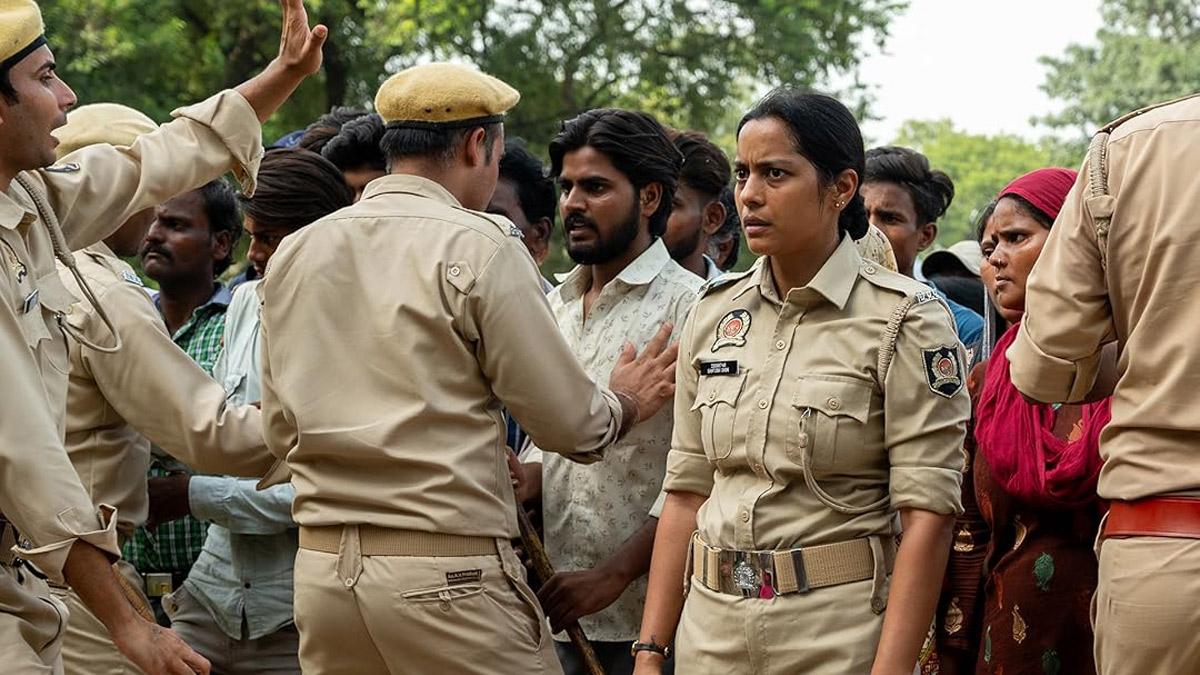
Sandhya Suri's Santosh comes with international acclaim.
It made its debut at the Cannes film festival, was the UK's official entry for the Oscars, went on to be nominated for a BAFTA for Best Debut Feature and its lead actor Shahana Goswami won the Best Actress at the Asian Film Awards.
In India, it was denied a censor certificate, in effect, stalling its release in theatres.
It finally reaches home audiences on the OTT platform, Liongsate Play.
Santosh depicts, without flinching, the misogyny, casteism and communalism rampant in a fictional north Indian town.
It is here that Santosh (Shahana Goswami) is given a job as a police constable on compassionate grounds, since her husband was killed in the line of duty.
Santosh looks ill at ease in the male uniform -- she wears the full sleeves down and walks with a slight hunch, as if not quite believing the authority given to her by the job.
At the police station, women personnel are treated with barely disguised disdain.
When Santosh joins duty, she and a female colleague are sitting at a table in the open, listening to a young woman complaining of her boyfriend's betrayal.
The other cop, with an unexplained scar on her face, has a hardened look on her face that the newbie is yet to acquire.
Her superior officer expects her to walk his dog and help his wife with the housework because to his patriarchal mindset, that's the place women ought to occupy.
Still to be crushed by normalised atrocity, Santosh feels sorry for a helpless Dalit man, whose complaint about his missing daughter Devika is not even taken down by the sneering male cops.
She is thrown into the deep end, when the girl's body is found, and people from her community protest outside the police station.
Later, the officer in charge forces Santosh to take Devika's corpse to the mortuary for the autopsy because nobody else will touch the body and he conducts a ritual to 'purify' the police station.
Still, due to the protests and media uproar, the lethargic cops are forced to investigate, and Santosh's new boss is a senior female cop, Geeta (Sunita Rajwar), who behaves like a man, but is firmly on the side of the women's cause.
With Geeta's encouragement, Santosh makes headway in the case, and a Muslim man is arrested as a suspect.
In the process, while encountering discrimination at every level, Santosh's wide-eyed naivete is slowly lost.
It is a classic police procedural, but without the glamour or thrill that fiction lends to such a plot.
Suri does not soft-peddle the ugliness of the landscape or the corruption embedded in the attitudes of those in power, misusing their wealth, caste and position with impunity.
In this patriarchal set-up, Santosh's gender is a disadvantage -- the only way she can survive in the force is if she acquires the same toxicity or makes the Faustian compromises Geeta has -- and the older cop is not half as evil as her male counterparts.
Lennert Hillege's cinematography has a documentary approach, and even the open spaces somehow look claustrophobic because they conceal so much cruelty and prejudice.
The power of the film hinges on the script, enhanced by the performances of Goswami and Rajwar, who display not the slightest trace or artifice, immersing themselves into the characters and blending into the milieu, aiming at a tenuous dignity in an environment that barely lets women keep their heads above the all-pervasive darkness.
Santosh streams on Lionsgate Play.
Santosh Review Rediff Rating:


