
'Most tax notices arise not from wrongdoing, but from unintentional mismatch or ignorance.'
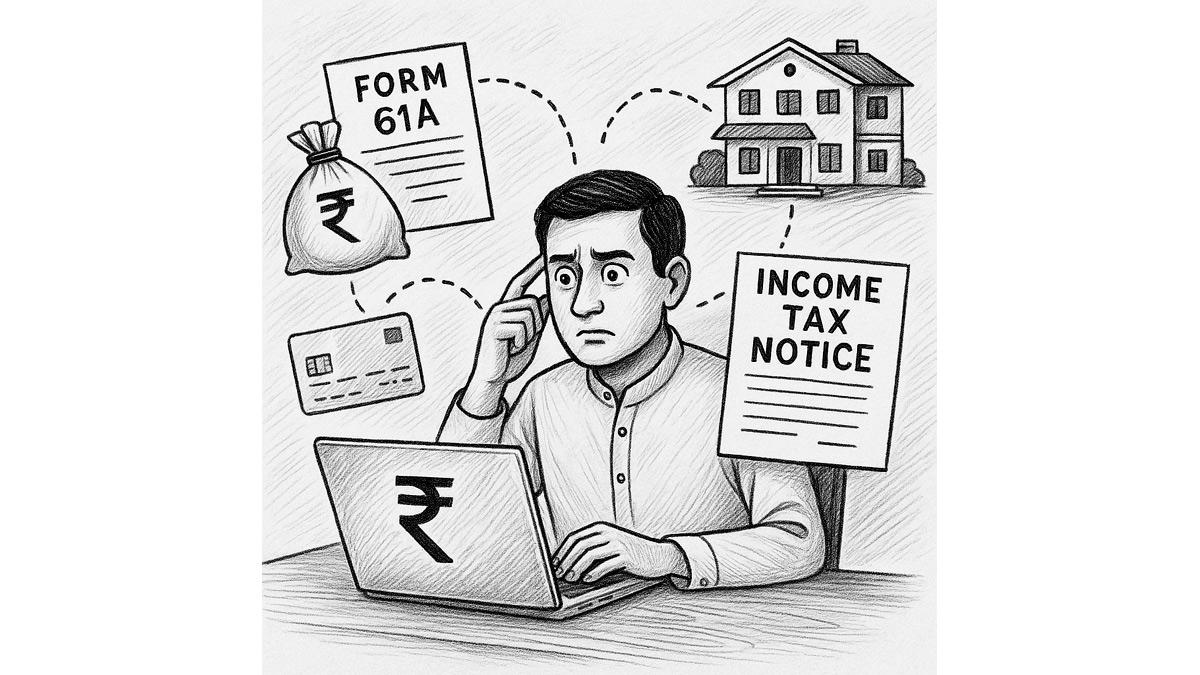
Did you know that your large cash deposit or high-value spending could land you an income tax notice -- even if you've done nothing wrong?
The reason lies in a crucial but often misunderstood document called Form 61A, a reporting mechanism used by the Income Tax department to monitor specified high-value financial activities across the country.
What is Form 61A?
Form 61A is part of India's Statement of Financial Transactions (SFT) system. It's not meant for individual taxpayers to file or worry about directly. Instead, it's the responsibility of banks, mutual funds, NBFCs, and other institutions to report transactions they conduct with customers.
"As a taxpayer, we have to do nothing. We individually do not require or do not get Form 61A," Vipul Bhavsar, a Pune-based chartered accountant with over 16 years of experience in corporate advisory and taxation tells Rediff.
"It is the responsibility of institutions -- banks, stock exchanges, NBFCs, credit card issuers, and even companies undergoing tax audits -- to submit it to the Income Tax department."
Essentially, these entities report the financial transactions of every account holder, borrower, or investor to the government by May 31 every year, covering the previous financial year.
Why Does This Matter to You?
Even if you're diligent about filing your Income Tax Returns (ITR), a mismatch between your reported income and your actual transactions -- as reported in Form 61A -- could get flagged by the tax authorities.
"This data now gets linked to your AIS (Annual Information Statement) and TIS (Tax Information Summary) through your PAN. Earlier, SFTs existed in silos. Now, they directly reflect in your AIS and TIS, which tax officers review first," Bhavsar points out.
"If your ITR fails to mention a transaction that's visible in your AIS, that's a problem."
Common Transactions That Trigger Form 61A Reporting
Here are some everyday financial activities that could get reported via Form 61A -- even if they seem routine to you:
1. Big Cash Deposits
• Threshold: Rs 10 lakh or more in a financial year
• Reported by: Your bank
• Why it matters: Even though the threshold is Rs 10 lakh, Bhavsar says, "Every person depositing cash above Rs 50,000 has to provide PAN, so in reality, even smaller deposits are being tracked."
2. Fixed Deposits Across Branches
• Threshold: Rs 10 lakh or more
• Multiple FDs across branches are aggregated and reported to assess your real financial inflow.
3. High-Value Property Transactions
• Threshold: Rs 30 lakh or more
• Reported by: Registrar/Sub-registrar
Though not under Form 61A but Form 26QB, such transactions are still closely monitored. "For example, if someone is purchasing a property for Rs 55 lakh, the buyer must deduct 1% TDS and deposit it with the government. The seller gets a certificate, which they can use to claim it while filing returns," adds Bhavsar.
4. Large Credit Card Payments
• Threshold: Rs 1 lakh in cash or Rs 10 lakh total in a year
• If your credit card spends far exceed your declared income, expect a closer look.
"If your credit card transactions don't match your declared income, you'll likely get a notice," Bhavsar warns.
5. Mutual Fund, Bonds, or Share Investments
• Threshold: Rs 10 lakh or more
• Brokerage firms, AMCs, and stock exchanges must report such investments to the IT department.
"Stock exchanges report every detail: Quantity, date of purchase and sale, rate, profit -- everything," Bhavsar notes.
6. Cash Payments for Foreign Travel
• Threshold: Rs 10 lakh or more
• Reported by: Banks or forex dealers
How the I-T department Uses This Data
Once your transactions are reported through Form 61A, the Income Tax department's AI-driven systems cross-verify them against your ITR. If your declared income doesn't justify your spending, an e-verification request or tax notice under Sections 133(6), 148, or 142(1) may follow.
"First, they just send an intimation via SMS or e-mail. But if ignored, it escalates to formal notices under relevant sections of the Income Tax Act," Bhavsar clarifies.
What About Withdrawals and TCS?
On large cash withdrawals -- Rs 10 lakh or more -- Tax Collected at Source (TCS) is levied. "Your account will be debited with Rs 10 lakh plus a percentage. That amount goes to the government. You can later claim this TCS while filing your return, just like TDS," Bhavsar explains.
What Should You Do?
Here's how to stay clear of trouble:
• File accurate ITRs and declare all income sources.
• Track your AIS and TIS via the income tax portal.
• Maintain records for property sales, mutual fund transactions, and cash activity.
• Avoid large unaccounted cash dealings.
• Ensure your PAN is linked to all financial accounts.
Income Tax Notices: Purpose and Key Sections
Income tax authorities issue notices under various sections of the Income Tax Act to ensure compliance, assess tax liability, or initiate inquiry in specific cases.
Commonly used sections include 142(1), 143(1), 143(2), 148, 139(9), and 156. Here's what each one means:
1. Preliminary Intimation for Non-Filing of Return: If a person has undertaken significant financial transactions but failed to file their Income Tax Return (ITR), the department may send a formal email or SMS urging them to do so. This is not a legal notice but an early compliance reminder.
2. Section 142(1) -- Inquiry Before Assessment: Issued when a taxpayer has not filed a return or when further details or documents are needed. This is a formal notice to submit the return or provide specific information.
3. Section 143(1) -- Intimation After Summary Assessment: A computerised intimation issued after the return is processed. It may confirm that no action is needed, or point out mismatches, refunds, or tax dues.
4. Section 143(2) -- Notice for Scrutiny Assessment: Sent when a return is picked for detailed scrutiny to verify accuracy, completeness, or legitimacy of claims, deductions, or income reported.
5. Section 148 -- Income Escaping Assessment: Issued if the Assessing Officer believes that income has escaped assessment. This allows the department to reassess the taxpayer's income for past years.
6. Section 156 -- Demand Notice: A formal demand for payment of tax, interest, penalty, or other dues payable under the Act.
Final Word: Be Smart, Not Scared
"Form 61A isn't for individuals to file -- it's for institutions to report your transactions. But you must stay alert about what's getting reported in your name," Bhavsar advises.
"Most tax notices arise not from wrongdoing, but from unintentional mismatch or ignorance."
With financial data now more connected than ever, staying informed, transparent, and proactive is the best defense against unexpected tax scrutiny.








 © 2025