

'Many policyholders do not understand that non-medical expenses, cosmetic treatments, and certain other procedures are not covered by health insurance policies.'

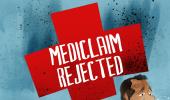
IMAGE: Couple reviews rejected insurance claim.
Complaints related to health insurance claims are rising.
According to data presented by Minister of State for Finance Pankaj Choudhury, 64,365 complaints were registered on the Bima Bharosa portal in 2024-2025 (FY25).
This figure had already touched 73,729, 14.5 per cent higher than the previous year, in 11 months of FY26.
- You can post your health insurance related questions HERE
Key Points
- Health insurance complaints surged, with over 73,000 cases recorded in FY26, reflecting rising disputes in claim settlements.
- Claims are often rejected due to non-disclosure, waiting periods, policy lapses, or treatments not meeting insurer criteria.
- Partial settlements occur due to room rent caps, co-pay clauses, sub-limits, and differences in hospital billing structures.
- Experts advise careful policy selection, full disclosure of medical history, and preference for network hospitals to avoid disputes.
- Policyholders can escalate rejected claims through insurers, regulators, ombudsman, or courts depending on claim size and resolution.
Why claims get rejected
Claim rejection often stems from a poor understanding of policy terms.
"Many policyholders do not understand that non-medical expenses, cosmetic treatments, and certain other procedures are not covered by health insurance policies," says Arun Ramamurthy, co-founder, Staywell.Health.
Non-disclosure of pre-existing diseases, like diabetes, high blood pressure, thyroid disorders, and so on, or past treatments can result in denial of claim.
Claiming during a waiting period may also result in rejection.
Claims may also not be paid if the treatment does not meet the insurer's criteria for medical necessity.
A lapsed policy, fraud, or discrepancies in documents can also trigger a denial.
Why claims are partially paid out
Partial claim settlements usually arise because the policy comes with certain restrictions.
Room rent caps can trigger proportionate deductions across the entire bill.
"If the policyholder chooses a room category above the permitted limit, that can reduce the payout by 20 to 40 per cent," says Saurabh VijayVergia, founder and CEO, CoverSure.
Co-pay clauses, sub-limits on specific treatments, and exclusion of consumables can lower the payout. Differences in package rates with the hospital can also result in partial settlement," says Ramamurthy.
Pre-purchase checks
Understand what the policy covers and its exclusions, instead of blindly going for the cheapest policy.
A suitable policy should preferably have no room rent cap, minimal or no sub-limits, and low or no co-pay.
"Check whether the policy offers restoration benefit, has short waiting periods for pre-existing diseases, and provides access to a strong hospital network," says Ramamurthy.
Make full disclosures
Many claim disputes occur because policyholders did not disclose all relevant information in the proposal form.
"People skip mentioning existing conditions and past treatments," says VijayVergia.
Some fail to mention information regarding lifestyle habits, such as smoking or alcohol consumption.
Buyers should also disclose existing policies.
Avoiding disputes in reimbursement claims
Sometimes, a major hospital may not be part of your insurer's network.
"That may be because the insurer has concerns about its charges," says Kapil Mehta, co-founder, SecureNow Insurance Broker.
Policyholders should prefer network hospitals whenever possible.
"If they opt for a non-network hospital, they should be prepared for reimbursement instead of cashless treatment," says Shilpa Arora, co-founder and chief operating officer, Insurance Samadhan.
Before getting admitted, inform the insurance company or third-party administrator (TPA).
"Submit a claim file within 30 days of discharge," says Arora.
She adds that the claim form should be filled out accurately, with all details, and be accompanied by original documents.
If claim is fully or partially rejected
After rejecting a claim or making a partial settlement, the insurer must issue a detailed settlement letter explaining what has not been paid and why.
"The insurer should list even small rejected items separately and state the reasons for not settling them," says Mehta.
Before escalating the matter, approach the insurer's grievance redressal officer for clarification and reconsideration.
"If that does not resolve the matter, escalate the complaint to the regulator via the Bima Bharosa portal," says Mehta.
If that also fails, file a complaint with the insurance ombudsman.
Civil and consumer courts are an option, but the process is usually lengthy.
"If the claim amount exceeds Rs 50 lakh and falls outside the ombudsman's jurisdiction, approach a consumer court," says Arora.
Documents you should have available
- At admission: Policy copy or health card, identity proof, doctor's prescription, admission notes and advice
- At discharge: Itemised hospital bills, discharge summary with diagnosis details, diagnostic reports, test results, pharmacy bills with prescriptions, payment receipts, implant details, KYC documents
- Complete, signed, error-free original documents and accurately filled and signed claim form
Disclaimer: This article is meant for information purposes only. This article and information do not constitute a distribution, an endorsement, an investment advice, an offer to buy or sell or the solicitation of an offer to buy or sell any securities/schemes or any other financial products/investment products mentioned in this article to influence the opinion or behaviour of the investors/recipients.
Any use of the information/any investment and investment related decisions of the investors/recipients are at their sole discretion and risk. Any advice herein is made on a general basis and does not take into account the specific investment objectives of the specific person or group of persons. Opinions expressed herein are subject to change without notice.
Feature Presentation: Ashish Narsale/Rediff










 © 2026