Let's decode how EPS works, who qualifies, and how pensions are calculated, using simple examples for different salary levels
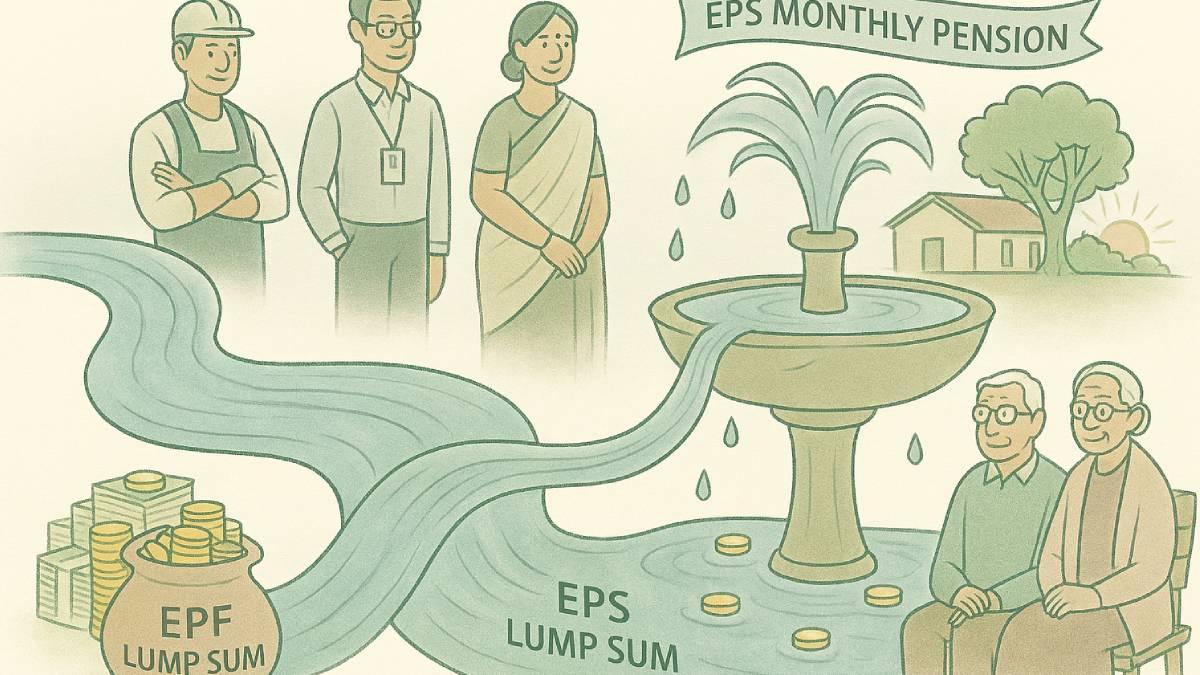
In Part 3, we explored how EPF balances earn interest and why the 8.25% rate matters for savers. But retirement planning isn't just about a lump sum -- it's about having a steady monthly income after you stop working. That's where the Employees Pension Scheme (EPS) comes in.
Every salaried employee enrolled in EPF also contributes to EPS, which provides a monthly pension, turning part of your employer contribution into lifelong income.
In this part, we decode how EPS works, who qualifies, and how pensions are calculated, using simple examples for different salary levels.
What is EPS and who runs it?
The Employees Pension Scheme (EPS), 1995 is a social security scheme under the Employees Provident Funds and Miscellaneous Provisions Act, administered by EPFO. Unlike EPF, which sits in your personal account, EPS is a pooled fund: contributions from many employers fund pensions for all eligible employees.
How contributions are split
When both employee and employer contribute 12% of basic salary + DA:
| Contribution | % | Goes to | Notes |
| Employee | 12% | EPF | Entirely to your EPF account |
| Employer | 8.33% | EPS | Pension, capped at Rs 15,000 salary ceiling, max Rs 1,250/month |
| Employer | ~3.67% + any excess | EPF | Remaining portion goes to your EPF account |
| Employer | Small % | EDLI + Admin | Life insurance and administrative charges |
Tip: Think: EPS = pension, EPF = retirement pot, EDLI = life insurance.
Eligibility for EPS pension
To draw a monthly pension:
If you leave service before 10 years, you can withdraw the EPS contribution as a withdrawal benefit, but no pension is payable.
How pension is calculated
EPS pension formula:
Monthly pension = Pensionable salary times; Pensionable service/70.
Where:
Worked example 1: Rs 15,000 ceiling case.
Suppose Ramesh, a factory worker:
Calculation:
Monthly pension = 15,000 × 2570 = Rs 5,357.
Ramesh receives Rs 5,357/month for life, with survivor benefits to his spouse.
Worked example 2: Rs 30,000 salary case
Suppose Rahul, an IT professional:
Step 1: Determine pensionable salary
Step 2: Pensionable service
Step 3: Calculate monthly pension
Monthly pension = 15,000 × 2570 = Rs 5,357.
Observation: Even though Rahul earns double the salary of Ramesh, his EPS pension is the same, because of the Rs 15,000 ceiling.
Step 4: Employer contribution split
| Component | % of salary | Amount (Rs) | Goes to |
| EPS (pension) | 8.33% | 1,250 | Pension fund (capped at Rs 15,000 ceiling) |
| Employer EPF | ~3.67% | 1,101 | EPF account (increases with higher salary) |
| Employee EPF | 12% | 3,600 | EPF account |
Key takeaway: Higher salaries don’t increase EPS pension under current rules, but EPF grows faster with higher pay.
First-time readers should note
The takeaway
EPS transforms part of your employer contribution into a steady monthly income, giving you financial security in retirement. By comparing the Rs 15,000 and Rs 30,000 examples, first-time employees can see clearly how the ceiling works, why EPF and EPS are different, and how your salary affects each component.
Limitations of EPS
This is why EPS is often seen as only a modest supplement, not a full retirement solution.
The bottom line
EPS is the pension pillar of India’s retirement system for salaried workers. While it provides lifelong income, the amounts are modest for most due to the Rs 15,000 ceiling. For someone new to the workforce, the key takeaway is: EPF will give you a lump sum, EPS a pension -- but you must plan beyond EPS if you want comfortable retirement income.
Part 1: Payslip To Pension To Long-Term Wealth: How EPF Works
Part 2: EPF Secrets Revealed: Where Your 12% Goes
Part 3: EPF@8.25%: Is It Really Worth It?
Part 5: EPF: How To Withdraw Smart, Protect Your Corpus
You can ask your personal finance questions to rediffGURUS HERE