

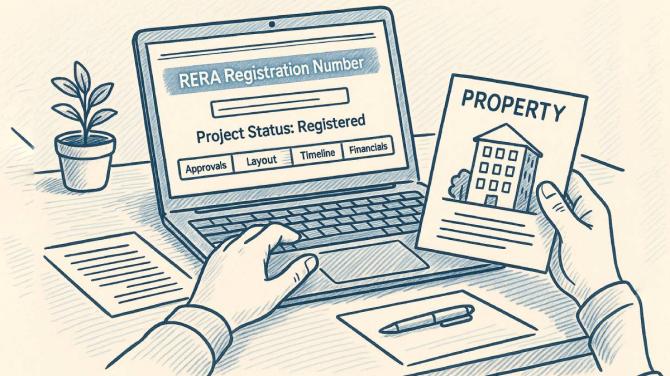
Before booking a flat, buyers should confirm that the project is registered with the state's Rera portal.
In the Hitendrakumar Bhaichandbhai Panchal vs Piramal Estate Pvt Limited case, the homebuyer alleged that the developer's refusal to share information delayed the approval of his State Bank of India home loan.
The Maharashtra Real Estate Regulatory Authority (MahaRera), however, held that the project was duly registered.
All disclosures were available online, and hence the builder was not responsible for the delay.
The case underlines the need for buyers to make better use of state Rera Web sites.
Check Rera registration
Before booking a flat, buyers should confirm that the project is registered with the state's Rera portal.
"Registration means the builder has shared all key project details -- land title, approvals, layout, possession timelines, and pending cases -- on a government platform. This ensures that the project is genuine and monitored by the regulator," says Shankey Agrawal, partner, BMR Legal.
"It also prevents fund diversion, as builders must keep 70 per cent of buyers' money in a dedicated account for that project," added Agrawal.
Registration also provides buyers with legal rights to seek refunds or compensation for delays or violations.
Checks to run before booking
Before paying or signing any agreement, buyers should review the project's registration certificate, approved layout plans, title documents, encumbrances, litigation history, possession timeline and the draft sale agreement on the Rera Web site.
Verified disclosures help confirm the project's legality and the builder's compliance track record.
Assess developer's track record
The Rera portal offers a clear view of a developer's past and ongoing projects, delays, complaints and penalties.
"A developer with timely completions and few disputes is more reliable, while one with repeated extensions or pending cases may pose a higher risk. This kind of due diligence helps buyers avoid problematic projects," says Agrawal.
Post-purchase informatioNn
After purchase, buyers should monitor the Rera portal for quarterly progress reports, construction updates with photographs, extensions, occupancy or completion certificates, and details of society formation or land conveyance.
These updates help track project status and spot deviations early.
Developers must update project information within 15 days of every quarter.
"Buyers should review these to check if timelines and approvals are on track, and specifications are not being changed.
"They should use Rera's transparency structure to stay informed and raise issues when needed," says Prashant Thakur, executive director and head, research and advisory, Anarock Group.
Common mistakes buyers make
Many homebuyers still overlook the Rera portal and rely on brochures, ads and sales pitches instead.
"Some skip checking project registration or ignore progress updates, risking financial loss and disputes.
"The Rera website is a government-verified source of authentic project details. Using it helps buyers verify claims, track progress and spot red flags early," says Agrawal.
Buyers commit several other mistakes as well.
"They often skip verifying statutory disclosures, overlook unilateral agreement clauses, make undocumented payments, and ignore revised timelines -- mistakes that reduce their legal options," says Thakur.
"The Rera Web site is an effective way for homebuyers to track project progress, yet many remain unaware of the registration requirements applicable to developers and the detailed information readily available on the Authority's Web site," says Manmeet Kaur, partner, Karanjawala & Co.
Make the most of Rera disclosures
Buyers should monitor disclosures before and during their homebuying journey.
"Using the Rera registration number, they can access updated disclosures, verify developer assurances, and check that 70 per cent of funds collected are deposited in the separate project account as required by Rera," says Kaur.
The Rera Web site should be buyers' primary reference point.
"It is user-friendly and provides more reliable details than other sources. Rera should be the first stop, not an afterthought, when checking a project's background," says Thakur.
RERA portal tools buyers should leverage
- Complaint dashboard: Shows project-specific complaints and non-compliance patterns
- Promoter profiles: Reveal lawsuits, past delays and completed projects
- Project comparison tools: Allow comparisons across states
- AI-powered delay alerts: Flag stalled projects
Source: Anarock Group
Disclaimer: This article is meant for information purposes only. This article and information do not constitute a distribution, an endorsement, an investment advice, an offer to buy or sell or the solicitation of an offer to buy or sell any securities/schemes or any other financial products/investment products mentioned in this article to influence the opinion or behaviour of the investors/recipients.
Any use of the information/any investment and investment related decisions of the investors/recipients are at their sole discretion and risk. Any advice herein is made on a general basis and does not take into account the specific investment objectives of the specific person or group of persons. Opinions expressed herein are subject to change without notice.
Feature Presentation: Ashish Narsale/Rediff









 © 2026